

Your next seller has already priced the home. They typed the address into ChatGPT, got a number back in four seconds, and read three tidy paragraphs explaining why that number is correct. Audit the AI's sources in front of them. Arguing with the number loses the room.
This is the same dynamic the Zestimate created, with one difference. The Zestimate was a number. ChatGPT delivers a number plus a justification, a comparable sales table, and a confident tone. It reads like a second opinion from a professional.
It is not one. And the seller has no way to tell.
Why Sellers Are Arriving With an AI Price
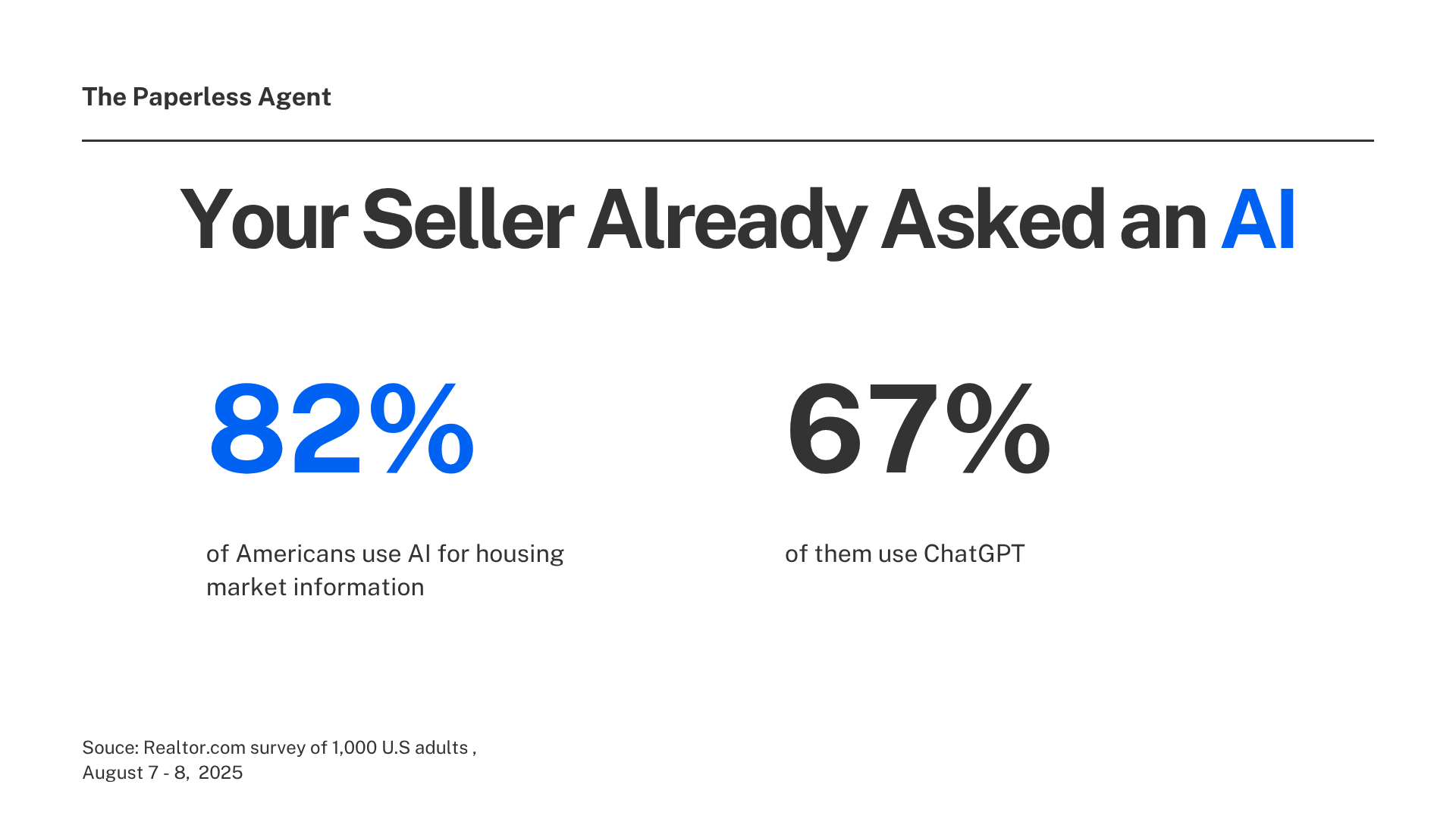
A Realtor.com survey of 1,000 U.S. adults conducted August 7 to 8, 2025 found 82% use AI for housing market information, with ChatGPT the most-used platform at 67% and Gemini at 54%. Respondents were people currently buying or selling a primary residence, or who had done so in the prior two years.
A separate Harris Poll of 2,094 U.S. adults for NerdWallet, fielded November 3 to 5, 2025, found 48% of Americans planning to buy within twelve months have used or will use AI during the process, and 27% will use it to estimate housing costs.
The consequences are already showing up in deals. Ryan Serhant told Fortune that a $50 million Manhattan penthouse nearly collapsed because both sides consulted ChatGPT. The buyer asked whether $50 million was too much and ChatGPT agreed it was. The seller asked whether $50 million was too little and ChatGPT agreed with that too.
Newsweek covered the same story on June 22, 2026 under the headline "Americans Are Using ChatGPT to Price Their Homes: Why That Could Backfire." Coldwell Banker Realty CEO Kamini Lane named the mechanism in that piece: "AI is trained to be sycophantic, more likely to give you the price that you want versus the price at which a home is going to sell for."
A seller who wants a big number will get one.
How Does ChatGPT Come Up With a Home Value?
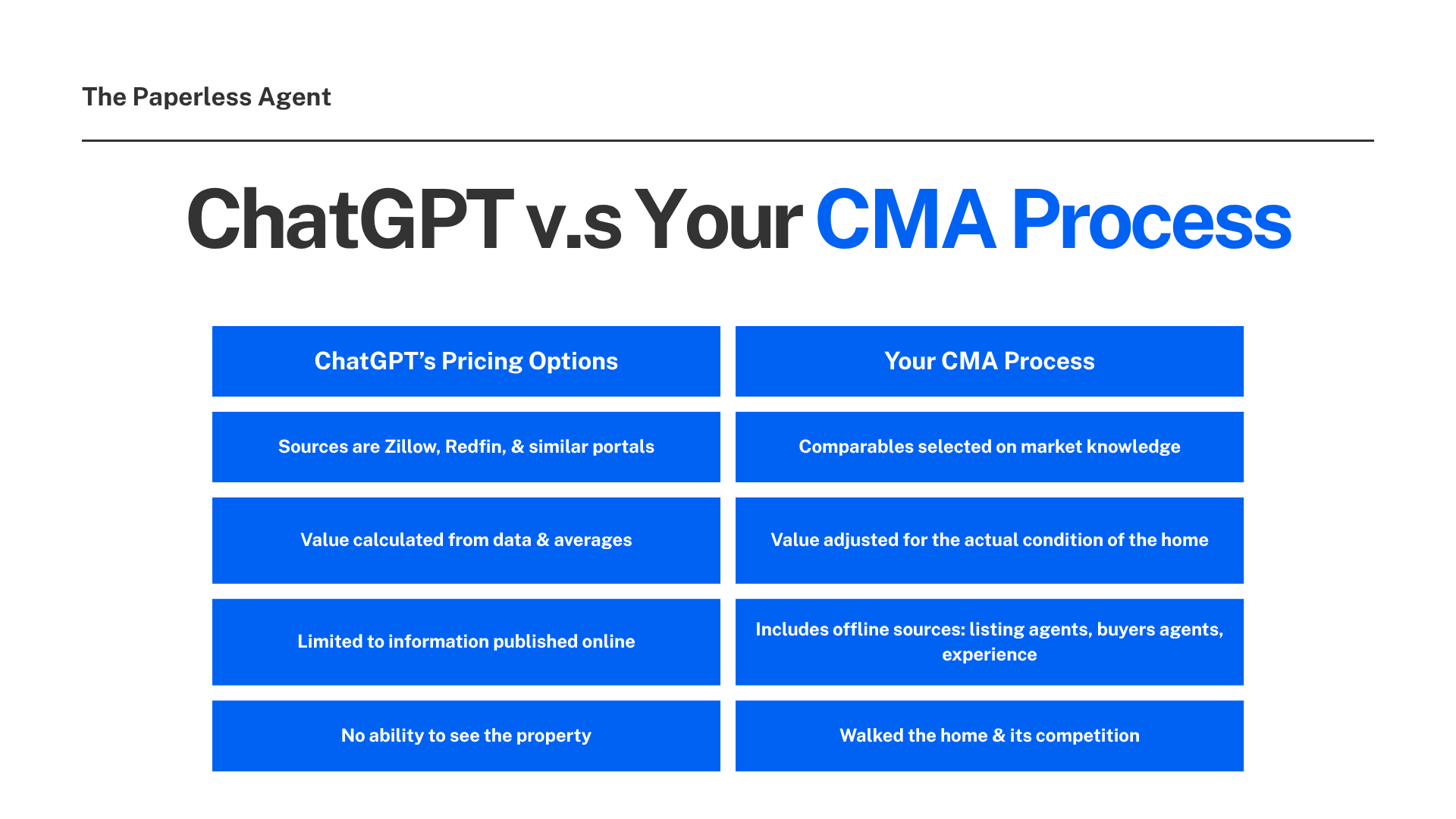
ChatGPT builds a home value from public listing data it can reach online, then averages it. Given an address and nothing else, it pulls whatever Zillow, Redfin, and similar sites expose, calculates a price per square foot across a handful of nearby properties, and reports a range with reasoning attached.
That process has four structural limits, and none of them are visible to a seller reading the output.
The sources are consumer portals. If ChatGPT is reading a Zillow page, the Zestimate is part of what it sees. An AI valuation built on portal data can be a laundered Zestimate wearing better prose.
Comparable selection is arithmetic, not judgment. It picks properties that look similar on paper. Square footage, bedroom count, proximity. It cannot know that the four houses on the other side of the arterial road belong to a different submarket.
Condition is invisible. Two homes by the same builder, same model, same footprint, can differ by six figures based on what was done to the kitchen. Photos and public records do not carry that.
Everything offline is missing. Calling the listing agent to find out why a property sat, or what the seller's situation was, or where the negotiation room sat, is not available to a model.
Confident output built on incomplete data is the failure mode behind most AI problems in this business, and we catalogued the rest of them in our breakdown of the pitfalls of using AI in real estate.
How Accurate Is ChatGPT at Pricing a Home?
ChatGPT's address-only estimates run far enough off to break a listing appointment, and the direction of the error is unpredictable. Two tests, one ours and one from another brokerage, landed on opposite sides.
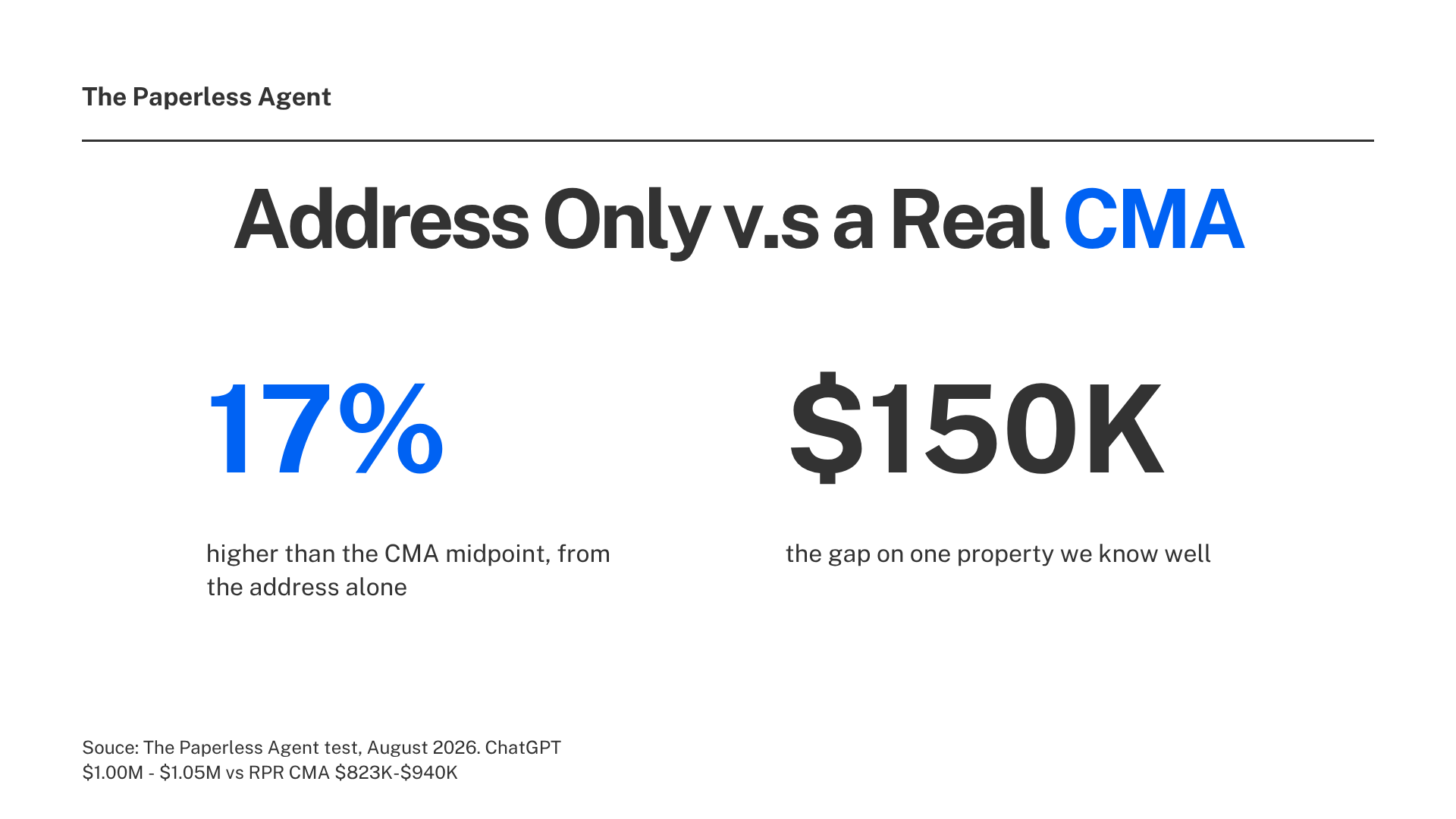
We ran a home we know well. Address only, no other information, one question: what is it worth? In our August 2026 test, ChatGPT returned a probable market value of $1,000,000 to $1,050,000, with reasoning and a comparable sales table showing addresses, square footage, sale prices, and price per square foot.
The RPR CMA we produced on the same property returned $823,000 to $940,000.
That gap is roughly $150,000 at the midpoint. A seller holding the first number and an agent holding the second will argue about whose source is real long before they get to price.
The error runs the other way too. Neuhaus Real Estate published a single-property test on a Hill Country home west of Austin where ChatGPT returned $580,000 to $620,000 against a CMA range of $680,000 to $695,000, an undervaluation of about 11%. Of the three comparable sales ChatGPT supplied to justify it, one closed in 2022, one was in a different neighborhood, and one could not be verified to exist.
The Correction That Only Appeared When We Pushed
The comparable sales table ChatGPT gave us looked authoritative. So we asked a single follow-up question: what were the closing dates on those sales?
Two things surfaced. The highest-priced comparable in the set had sold the previous year, which the original answer never flagged. And then ChatGPT volunteered something we had not asked for, labeled "Important correction to my previous answer."
One of the properties it had presented as a $975,000 closed sale was not a closed sale. That was the May 1 list price.
Its own explanation: Texas is a non-disclosure state, so public sites can obscure or inconsistently expose actual closed prices. Roughly a dozen states work this way, and in all of them the portal data an AI reads is thinner than it looks.
List price is what a seller hoped for. Closed price is what a buyer paid. A valuation built on the first one is a valuation built on other sellers' optimism.
Your seller does not know to ask that question. You do.
The Four-Step "ChatGPT Says" Objection Handler
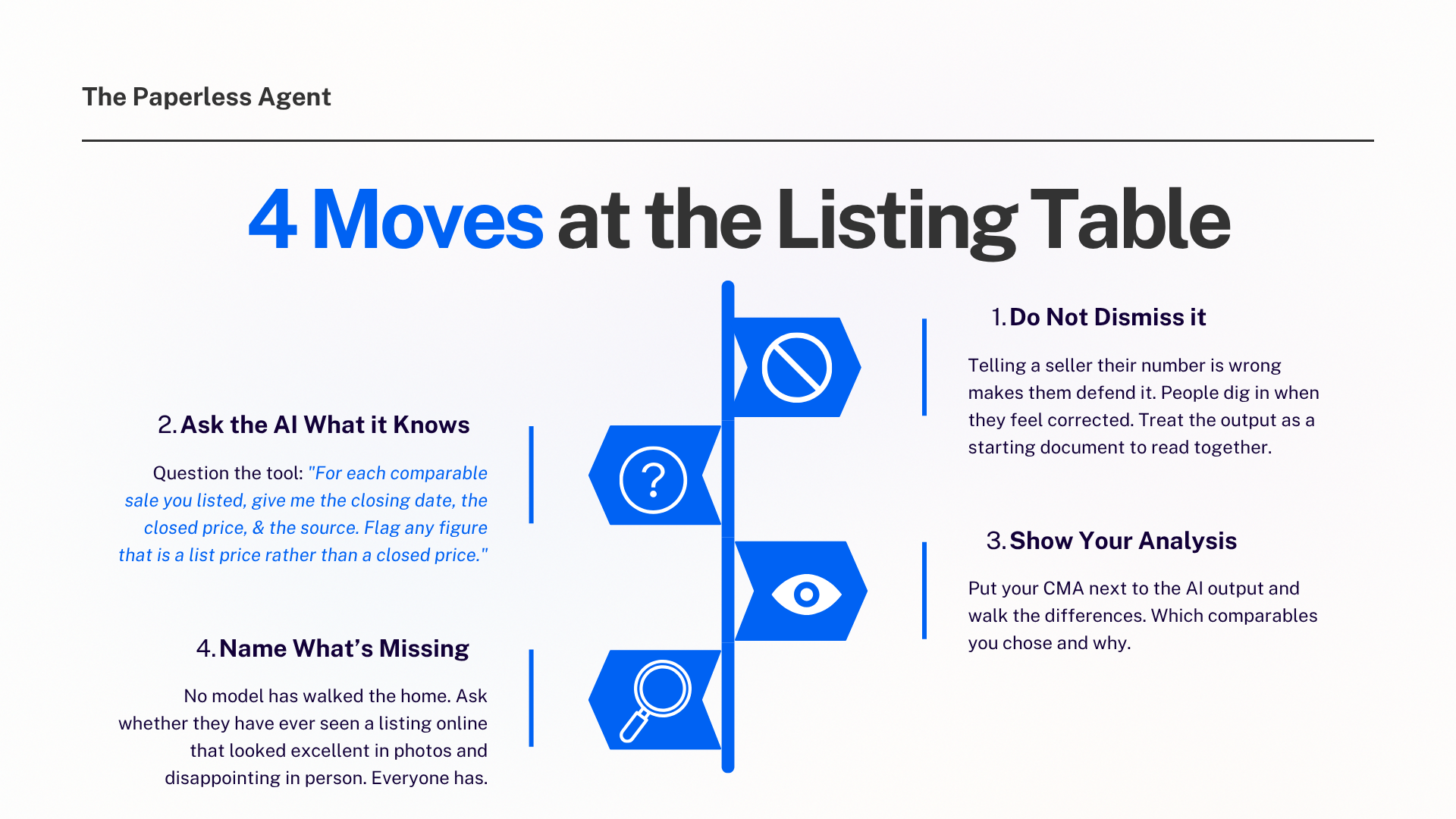
Work through these in order at the appointment. The goal is a shared conclusion, not a won argument.
1. Do not dismiss it. Telling a seller their number is wrong makes them defend it. People dig in when they feel corrected, and you have now spent your credibility on the first thirty seconds of the conversation. Treat the output as a starting document you are going to read together.
2. Ask the AI what it knows. Question the tool, not the seller. Open ChatGPT in front of them and run the audit: "For each comparable sale you listed, give me the closing date, the closed price, and the source. Flag any figure that is a list price rather than a closed price." The weak points surface on their own, in the AI's own words. Nobody had to be told they were wrong.
3. Show your analysis. Put your CMA next to the AI output and walk the differences. Which comparables you chose and why. Which ones the AI used that you rejected. This is also where you explain how you use AI in your own process, which changes your position from AI skeptic to the person in the room who understands the tool best.
4. Name what is missing. No model has walked the home. Ask whether they have ever seen a listing online that looked excellent in photos and disappointing in person. Everyone has. That gap is the entire case for condition-adjusted pricing, and they just made it themselves.
What Happens When You Give ChatGPT Real MLS Data?
Feeding ChatGPT current MLS data and a full CMA changes its answer, and running that comparison in front of a seller is the most persuasive thing you can do at a listing appointment.
We tested this on a second property, an active listing. Address only, no other input: ChatGPT returned $660,000 to $685,000 in our test, with $670,000 as its preliminary estimate.
Then we started a new conversation with the same address, pasted in the MLS listing sheet, and attached a full CMA generated that morning.
The same model, given our MLS data, landed at $640,000.
It also explained the move: list price context, which comparables carried the most weight, the year built relative to competing inventory. The reasoning was detailed enough to lift straight into a pricing narrative.
Nothing sophisticated happened here. No prompt engineering, no custom instructions. The only variable that changed was data quality.
That is the demonstration to run live. You are showing a seller that the tool they trust produces a different answer when it stops guessing, and that you are the reason it stopped guessing. The conversation moves from "ChatGPT said a million" to "here is what changes when the inputs are real."
You can push it further. Point at specific comparables in the CMA and add the qualitative detail: this one has a renovated kitchen and new flooring, this one has original finishes from the build year. Condition notes only exist because somebody walked both houses.
The same pattern of feeding real data in before asking for output drives the three-prompt listing presentation, which turns a finished CMA into a consultation report, a seller email, and a branded deck.
Delegate the Analysis. Keep the Judgment.
None of this makes ChatGPT the pricing decision. Feeding it good data produces a better analysis, and analysis is one input to a price.
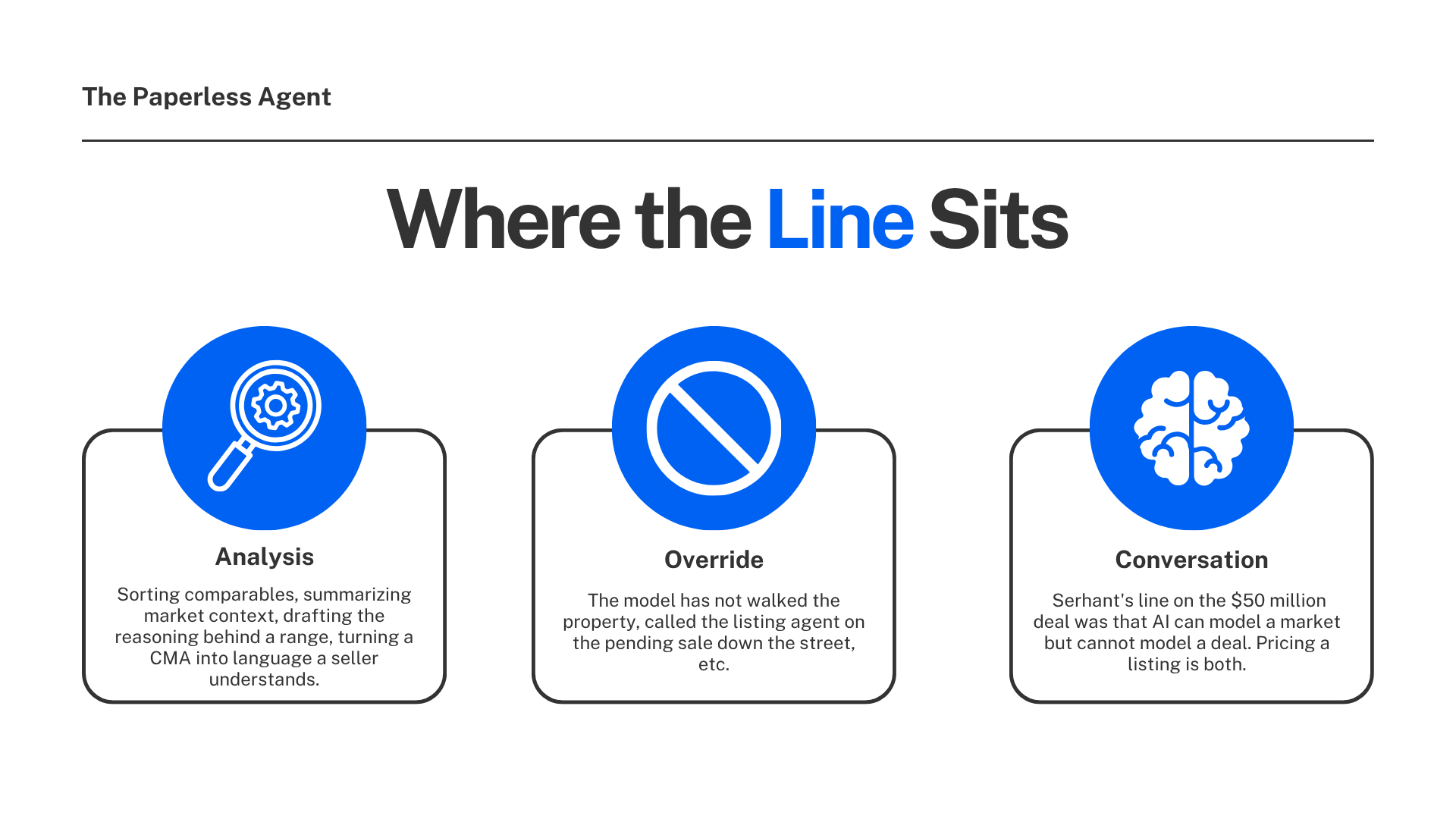
The division that holds:
Analysis goes to the AI. Sorting comparables, summarizing market context, drafting the reasoning behind a range, turning a CMA into language a seller understands.
Override stays with you. The model has not walked the property, has not called the listing agent on the pending sale down the street, and does not know that three homes competing with this one are about to come off the market.
The conversation is yours entirely. Serhant's line on the $50 million deal was that AI can model a market but cannot model a deal. Pricing a listing is both.
Delegate the analysis. Keep the judgment.
What to Do Right Now
Before your next listing appointment, run these three steps. Fifteen minutes total.
- Price the listing the way your seller will. Open ChatGPT, start a Temporary Chat so your history does not influence the result, and enter the address with nothing else. Read what comes back. You now know the number you are walking into.
- Audit it. In the same chat, ask: "For each comparable sale you listed, give me the closing date, the closed price, and the source. Flag any figure that is a list price rather than a closed price." Save the response. If it issues a correction, save that too.
- Run the informed version. Start a fresh chat. Paste in the MLS listing sheet and your full CMA, then ask: "Using only the data I provided, give me a price range and explain your reasoning. Note where this data disagrees with what you would have assumed from public sources."
Bring all three to the appointment. The seller sees the AI they trust, the audit that found its weak points, and the analysis it produces when a professional supplies the inputs.
Frequently Asked Questions
Q: Is ChatGPT accurate for home values?
ChatGPT is unreliable for home values when given only an address, and the error can run in either direction. In one test we ran, ChatGPT returned $1,000,000 to $1,050,000 on a property where the RPR CMA returned $823,000 to $940,000. A published test by Neuhaus Real Estate on an Austin-area home found the opposite error, with ChatGPT about 11% below the CMA range. The tool has no access to MLS closed-sale data, cannot see the condition of any property, and builds its estimate from whatever consumer portals publish.
Q: What should I say when a seller tells me ChatGPT valued their home higher than my price?
Do not tell them the number is wrong. Ask the AI to show its work instead. Open ChatGPT with the seller and ask it for the closing date, closed price, and source of every comparable sale it used, plus a flag on anything that is a list price rather than a closed price. The gaps surface in the AI's own words rather than as your correction, which keeps the seller on your side of the table. Then show your CMA and walk through which comparables you selected and why.
Q: Why does ChatGPT get prices wrong in Texas and other non-disclosure states?
In non-disclosure states, sale prices are not part of the public record, so consumer real estate portals often display list prices rather than closed prices. ChatGPT reads those portals. In our test, it presented a $975,000 figure as a closed sale, then corrected itself when questioned and confirmed the number was a May 1 list price. Roughly a dozen states operate this way. In all of them, an AI valuation built on public data is built on what sellers asked for rather than what buyers paid.
Q: Can I use ChatGPT to build a CMA?
ChatGPT should not build your CMA, and it is useful once your CMA exists. Pull comparables from the MLS, make your condition and location adjustments, then paste the listing sheet and the completed CMA into ChatGPT and ask it to explain the range. What comes back is a pricing narrative a seller can follow, which is the part of the work that eats the most time. The comparable selection and the adjustments require a license and a set of eyes. The explanation does not.
Q: Is a ChatGPT estimate better or worse than a Zestimate?
A ChatGPT estimate and a Zestimate share the same weakness, and ChatGPT adds a second one. Both are built from public data with no view of a property's condition. The difference is presentation. A Zestimate is a number a consumer can recognize as an automated estimate. ChatGPT returns a range plus a comparable sales table plus paragraphs of reasoning, which reads like professional analysis. If ChatGPT is reading a Zillow page, the Zestimate may be one of its inputs, so the AI answer can be a Zestimate with better packaging.
Q: What if ChatGPT's number is right and my price is wrong?
Run the audit and find out. Ask ChatGPT for the closing dates, closed prices, and sources behind its comparables. If those hold up and the properties are comparable in condition and location, you have learned something before the listing goes live rather than after thirty days of no showings. The audit protects your pricing either way. A seller in Cooper City, Florida sold for $954,800 after using ChatGPT throughout the process, roughly $100,000 above what agents had recommended, though other professionals estimated he may have left $75,000 to $225,000 on the table during negotiation.
Q: Should I tell my seller I use AI in my pricing process?
Yes, and demonstrate it rather than describing it. A seller who arrived with a ChatGPT number already believes the tool has value. An agent who dismisses it looks behind, while an agent who opens the same tool, audits its sources, and then feeds it real MLS data looks like the person in the room who understands it best. Showing the difference between an address-only estimate and a data-informed one moves the conversation from whose number is right to what the inputs were.
Q: Which AI tool is best for pricing a listing?
The tool matters less than the data you give it. Every general-purpose assistant, ChatGPT and Gemini and Claude alike, is limited to public information when you supply nothing else, which is the source of the error. The variable that changed the answer in our test was not the model. It was pasting in an MLS listing sheet and a completed CMA. Pick whichever tool you already use for client-facing writing, and spend your effort on the quality of the inputs. Our side-by-side comparison of Claude and ChatGPT for real estate covers where each one holds up.
Chris A. Scott is a Real Estate Digital Marketer & AI Strategist at The Paperless Agent where we make AI and real estate technology useful, practical, and profitable.