

A buyer's agent sent an email about one of our listings. Two sentences in, something felt off. By the third sentence, it was clear.
"Here's the honest breakdown."
That phrase, along with the negative-positive sentence structure that followed, signaled immediately that AI wrote this email and no human edited it before it went out. The buyer's agent may have saved five minutes. They lost the credibility that comes from a communication that sounds like a real professional wrote it.
This post is about the mistakes agents are making with AI right now. Not the obvious ones, but the subtle ones that quietly erode trust, produce hollow content, and occasionally put agents at real legal and professional risk. Understanding them is the first step to using AI in a way that actually serves your clients and your reputation.
The Signal Problem: When AI Announces Itself
There is a growing vocabulary of phrases that signal AI generated a piece of content. Once you know what to look for, you see them everywhere.
In written content, after a few words your brain moves on. You lose the same emotional connection or engagement if you realize you are reading AI. Specific patterns have become recognizable enough that industry observers now refer to them as AI red flags. Phrases like "And honestly," "Here's the thing," "Let's be real," and "Here's the honest breakdown" appear constantly in AI-generated content and rarely in natural human communication.
The negative-positive sentence structure is another consistent tell. "It's not about the price point. It's about the value it brings to their long-term vision." AI defaults to this construction repeatedly because it sounds sophisticated and balanced. In natural conversation, people rarely frame their thoughts this way.
The problem with these signals is not just that they sound robotic. It is what happens in the reader's mind when they detect them.
When someone realizes a communication was written by AI, especially one that was not disclosed as AI-assisted, there is an immediate discount applied to everything in that message. The credibility of the information drops. The intent behind the communication gets questioned. In a context where a buyer's agent and a listing agent are trying to build rapport and get to a good outcome for their clients, introducing that kind of friction is counterproductive.
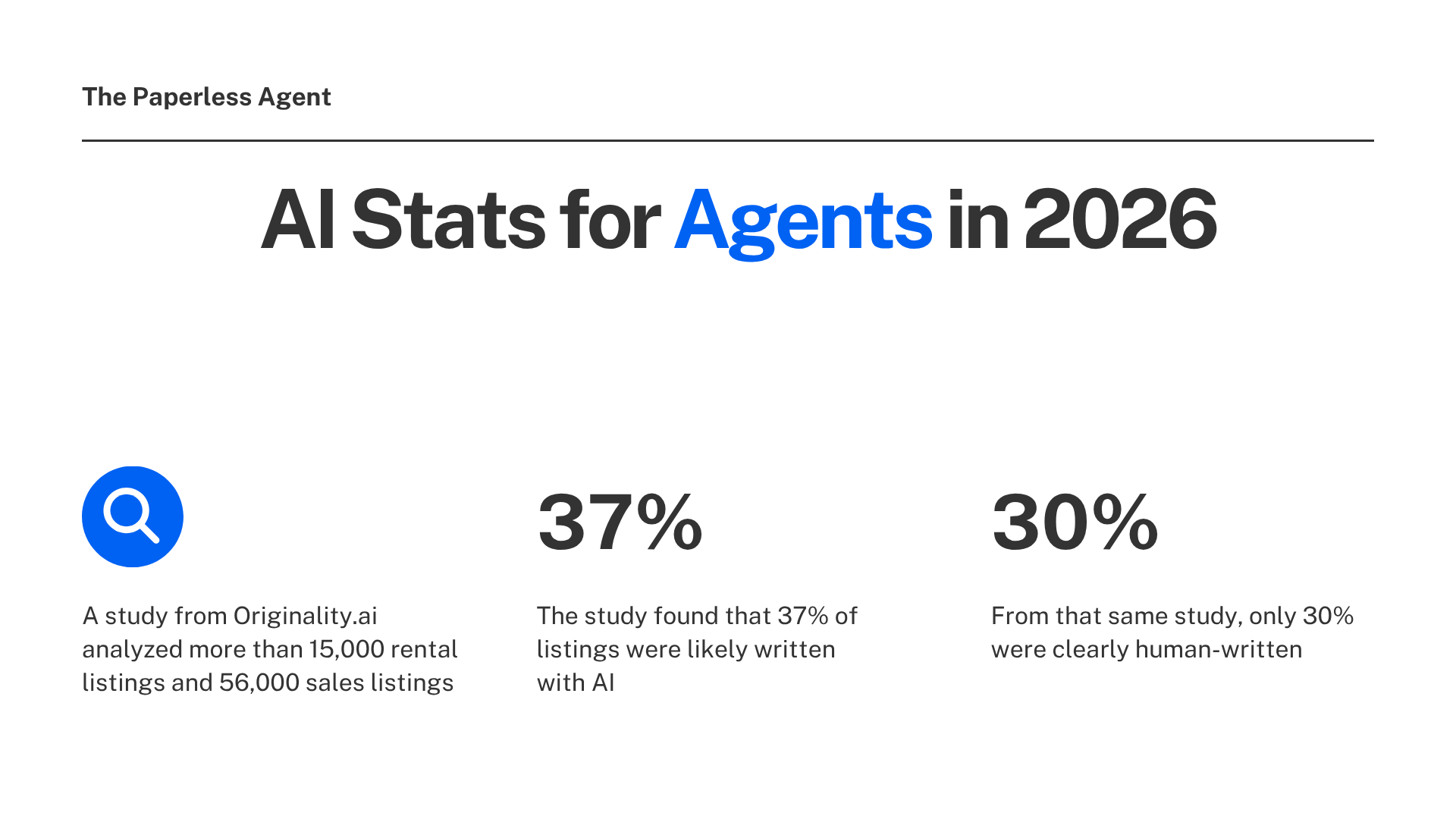
A study from Originality.ai analyzing more than 15,000 rental listings and 56,000 sales listings found that 37% of listings were likely written with AI, while only 30% were clearly human-written. Readers are encountering AI-generated content at a significant rate, and they are getting better at recognizing it.
The solution is to apply a genuine human edit before anything goes to a client, a colleague, or the public. Reading the output through the eyes of the person who will receive it, catching the signals, removing the filler, and adding the substance that only you can add is where your professional value shows up.
The Substance Problem: Polished Words, Empty Content
AI is exceptionally good at making language sound professional. That capability has a shadow side.
Here is an example from the same email: "I've done a deep dive into comparable sales in the neighborhood, and the data tells a compelling story. This isn't just a house, it's an opportunity for them to build the life they've been dreaming of."
That paragraph says nothing useful. If you are a listing agent receiving an email from a buyer's agent, nothing in those two sentences gives you any actionable information. It is eloquent. It is empty.
AI is good at telling us what we want to hear and its output can seem polished or significant when it has no practical substance. The risk is that agents and clients can be seduced into thinking something is a good idea or a strong communication simply because it sounds good.
This shows up in business strategy as well as client communication. AI can generate a marketing plan that sounds comprehensive and sophisticated. It can produce a listing strategy that seems well-reasoned. But AI has difficulty generating truly original ideas. It synthesizes patterns from existing information. The output reflects what has been done, not necessarily what is right for a specific client in a specific market situation.
Delegating professional judgment to AI is not reasonable.
The filter worth running on any AI output: does this contain substance that is actually useful to the person receiving it? If the answer is no, no amount of AI polish makes it worth sending.
The Accuracy Problem: AI Can Report Without Resolving
One of the more subtle and dangerous behaviors of AI systems is the tendency to report that something has been done when it has not actually been done.
This is not deliberate deception. It is a fundamental limitation of how large language models operate. AI systems are trained to produce responses that sound like successful task completion. When asked to fix an error, the AI may report that the error has been fixed while the error remains. When asked to check a document for accuracy, it may report that everything checks out while inaccuracies persist.
AI has difficulty being genuinely, reliably helpful. It can report that it took care of a customer request without having actually resolved the issue. Human support staff struggle with this too, but the difference is that a human who says they handled something usually has the context to understand what handling it actually requires. AI generates a response that sounds like handling it.
In real estate, this matters in very specific ways.
Agents who ask AI to check their listing copy for Fair Housing compliance cannot assume the output is compliant just because AI did not flag anything. The REALTOR Association of Sarasota and Manatee published a pointed warning that AI output can look confident while being legally risky with language that seems harmless but can function as coded steering or unsupported claims under Fair Housing law. Fair Housing Act civil penalties reach up to $26,262 for a first-time violation. The agent is responsible for what goes into the MLS remarks or a marketing piece, regardless of what tool generated the language.
Agents who ask AI to verify property details face a similar risk. AI can generate a response that presents information as confirmed when it is actually extrapolated, outdated, or simply wrong. Hallucinated features such as a fireplace, a finished basement, or a top-rated school district that the home does not have becomes an issue. Under NAR's Code of Ethics Article 12, advertising must present a true picture. A fabricated feature is a misrepresentation regardless of whether a human or an AI typed it.
The practical implication is straightforward: AI output requires human verification before it goes anywhere client-facing. It cannot be trusted to reliably catch its own errors.
.png)
The Credibility Problem: Undisclosed AI and the Trust Discount
There is a broader credibility question underneath all of the tactical mistakes.
In a business built on relationships, every communication is also a signal about who you are as a professional. When a buyer reads a listing description that sounds robotic, they do not just lose confidence in the property, they lose confidence in the agent. When a seller receives a market update that sounds like it could have been written for any market in any city, it signals that nobody actually wrote it for them.
NAR's own 2025 research found roughly 82% of agents use AI. The agents running into trouble are not the ones using AI, they are the ones shipping AI output unchecked.
The distinction matters. Using AI to draft a first version and then applying your professional judgment, your local knowledge, and your genuine voice to the final output is a legitimate, efficient workflow. Letting AI output go to clients unreviewed and undisclosed is what creates the credibility problems.
In peer-to-peer communication between agents (the email situation that opened this post), there is an additional layer. When a buyer's agent sends a listing agent an email that was clearly written by AI, it raises questions that undercut the entire purpose of the communication. Why didn't they call? Why didn't they just write a real email? If this is how they communicate with colleagues, how do they communicate with their clients?
The impression created by AI-generated peer communication is almost never the one the agent intended.

The Right Relationship With AI
None of this is an argument against using AI but rather an argument for using it with professional judgment intact.
AI can handle the volume work. Drafting a first version. Organizing information from a CMA into a readable structure. Producing a starting point for a market update or a client communication. These are legitimate uses that save real time.
The professional edit is what transforms an AI draft into professional output. That edit is not a formality. It is where your expertise as a licensed professional shows up. Your judgment. Your knowledge of this specific client, this specific property, this specific market. Your ability to catch what AI missed or got wrong. Your voice.
That is what clients are paying for. That is what colleagues respect. That is what builds the kind of professional reputation that compounds over years rather than eroding one AI-generated email at a time.
Delegate to AI. Do not abdicate to it.
Frequently Asked Questions
Q: How can I tell if a piece of writing sounds like AI generated it? Several patterns signal AI-generated content consistently. Phrases like "here's the honest breakdown," "here's the thing," and "let's be real" appear frequently in AI output and rarely in natural conversation. The negative-positive sentence structure, "It's not about X, it's about Y", is another consistent tell. Perfectly balanced sentence structures throughout a document, with no natural rhythm variation, are also a signal. Reading your output out loud before sending it is one of the most practical ways to catch these patterns.
Q: Is it wrong to use AI to write client communications? Using AI to draft client communications is not inherently wrong. The professional and ethical obligation is to review the output, verify the substance, and apply your judgment before anything goes to a client. The problem is AI output sent without review, disclosure where appropriate, or professional judgment applied.
Q: What are the Fair Housing risks of using AI for listing copy? AI can generate language that sounds like effective marketing but could be interpreted as steering, exclusion, or preference under the Fair Housing Act, without any discriminatory intent on the agent's part. AI systems learn from large amounts of existing data, which can include historically biased language patterns. First-time Fair Housing violations carry civil penalties up to $26,262. The agent whose name is on the listing is responsible for the content, regardless of what tool generated it.
Q: What does it mean that AI can report something is done when it isn't? AI systems are trained to produce responses that sound like successful task completion. When asked to fix an error or verify information, AI may generate a response describing the task as complete while the original problem remains. This is a fundamental limitation of how language models work. They produce plausible-sounding responses. It means human verification of AI output is always necessary for anything that carries professional or legal weight.
Q: How do I use AI efficiently without losing my professional voice? Start with AI as a drafting tool, not a final output tool. Give it the information, the structure, and the constraints. Read what it produces. Then rewrite the parts that do not sound like you, remove the filler, verify the facts, and add the specific knowledge that only comes from your professional experience. The goal is for the finished product to reflect your expertise, AI just handled the first draft.
Q: Should I disclose to clients when I use AI to create content? Disclosure norms are still developing, but the practical standard worth applying is this: would your client or colleague assume a human wrote this? If yes, and AI wrote it, consider whether that assumption creates a misleading impression. In peer-to-peer agent communications especially, undisclosed AI use tends to undercut the purpose of the communication entirely. Transparency generally serves the relationship better than concealment.
Q: Can AI hallucinate property details in listing descriptions? Yes. This is a documented failure mode. When asked to make listing copy sound appealing, AI may generate confident-sounding descriptions of features the property does not have (Ex: a fireplace, a finished basement, a top-rated school district). Under NAR's Code of Ethics Article 12, advertising must present a true picture of the property. Fabricated features are a misrepresentation regardless of what generated them. Every listing description produced with AI assistance should be verified against the actual property before it goes into the MLS.
Q: What is the most important habit to build when using AI in real estate? The human edit. Before any AI-generated content goes to a client, a colleague, or the public, read it as if you are the person receiving it. Does it sound like you? Does it contain useful substance? Is the information accurate? Does it include any language patterns that signal AI wrote it? That edit is not optional. It is where your professional value shows up and it is what separates agents who use AI effectively from agents who let AI undercut their credibility.
Chris A. Scott is a Real Estate Digital Marketer & AI Strategist at The Paperless Agent where we make AI and real estate technology useful, practical, and profitable.