

ChatGPT is the biggest name in AI. It was the first tool most of us tried, and for a lot of agents, it became the default.
That default is worth reconsidering.
The question worth asking is specific: which AI tool produces output you can put your name on without significant editing? In a client-facing business where every email, every listing description, and every communication carries your professional reputation, that is the only standard that matters.
When you hold both tools to that standard, a clear pattern emerges.
The Problem With ChatGPT for Real Estate Work
ChatGPT was built to be broadly agreeable. That design works well for general consumer tasks such as planning a trip, finding a recipe, or summarizing a long article. For those use cases, a tool optimized for broad appeal makes sense.
When you need professional, client-ready output in a business where precision and tone carry real weight, that same design becomes a liability.
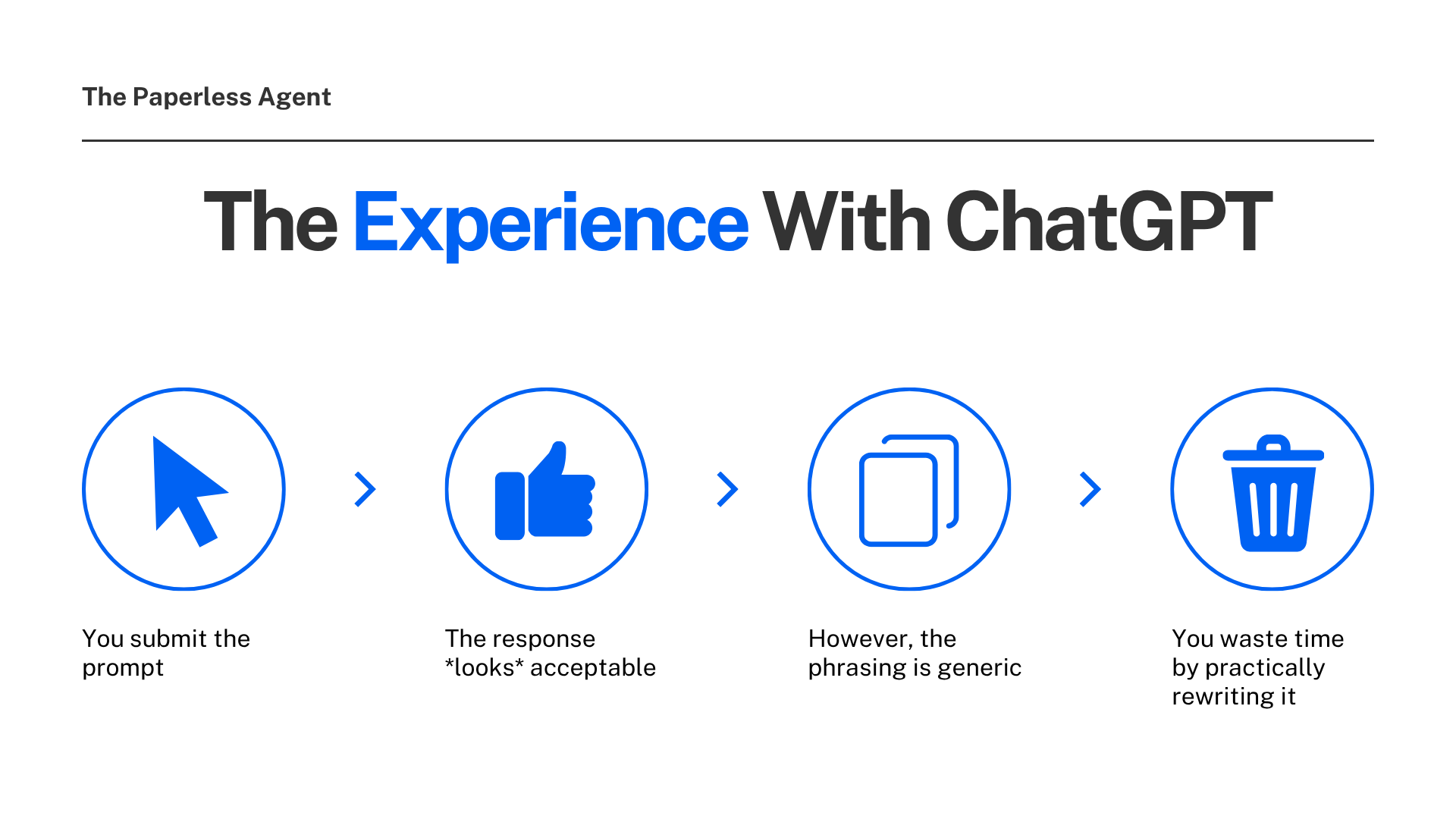
The general experience goes like this: you submit a prompt, the response looks acceptable at first glance, and then you read it more carefully. The phrasing is generic. Nobody in a professional context really communicates that way. Phrases like "here is the honest breakdown" or "let us dive into" appear throughout. You spend the next 20 minutes editing the output.
At that point, you have not saved time. You have wasted it.
Independent analysis backs this up. Zapier's Claude vs ChatGPT analysis found Claude outperforming ChatGPT on writing quality, instruction following, and nuanced tasks which are the exact areas where ChatGPT complaints concentrate.
A second problem compounds the first: inconsistency. Ask ChatGPT the same prompt twice and you are likely to get meaningfully different responses. In longer conversations, it drifts from the instructions you gave it earlier and starts reverting to defaults. ChatGPT's inability to consistently follow custom instructions gets frustrating when you are trying to maintain a specific brand voice across projects.
For an agent trying to build repeatable workflows (a pre-listing packet process, a listing marketing sequence, a client update template) inconsistency is not a minor inconvenience. It makes the tool unreliable as a foundation for any system.
Why Claude Produces Better Output for Real Estate
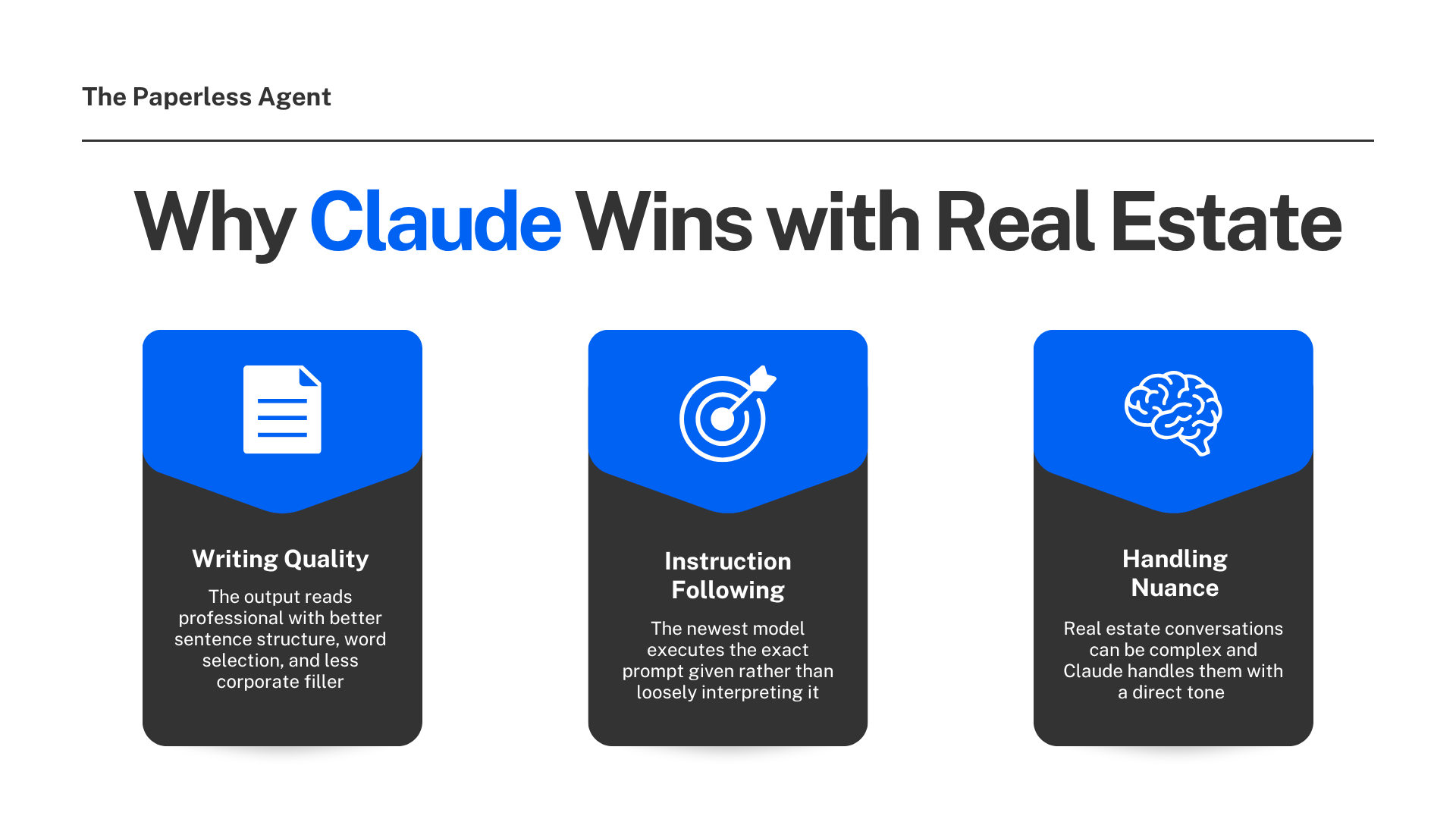
Three specific differences explain why Claude consistently outperforms ChatGPT for the work real estate agents do every day.
1. Writing Quality
Writers and editors consistently rate Claude highest for nuanced, natural prose that resists the generic AI voice. Claude's writing is characterized by careful instruction-following, tone consistency across long documents, and what reviewers often describe as "taste."
In practice, this shows up immediately when you run real estate scenarios through both tools. Pre-listing packet emails. Client responses to listing inquiries. Listing descriptions built from CMA data. Marketing copy for a specific property.
Claude's output reads like a thoughtful professional wrote it. Better sentence structure. More precise word selection. Less corporate filler. In most cases it requires little to no editing before it is ready to send or publish. Claude produces higher-quality writing that performs better for building authority and engaging serious readers.
Every minute spent editing AI output is a minute the tool should have handled itself. If you are consistently cleaning up ChatGPT responses before they are usable, the tool is not doing its job.
2. Instruction Following
When you tell Claude to write conversationally and avoid business jargon, it does it consistently.
This matters more than it might seem at first. Real estate prompts are often specific. Reference this CMA when writing the email. Match this tone. Do not use these phrases. Write from the perspective of an agent with 15 years of experience in this specific neighborhood.
Claude holds those instructions throughout the conversation. Opus 4.7's instruction-following got stricter in April 2026, as the model executes the exact text you provide rather than loosely interpreting and gap-filling.
ChatGPT drifts. The longer the conversation, the more it reverts to its defaults and abandons the specific guidance you gave it earlier. For anyone building repeatable processes for their real estate selling needs, the consistency gap between the two tools is significant.
3. Handling Nuance
Real estate conversations are complex. Explaining a pricing strategy to a seller who wants to list above market value. Managing a buyer's expectations in a competitive multiple-offer situation. Walking a client through the takeaways from a difficult inspection report without losing their confidence.
These conversations require precision. A voice that can be direct without being cold. An ability to acknowledge difficulty without becoming vague or falsely optimistic. ChatGPT defaults to cheerful and generic when the situation calls for something more careful.
Claude writes better than ChatGPT, which produces strongly clichéd texts and seems less responsive to nuanced instructions. In high-stakes client communications, that difference is visible and your clients will notice it.
The Standard Worth Applying
Peter Drucker, widely regarded as the father of modern management, drew a clear line between effectiveness and efficiency. Effectiveness *doing the right things well* matters more than efficiency, which is just doing more things.
Applied to AI: the goal is not to produce more output faster. The goal is to produce the right output reliably. An AI tool that generates 10 mediocre client emails per hour is less valuable than one that produces two emails you would truly send.
The question to ask about any AI tool is not "how fast does it respond?" It is: which tool produces consistent, client-ready output that fits into how I work?
Claude's output quality is remarkably stable across sessions. You get the same model every time. For a client-facing business where your reputation rides on every communication, that stability is not a minor feature. It is the foundation of any reliable workflow.
What ChatGPT Still Does Well
ChatGPT is a capable general-purpose tool for research tasks, travel planning, summarizing documents, generating images, and exploring ideas quickly.
The most robust workflow uses both tools. Start with ChatGPT for research and structure, move to Claude to refine the actual writing.
The case being made here is that when client-ready professional writing is the goal (which is most of what real estate agents need AI for), Claude produces better results more consistently.
How to Make the Switch Without Starting Over
You do not need to drop ChatGPT immediately to test this. The practical approach is simpler.
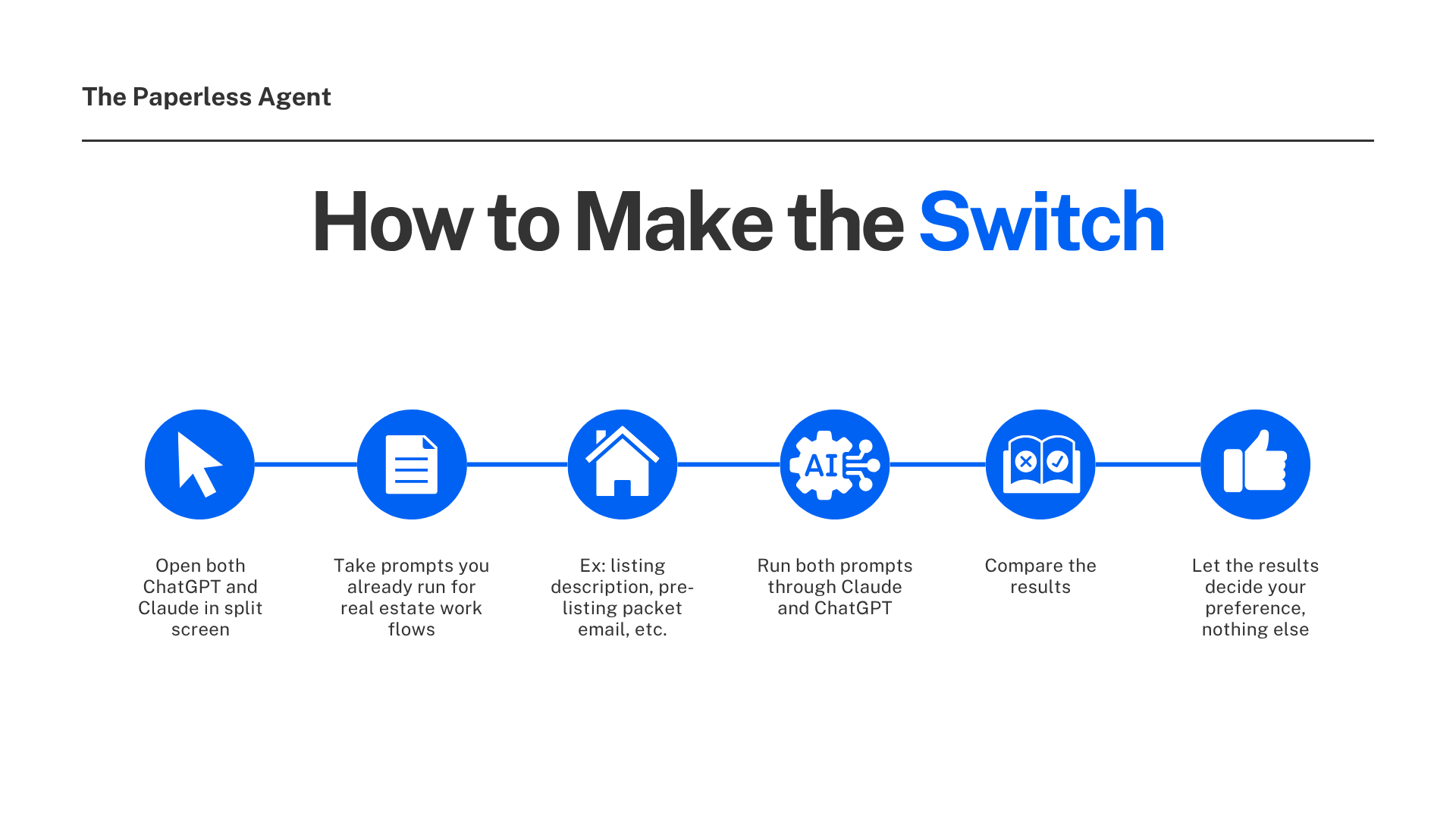
Open both tools in a split screen. Take the prompts you already run in ChatGPT regularly such as a listing description, a pre-listing packet email, or a client follow-up and run the same prompt in Claude. Compare the outputs side by side.
Let the results determine your preference. Not the brand recognition or which tool you have been using longer. The output quality for the specific tasks you do every day.
Claude's free version at claude.ai handles most common real estate workflows. Claude Pro, at $20 per month, provides higher usage limits and access to more powerful models, which is the same price as ChatGPT Plus if you are currently subscribed.
You need Claude if you are a professional managing client-facing communications with different contexts and tones who needs writing that does not sound like a bot and consistency that holds across sessions.
That describes real estate agents precisely.
Frequently Asked Questions
Q: Is Claude better than ChatGPT for real estate, or is this subjective? For the specific tasks real estate agents use AI for most, Claude consistently produces more natural, more precise, and more client-ready output than ChatGPT. Independent analyses from Zapier, Stack Overflow developer data, and professional writing benchmarks all point in the same direction. That said, the most reliable test is running the same prompts you already use in both tools and comparing the outputs yourself.
Q: What does it mean that ChatGPT "drifts" in longer conversations? In extended sessions, ChatGPT tends to gradually abandon the specific instructions you gave it earlier and revert to its default behaviors. If you told it to write in a particular tone, avoid certain phrases, or follow a specific format, it may stop honoring those instructions after several exchanges. Claude holds context and instructions more consistently across longer sessions, which matters when you are running multi-step workflows or building templates you plan to use repeatedly.
Q: Can I use Claude for free? Yes. The free version of Claude at claude.ai handles most common real estate writing tasks including listing descriptions, client emails, pre-listing packets, and social media content. Claude Pro costs $20 per month and provides higher usage limits and access to more advanced models. That is the same price as ChatGPT Plus if you are currently a paying subscriber.
Q: Should I switch completely to Claude or use both tools? Using both is a practical approach, especially at the start. ChatGPT works well for general research, brainstorming, image generation, and quick lookups. Claude works better for anything that requires client-ready writing, consistent tone, and precise instruction following. Many professionals use ChatGPT to explore and structure ideas, then move to Claude to produce the actual finished output.
Q: Does Claude hallucinate or make up information? All AI tools can produce inaccurate information, and Claude is no exception. Any factual claims such as market statistics, property details, or neighborhood data should be verified before including them in client communications. The difference in Claude's favor is writing quality and instruction adherence, not factual infallibility. Always verify CMA data, pricing information, and specific facts against your primary sources.
Q: What real estate tasks is Claude best suited for? Pre-listing packet emails built from CMA data, listing descriptions, client response emails, price reduction communications, market update content, personal newsletters, social media captions, and any writing where precision, natural tone, and instruction following matter. These are the tasks where the quality gap between Claude and ChatGPT is most visible in practice.
Q: How do I set up Claude to match my voice and brand? Claude holds instructions well across a session, so starting each conversation with a brief context prompt including your name, your market, your preferred tone, and any phrases to avoid produces more consistent on-brand output. For ongoing use, Claude's Projects feature allows you to save instructions, documents, and context that carry across multiple conversations without re-entering them each time.
Q: What does Claude Pro include that the free version does not? Claude Pro provides significantly higher usage limits, priority access during peak hours, access to Anthropic's most advanced models, and the ability to upload and process larger documents. For agents running CMA uploads, inspection reports, or extended multi-step workflows, the Pro plan removes the constraints that can interrupt the free version during heavy use.