

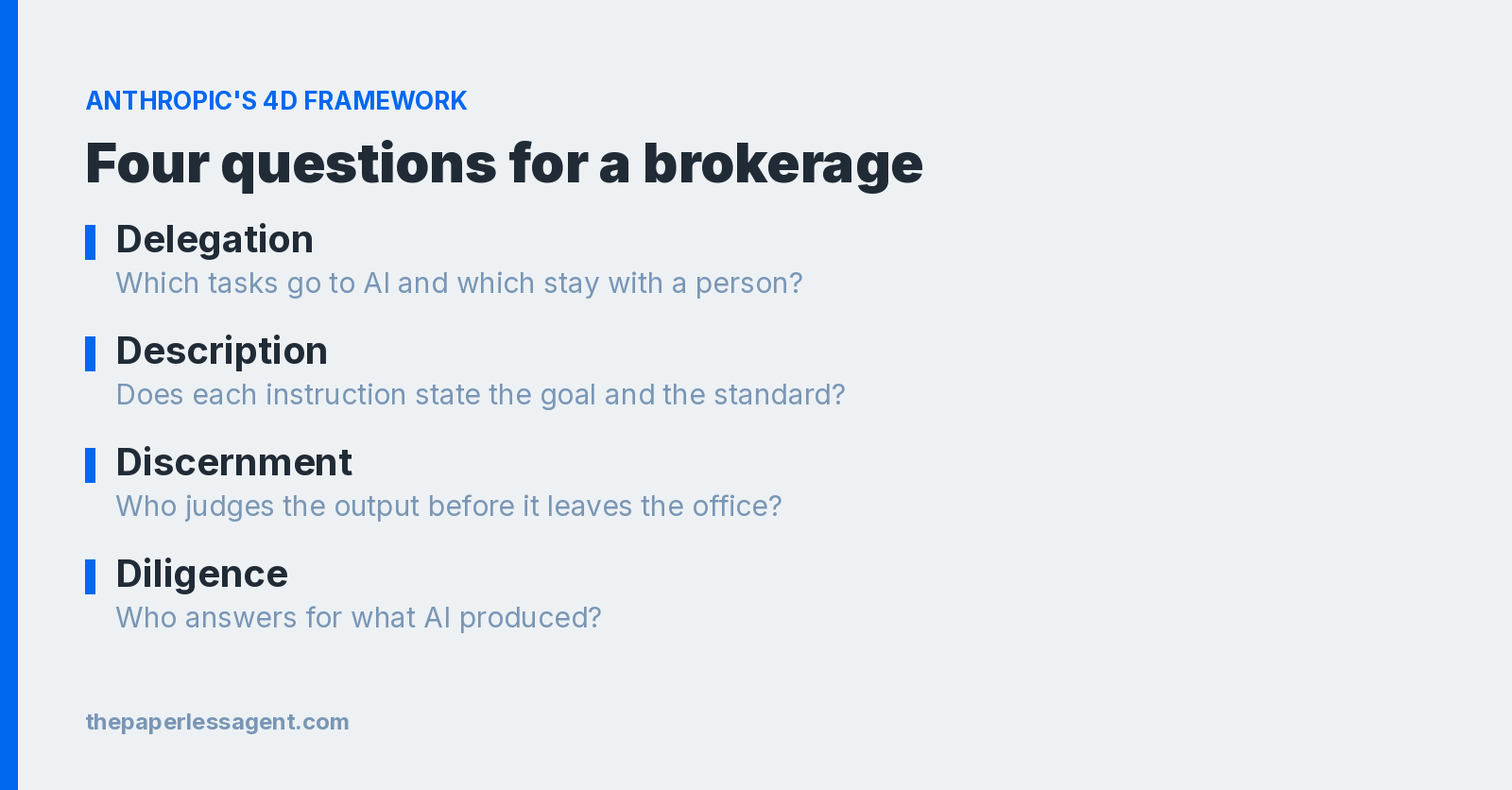
Anthropic's AI Fluency Framework names four competencies, and each one raises a question you can settle before buying any AI tool: what to delegate, how to describe it, how to judge the output, and who owns the result. They are Delegation, Description, Discernment, and Diligence. Together they decide what AI handles and what a person approves.
Every week brings a new AI headline and a new vendor pitch. Each one pushes you to pick a tool before you decide what the tool is for. The framework puts that decision first, and it holds up whichever tool you end up choosing.
Anthropic teaches the framework in an AI Fluency course on Claude Academy, and the course is free to register for on Skilljar. Start there, then use the sections below to turn each D into a decision your brokerage owns.
What Is Anthropic's AI Fluency Framework?
Anthropic's AI Fluency Framework is a set of four competencies for working with AI: Delegation, Description, Discernment, and Diligence. Professors Rick Dakan of Ringling College of Art and Design and Joseph Feller of University College Cork developed it in 2023-2024, according to Claude Academy.
Anthropic teaches the framework in an online course, AI Fluency: Framework and foundations, which it built with the two professors. Claude Academy states the aim in one sentence: "Learn to collaborate with AI effectively, efficiently, ethically, and safely using the 4D framework: Delegation, Description, Discernment, and Diligence."
The framework applies to any AI tool you evaluate.
What Are the 4Ds, and What Does Each One Mean for a Brokerage?
The 4Ds are Delegation, Description, Discernment, and Diligence. Claude Academy calls them four interconnected competencies that enable more effective, efficient, ethical, and safe human-AI collaboration. Each one converts into a decision a broker owns.
.png)
The question column translates each D into a question for brokers, and the "What the course covers" column follows the learning outcomes Claude Academy lists.
Claude Academy calls for making "strategic Delegation decisions." The framework moves the delegation decision ahead of the work, before an agent opens a chat window and starts typing.
How Do You Decide What to Delegate to AI?
Decide what to delegate to AI by asking two questions about every task:
- Does AI handle this kind of work well?
- Which person judges the result before anyone outside the office sees it?
Ask of every workflow you review: where does a person approve the output?
Find the point where a person decides whether the output AI created is good, for anything a client or the market will see under your brokerage's name.
Asking where a person approves the output works as a filter for every AI tool: a workflow with a clear approval step passes, and a tool with no point to review or approve fails, however good its demo looks.
Where a person approves the output shapes the delegation choice itself. Ask whether each task belongs with a person or with AI.
Four example brokerage tasks show how to sort AI work:
.png)
Build a sorting table like this for every task your agents already run through AI. A task with no named reviewer pauses until it has one.
Why Does Real Estate Make Human Review Non-Negotiable?
Real estate is a licensed profession, so AI output that reaches a client carries your license with it. NAR's chief data officer, David Conroy, told brokers at the Idea Exchange Council for Brokers Forum during the 2026 REALTORS Legislative Meetings: "Things can get really dicey when your AI tool is acting in similar ways as a licensed activity," according to NAR.
Conroy's recommendations, as NAR reports them, include mandatory human review. NAR states: "Nothing produced with AI should go out without human oversight."
Mandatory human review is Discernment, the third D of Anthropic's framework, applied to a brokerage. Anthropic's course teaches you to evaluate AI output critically, and NAR's guidance names where the evaluation is required. The Paperless Agent's breakdown of NAR's AI policy template for brokerages lists the specific points where a person must review AI content before it goes out.
How Do Description and Diligence Fit a Brokerage?
Description and Diligence, the second and fourth Ds of Anthropic's AI Fluency framework, turn the framework into training and accountability.
Claude Academy teaches Description as communicating clearly with AI through Product, Process, and Performance Description. At brokerage scale, Description means writing down what a good instruction contains and sharing it, so every agent starts from the same goal, context, and quality standard.
Diligence covers taking responsibility for AI-assisted work, according to the learning outcomes Claude Academy lists. Your license sits behind every client communication AI helps draft, so a named person owns each result. Name that person before the workflow goes live.
Why Learn the 4Ds Before Choosing AI Tools?
AI tools change faster than the decision about what to delegate does. Claude Academy says the 4D framework enables effective human-AI collaboration "regardless of which new AI models or tools emerge," so it keeps working when the tool changes, and the tool will change.
OpenAI states that custom GPTs retire on December 11, 2026, and on February 11, 2027 for Enterprise workspaces with an approved deferral. If your brokerage built workflows on custom GPTs, you now have a migration project. In a September 2026 test by The Paperless Agent, migrating a Marketing Club GPT carried its instructions into a plugin and dropped its Zapier connection. The steps are in The Paperless Agent's custom GPT migration guide.
Software built on top of Claude or ChatGPT carries a specific risk: the model provider can ship the same capability inside the model itself. A tool you adopt this month may have a better version within a few months. The decision about which tasks AI should handle in your brokerage survives tool churn.
Slow the tool decision down until you have sorted which tasks go to AI. A list of tasks sorted by who approves them lets you evaluate any tool in a single conversation.
The Principle Behind the 4Ds: Sort the Work Before You Pick the Tool
The 4Ds of Anthropic's AI Fluency framework give you an order of operations:
- Delegation sorts the work.
- Description sets the instruction.
- Discernment checks the output.
- Diligence assigns the owner.
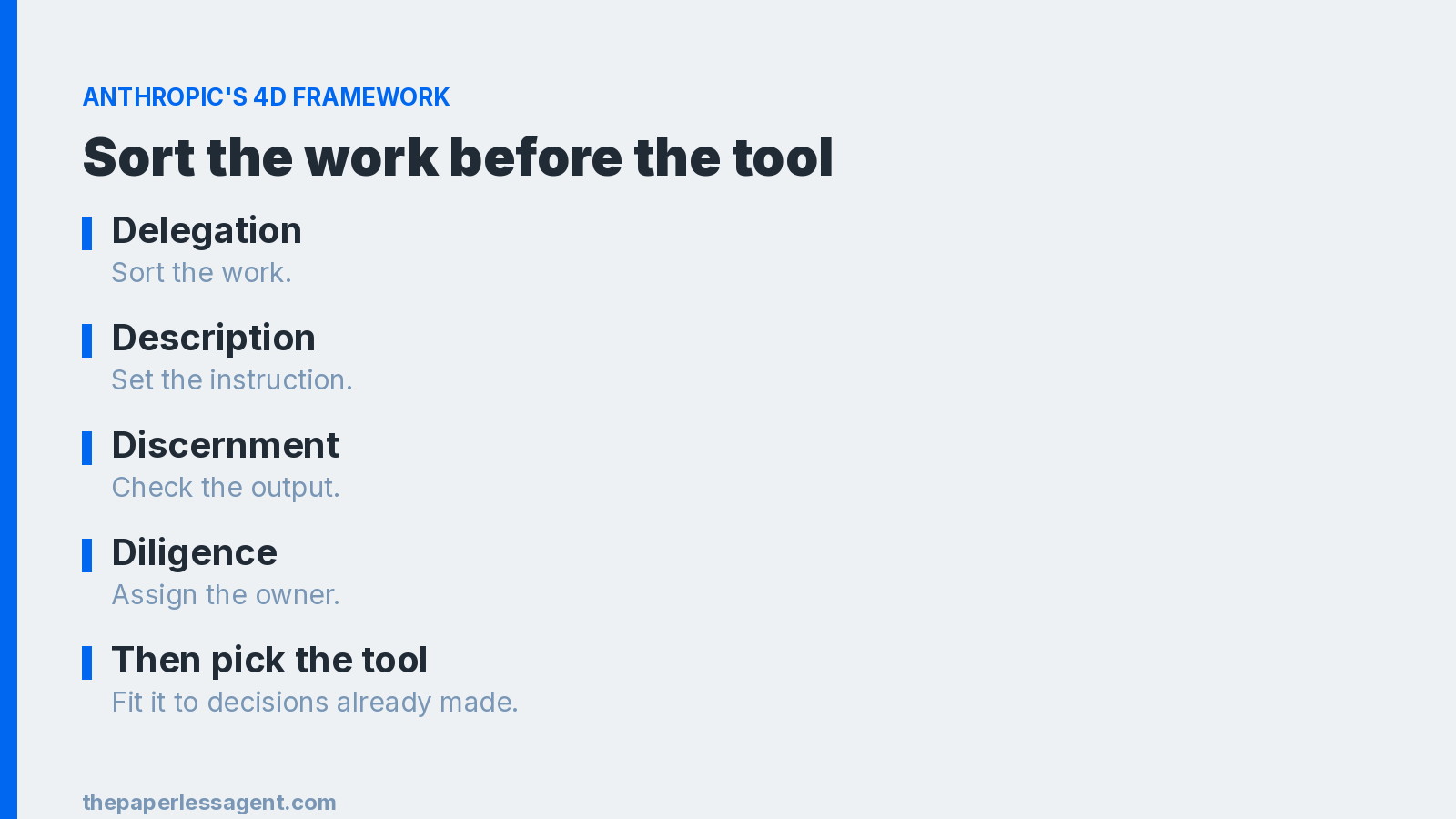
Tool selection comes after Delegation, Description, Discernment, and Diligence. A tool chosen first dictates the workflow, and the workflow then dictates who reviews what. A tool chosen last has to fit decisions you already made about where a person approves the output.
AI can improve your client experience and equip your agents to serve clients better, and both outcomes depend on knowing what to delegate and who approves it.
Decide who approves each AI output. Then pick the tool.
Frequently Asked Questions
These seven answers cover what the AI Fluency course is, what it costs, how long it takes, and how a broker applies the 4Ds.
Q: What is Anthropic's AI Fluency course? AI Fluency: Framework and foundations is an online course from Anthropic built around the 4D framework of Delegation, Description, Discernment, and Diligence. According to Claude Academy, it has 14 lessons and a quiz, takes 4 hours, and ends with a completion badge. Professors Rick Dakan of Ringling College of Art and Design and Joseph Feller of University College Cork developed the underlying framework. You can use it as a decision framework before choosing any AI tool.
Q: Is the AI Fluency course free, and does it include a certificate? The AI Fluency course is free to take. Claude Academy lists a Start course button and no price, and Anthropic's course on Skilljar shows a registration button that reads "Register | FREE." The final assessment earns a completion badge, and Skilljar adds a certificate of completion.
Q: How long does the AI Fluency course take? The AI Fluency course takes about 4 hours across 14 lessons and 1 quiz, according to Claude Academy. Split the time across two sittings, and give the Delegation and Discernment lessons your full attention, because those two produce the decisions a licensed business needs first.
Q: What are the 4Ds in Anthropic's AI Fluency framework? The 4Ds are Delegation, Description, Discernment, and Diligence, the four competencies of Anthropic's AI Fluency Framework. According to the learning outcomes Claude Academy lists, they cover deciding what work to give AI, communicating clearly with it, evaluating its outputs, and taking responsibility for AI-assisted work. For a brokerage, each D becomes a question someone owns.
Q: Should a brokerage have a formal AI policy? Yes, according to NAR. Its chief data officer, David Conroy, emphasized the need for a formal policy when he briefed brokers in 2026, and his recommendations include mandatory human review. NAR states: "Nothing produced with AI should go out without human oversight." The Paperless Agent's breakdown of NAR's AI policy template covers what the template asks of a brokerage. This is not legal advice, so confirm requirements with your state association or attorney.
Q: Who at a brokerage should take the AI Fluency course? If you own or lead a brokerage, take the AI Fluency course first, along with anyone who decides which AI tools your brokerage adopts. The 4Ds govern which tools you buy and who approves their output, and those decisions sit with leadership. Finish the course at the leadership level before rolling out any tool to your agents.
Q: Do I need to use Claude to benefit from the AI Fluency course? Prior Claude experience is optional. Claude Academy says Anthropic's goal is to make AI Fluency "accessible and useful to everyone, no matter what stage of AI expertise you find yourself at." The four questions the 4Ds raise, what to delegate, how to describe it, how to judge it, and who owns it, apply to any AI tool you evaluate.
Last updated: October 9, 2026.
Chris A. Scott helps professionals use AI to grow. He is an AI Marketer at The Paperless Agent and the author of Real Estate AI Professional.