

NAR released an AI policy template for brokerages this year. It designates an AI oversight lead, requires human review before AI content reaches a client, and limits what agentic AI can do. The template is recommended, not required. Read it anyway. It is NAR's clearest statement of what counts as safe AI use, whether or not your brokerage adopts it.
Is NAR's AI Policy Required, or Just a Suggestion?
NAR's AI policy template is recommended, not required. NAR has no way to enforce it on any brokerage. What it does is define what NAR considers safe and compliant AI use, and that definition becomes the reference point your broker gets measured against once a client, a reporter, or a regulator asks how something got written.
David Conroy, NAR's chief data officer, explained why NAR built the template: "Agents are already using this technology. They are already experimenting with it." His warning about where that experimentation goes wrong is the sentence worth remembering: "Things can get really dicey when your AI tool is acting in similar ways as a licensed activity."
NAR offers the template in two versions, condensed and comprehensive, both built for a brokerage to drop in its own name and effective date. State and local associations are already pointing members to it, including South Carolina REALTORS. If your brokerage has adopted neither version, you are not outside the policy's logic. You are just ahead of a conversation your broker has not had yet.
The scope is broad by design. NAR's definition of AI covers a single ChatGPT conversation, an advanced automated workflow connected to your CRM, and everything between. Every one of those falls under what NAR is describing when it says "AI."
The Five Places AI Content Needs Your Eyes Before It Goes Out
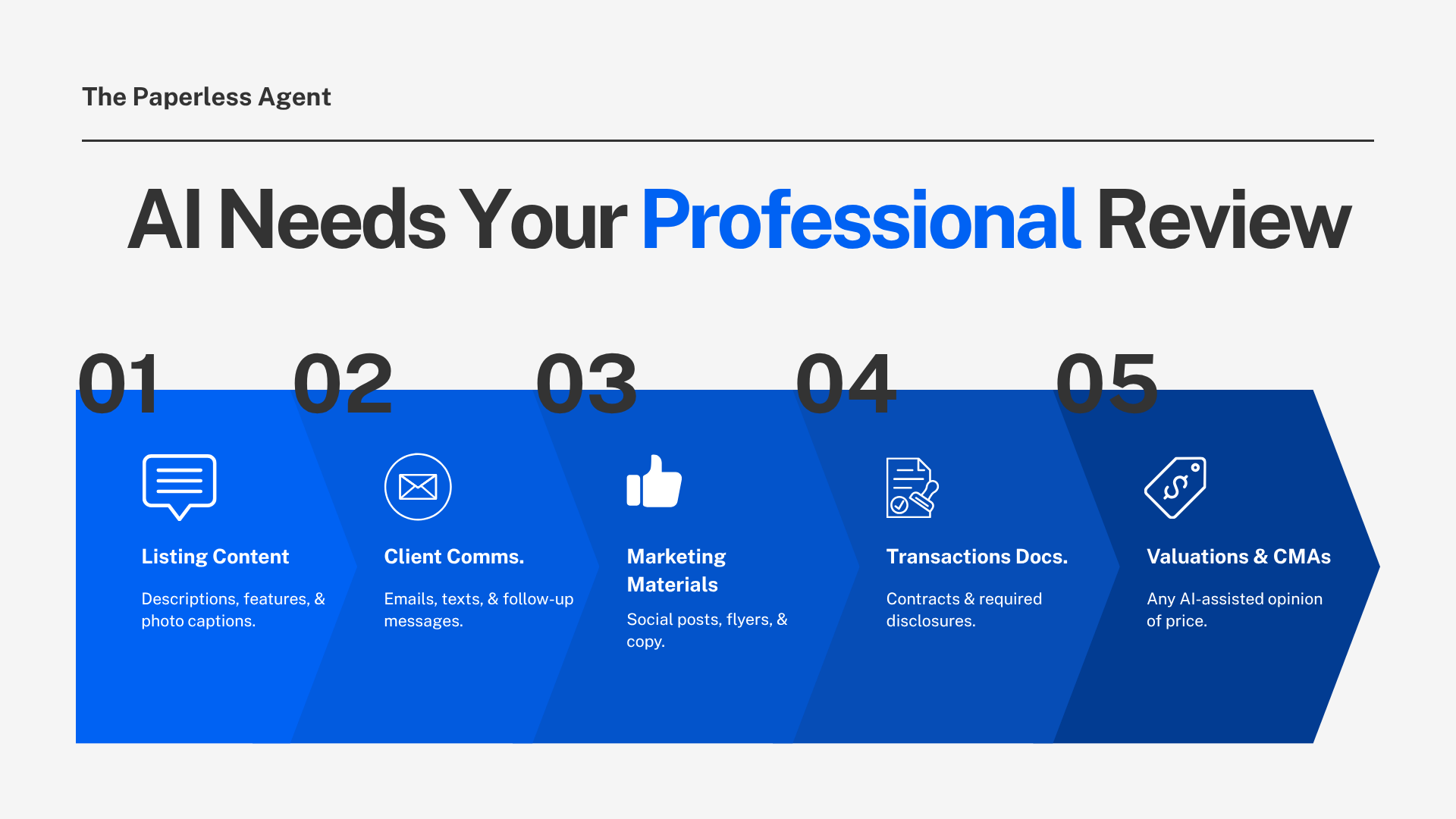
The template lists five specific triggers for mandatory human review, and between them they cover nearly everything an agent uses AI for.
Anything published on a listing. Descriptions, feature highlights, photo captions.
Anything sent to a client or consumer. Emails, texts, follow-up messages.
Marketing and advertising materials. Social posts, flyers, ad copy.
Transaction documents and disclosures.
Property valuations and CMAs.
Notice what is not on that list: a private conversation with ChatGPT that never leaves your own screen. That is the one category the oversight-lead approval requirement struggles to reach. No single person at a brokerage can review every prompt every agent types in a day, and a policy that assumes otherwise is a policy that gets ignored rather than followed.
The practical version of the rule is narrower and easier to hold onto. Draft with AI as freely as you want. Review before any of it reaches someone outside your office. That is the line the template draws, once you separate what it says from what any one person can enforce.
What You Are Not Allowed to Do With AI, According to NAR
Four uses cross the line from risky to prohibited under NAR's template, and one of them is a mistake agents make without realizing it.
Fair Housing Violations
Any property description, advertisement, or communication that violates fair housing law is barred outright, whether or not the discrimination was intentional. AI does not need to be told to steer or exclude to end up doing it. It can produce the pattern on its own, pulled from training data shaped by decades of biased listing language. We cover the specific phrasing to watch for, along with the $26,262 first-violation penalty under HUD, in our earlier breakdown of AI's pitfalls in real estate. This is legal-adjacent territory. Nothing here is legal advice, and a fair housing question specific to your market belongs in front of your broker or your association's legal hotline.
Property Valuations Handed to a Client Without Agent Review
Treat an AI valuation as an input you check, never as a finished product you pass along. NAR's rule matches what public tests keep finding. Neuhaus Real Estate ran a single-property test in which an address-only ChatGPT estimate landed about 11% below the actual CMA range, built partly on a comparable sale that had closed years earlier and another that could not be verified to exist. Separate tests land on opposite sides of the true value, and the tool presents its number with the same confidence regardless of which way it missed.
Representing AI-Generated Content as Human-Authored
Not disclosing that AI assisted with something you send, publish, or post crosses from a style choice into the specific thing the template prohibits.
Agentic AI Performing Licensed Activities
This is where Conroy's warning lands hardest: "Things can get really dicey when your AI tool is acting in similar ways as a licensed activity." Agentic AI means a system taking multiple steps on its own rather than answering one prompt at a time. Left unsupervised, an agentic workflow can drift into negotiating, advising on price, or drafting binding terms without anyone deciding it should. Telling it not to is not a safeguard by itself. A broad instruction like "do not do anything that requires a license" assumes the model knows exactly where that line sits in your state, your transaction type, and the specific words it chooses. It does not reliably know that. Review the output, and review the steps it took to produce it.
.png)
Why Sounding Like AI Costs You More Than a Policy Violation
NAR's template treats AI content passed off as human-authored as a brand integrity problem, and it carries as much weight in the document as any compliance rule. The practical cost shows up before anyone checks whether you disclosed anything. People discount, get distracted by, and sometimes take offense at content they can tell was made by AI, and none of that requires them to know a policy exists.
The discount effect. The moment someone reads a phrase like "here's the honest breakdown," or spots the reverse-negative construction where a sentence says what something is not before saying what it is, they stop trusting what follows. We catalogued these exact tells earlier this year, and the pattern keeps moving. It started as obvious signals like em dashes and emojis. Now it shows up at the sentence level, which makes it harder to spot and worse once a reader catches it.
The distraction effect. A commercial ran while I was watching TV with my son. It had an animal doing a little dance, and he asked whether it was AI. I did not know. Neither of us could tell you what the commercial was selling, because we spent the ad wondering about how it was made instead of receiving its message. The same thing happens to a listing description or a client email. Once a reader starts wondering whether AI wrote it, your message has already been lost.
The offense effect. A client who suspects an email was AI-generated does not usually think "efficient." The more common reaction is closer to "too busy for me," and the relationship absorbs that cost at exactly the moment you needed trust.
None of these three require anyone to catch you violating a written policy. They happen the instant the content reads wrong, which is the real argument for reviewing everything before it goes out, independent of anything NAR requires.
Let AI Draft It. You Still Sign It.
NAR's template says a version of this directly: agents and staff are fully accountable for AI-generated content they use, share, or publish, whatever the brokerage's AI oversight lead did or did not approve along the way. That accountability was already yours before this policy existed. A real estate license does not transfer to a chatbot, and neither does the responsibility for what it produces under your name.
.png)
What to Do Right Now
Before your next listing appointment, client email, or ad campaign, run these three checks. None of them require your broker to have adopted anything yet.
- Ask your broker if a written AI policy exists. If the answer is no, forward the link to NAR's AI Policy Template for Brokers. Your NAR membership login is what it takes to open it.
- Stop using free-tier consumer AI accounts for anything client-facing. NAR's template flags this as a security risk, not a productivity complaint. If your brokerage has not set up paid or team accounts, that is the conversation to raise next, not a reason to keep drafting listing copy or client email on the free tier.
- Build a compliance check into whatever you already use. A dedicated project loaded with your brokerage's actual compliance guidance will screen a draft for fair housing language and missing disclosures before you send it. The full setup is here.
Frequently Asked Questions
Q: Is NAR's AI policy required for real estate brokerages?
No. NAR's AI policy template is recommended, not required, and NAR has no mechanism to enforce it on any individual brokerage. What the template does is establish what NAR considers safe and compliant AI use, and that standard becomes the reference point a brokerage gets measured against the moment a client, a journalist, or a regulator asks a hard question. Several state and local associations, including South Carolina REALTORS, already point members directly to NAR's template rather than writing their own from scratch.
Q: What is an AI oversight lead, and does my brokerage need one?
An AI oversight lead is the person NAR's template designates to approve AI use cases and monitor how AI gets used across a brokerage. In most firms this defaults to the broker of record. Larger firms may name someone else. Running the role as literal prior-approval for every prompt an agent types is not realistic, since no one person can review that volume. In practice it functions as the person accountable for the brokerage's overall AI posture and for reviewing anything that reaches a client.
Q: Can I use free ChatGPT for real estate work?
NAR's template flags free, consumer-grade AI accounts as a security risk for real estate work, separate from whether the output itself is good. Free-tier accounts are not built with client data protection the way paid business or team accounts are, and the template recommends against personal, consumer-grade tools for brokerage business. The account tier is the fix here. Ask your broker whether a paid or team account is available before doing more client-facing work on a free plan.
Q: Do I have to tell a client when I used AI to write something?
NAR's template does not spell out a disclosure script, but it does prohibit representing AI-generated content as human-authored. Beyond the compliance question, disclosure protects you practically. People who detect AI-generated content without being told tend to discount it, get distracted from the actual message, and sometimes read it as a lack of personal effort. Reviewing and personalizing an AI draft before sending it, rather than sending it untouched, satisfies both the policy and the relationship.
Q: Can AI legally give a client a home value estimate?
Not without your review. NAR's template lists AI-generated property valuations delivered to a client without agent oversight as a prohibited use. Public tests back up why: address-only AI estimates have missed actual CMA ranges by double-digit percentages in either direction, often built on comparables that turn out to be list prices, outdated sales, or properties that cannot be verified at all. Treat any AI valuation as a draft that needs your comparables, your adjustments, and your judgment before a client ever sees a number.
Q: What counts as agentic AI performing a licensed activity?
Agentic AI refers to systems that take multiple steps toward a goal with limited human input, rather than answering one prompt at a time. NAR's template prohibits agentic systems from performing any activity that legally requires a real estate license, which can include negotiating on a client's behalf, giving specific pricing advice, or drafting binding transaction terms without review. Instructing an AI system not to do this is not sufficient on its own. NAR's chief data officer, David Conroy, has described this exact scenario as where AI use "can get really dicey," which is why reviewing both the output and the steps an agentic tool took matters more here than almost anywhere else in the policy.
Q: How often does NAR say agents should be trained on AI?
NAR's template calls for AI training when a brokerage adopts the policy, then at least annually after that. Given how fast AI tools and their risks change, treating the annual requirement as a floor rather than a target is the more realistic approach. A rule you learned to follow in January can be outdated by the tools you are using in June.
Q: What happens if I use AI-generated content and it turns out to be wrong?
Under NAR's template, you are accountable for AI-generated content you use, share, or publish, regardless of what the tool produced or what any oversight process approved. The tool carries no liability and takes no responsibility. Mandatory human review before distribution exists precisely because the accountability does not move, no matter how the content was drafted.
Chris A. Scott is a Real Estate Digital Marketer & AI Strategist at The Paperless Agent where we make AI and real estate technology useful, practical, and profitable.