

Search for the best real estate agent in your neighborhood and watch what the AI does next. It does not check who sold the most homes. It breaks your question into a dozen smaller searches, runs them at once, and stitches the results into one answer. That process is called query fan-out, and it decides who gets named.
Why the Top Producer Rarely Gets Named
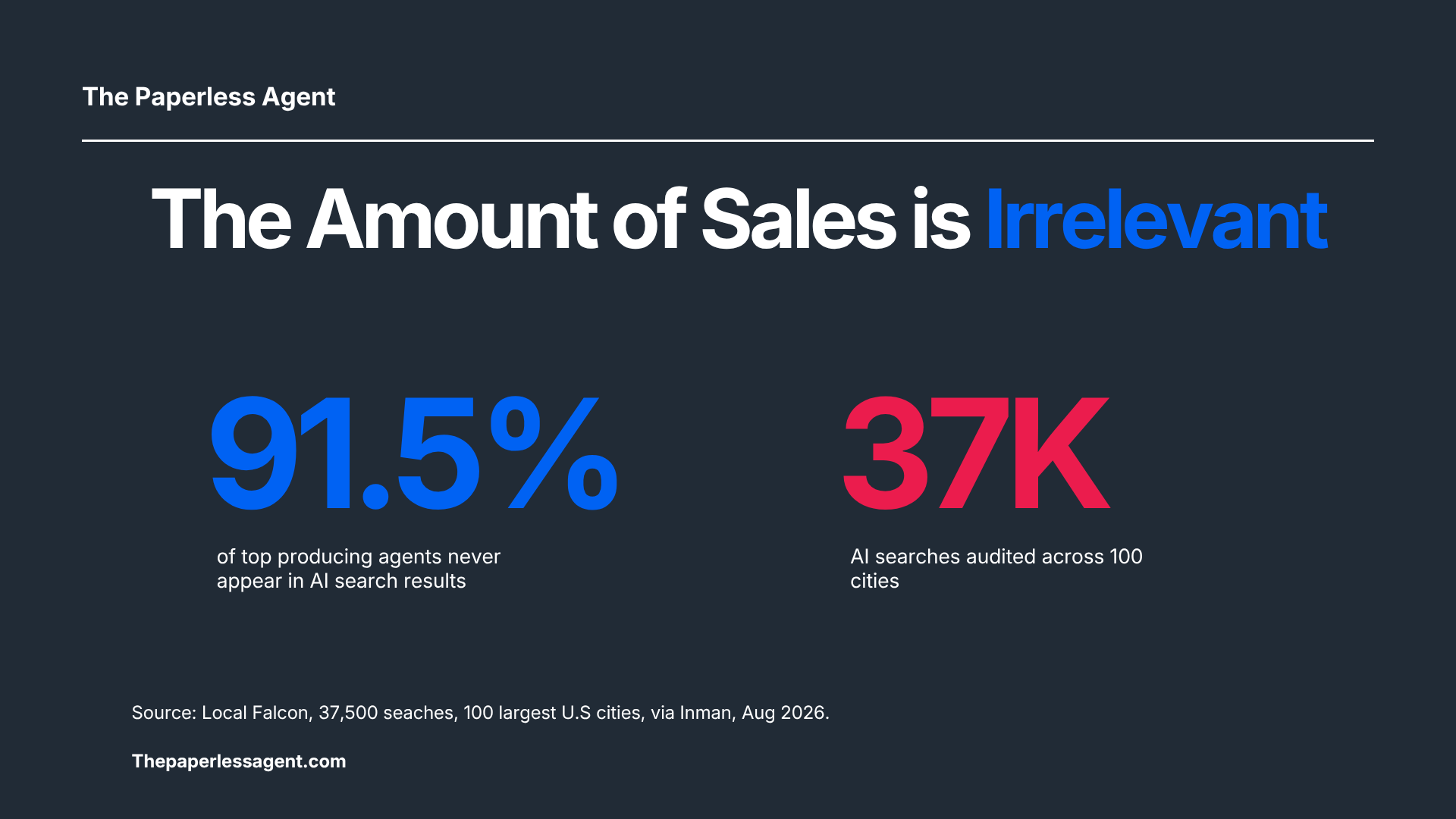
Inman reported on a Local Falcon study of 37,500 AI searches across the 100 largest cities in the United States, published August 24, 2026. It found that 91.5% of top-producing agents never appear in AI search results at all. The agents who do surface are rarely the ones closing the most transactions. They are the ones who wrote a page.
Local Falcon CEO David Hunter named the mechanism directly: "The models aren't reading MLS data or production rankings; they're reading pages. So the agent who wrote a 'best agents in Tulsa' post gets named, and the agent who actually sells the most homes in Tulsa doesn't."
Query fan-out is the direct cause. AI does not rank agents. It ranks the pages, reviews, and profiles that answer whichever sub-query it generated, one search at a time. An agent with no content addressing a given sub-query is invisible to that search, regardless of production.
This is already happening in your market. Right now, someone is typing a long-tail question about your neighborhood into ChatGPT, Google's AI Overviews, or Perplexity, and each of those tools runs its own version of the same fan-out process on whatever it finds. If none of the results lead back to you, the model has no way to find you.
What Is Query Fan-Out?
Query fan-out is the process an AI search system uses to answer a question that a single search cannot cover. The model breaks the original question into a set of smaller sub-queries, searches for each one separately, and merges the results into one response.
Google's own search team named the mechanism directly. Dounia Berrada, Search Senior Engineering Director at Google, described it this way in a company blog post published March 5, 2026: "AI Mode is basically doing a dozen searches for you in the time it takes to do one." The model identifies the sub-queries a complete answer requires, triggers all of them at once instead of one after another, reads through what comes back, and presents a single response with sources attached.
Search Engine Land's breakdown of the process names five steps. Decomposition identifies the core topics and implied follow-up questions inside the original query. Expansion generates the sub-queries themselves, each one targeting a different facet of the original question. Execution runs every sub-query at the same time rather than in sequence. Synthesis reviews what came back and resolves contradictions between sources. The final step returns a written answer with citations attached, instead of a ranked list of links.
Google alone generates at least eight distinct types of sub-queries from a single question, including equivalent phrasings, follow-up questions, broader and narrower versions of the same topic, and requests for clarification. Our AI Search Masterclass for Real Estate Agents covers the fundamentals behind this shift in more depth.
Query Fan-Out in Action: One Search, Nine Sub-Queries
Here is what that looks like on an actual real estate search. Someone in Southwest Austin considering a listing agent might type "real estate agent Circle C Ranch" into an AI tool, or ask something closer to a real conversation: "I live in Circle C Ranch and I am thinking of selling my home. Can you recommend some of the top listing agents in my area?"
Neither version gets answered directly. The model fans it out.
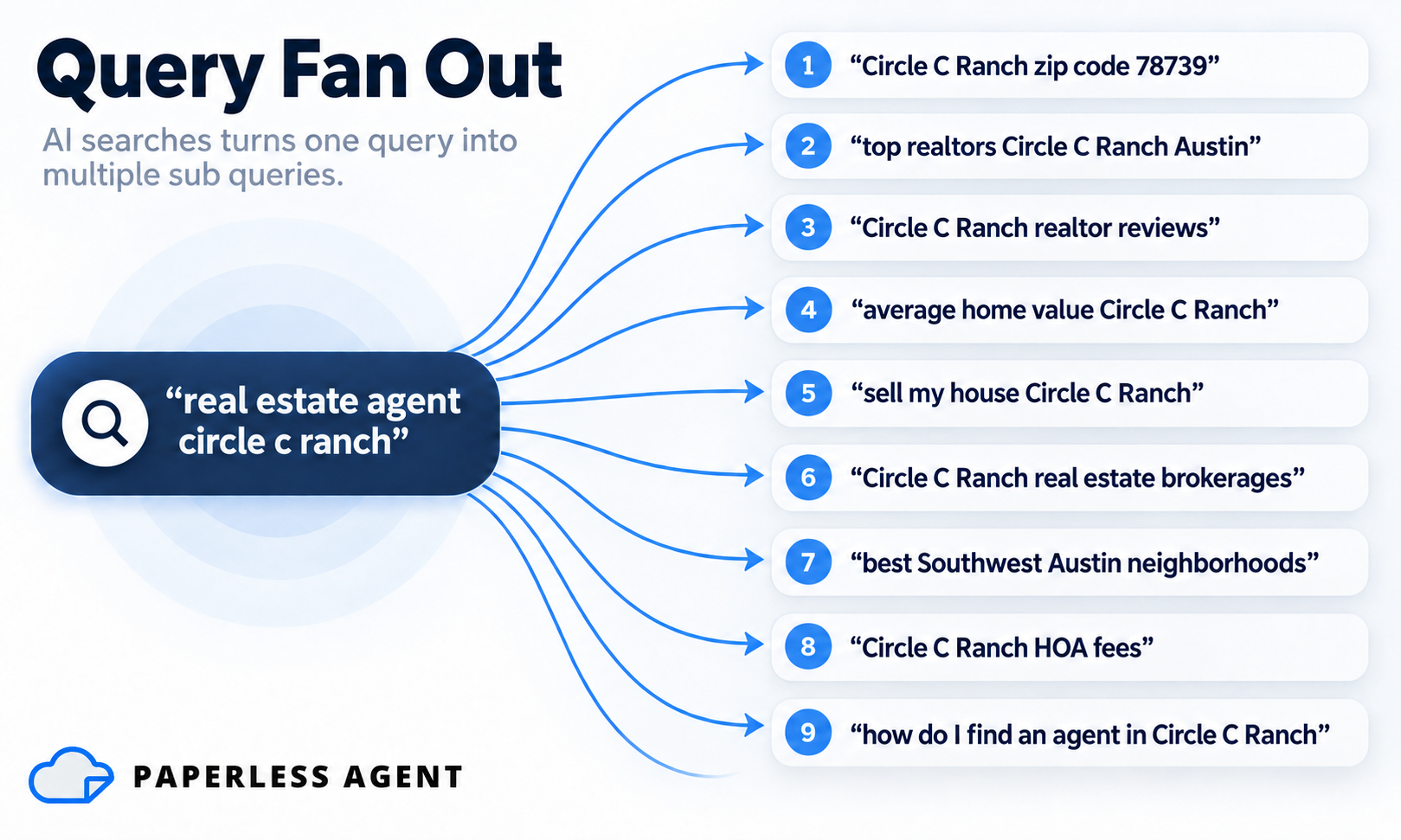
One search for a Circle C Ranch agent produced sub-queries about the zip code, the top realtors in the area, realtor reviews, average home values, selling a house in the neighborhood, the brokerages operating there, competing Southwest Austin neighborhoods, HOA fees, and the plain question of how to find an agent in the first place. Nine separate searches, each one pulling from a different kind of source: a zip code lookup, a business listings comparison, a review aggregator, a home value tool, a neighborhood guide, an HOA directory.
An agent with only a homepage and a single listing page answers none of these directly. An agent whose reviews, business listings, and content cover even half of them starts showing up across multiple sub-queries, which is what makes the synthesized answer name them instead of a competitor.
That illustrates the shape of one fan-out. We wanted to know whether the shape holds up on a second attempt, so we built tools to run the same question again and watch what changed.
Inside the Fan-Out: What Our Own Tracking Tools Found
We built tools that capture the actual sub-queries a fan-out generates on ChatGPT and on Google's AI Overviews, rather than take a single search's word for it. Each tool lets you set how many times it repeats a question in one session, and we run both routinely against real estate searches, since that is our audience. The data below comes from one documented session, the same question run side by side on both platforms.
On ChatGPT, that session ran the identical Circle C Ranch question three times: "I'm selling my home and need a good realtor. My home is in Circle C Ranch in Austin, TX. Who are agents you recommend?" Those three runs alone produced 16 unique sub-queries between them, an average of 5.7 per run. None of the 16 appeared in every run. The closest thing to a stable core was one query, a generic "top real estate agents" search, which showed up in two runs out of three and nowhere else.
.png)
Each attempt at query fan-out is a fresh decomposition, pulled from a wider pool of possible sub-queries than any single run reveals. Content built to answer only the sub-queries from one test misses most of what the same original question could generate on the next attempt.
Google's AI Overviews behaved differently in that same session. The core recommendation intent, a realtor recommendation tied specifically to Circle C Ranch, appeared in every run. What moved underneath that stable intent was the specific language. A seller-side narrowing, toward a "top listing agent" or "top seller's agent," appeared in one run out of three. A validation check against Reddit's r/Austin community, run with a site:reddit.com/r/austin search operator, appeared in a separate run out of three. Google was not only answering the question. It was checking a public forum for confirmation before finalizing what to say.
One individual agent's name recurred as the strongest signal inside that stable neighborhood cluster, appearing consistently once it showed up at all. Two competing brokerages surfaced as lower-share alternatives. The names matter less here than the pattern: a search this specific already has an incumbent. Nothing about your production changes that until you have content in the places the fan-out is already checking.
How to Reverse-Engineer Your Own Fan-Out
Start with the question a real buyer or seller in your market would type, not a keyword. Write out the sub-queries a search for your name, your neighborhood, or your zip code would fan out into: property values, HOA information, competing neighborhoods, brokerages, reviews, and the direct "how do I find an agent" question. A transcript of a listing presentation or a training session usually contains most of these already, in the exact words a client used.
Consistency is not a guess here. Our own fan-out testing found that the neighborhood and service language holding stable across every Google run is the same language that needs to read identically across your website, your Google Business Profile, and every directory that lists you. A name, a license, or a service area that varies from one listing to the next forces the model to guess which entity it is even looking at.
Reviews carry the same requirement in a different form. A review naming a neighborhood, a price point, or a specific situation answers one of the sub-queries you wrote down. A generic five-star rating with no detail answers none of them.
The advice does not transfer evenly across platforms, and that is worth naming directly. ChatGPT runs its web search through Bing, not Google's own index, so the fan-out behavior and the sources it trusts can differ from what a Google-focused test shows. We compared how differently ChatGPT and Claude answer identical real estate questions in our own AI search audit, and reviews carried far more weight on one model than the other. Build your sub-query answers assuming a buyer or seller could be asking any of the major platforms, not just one.
For each sub-query you identify, ask what a stranger typing exactly that question would need to find. That is the content to build, not a general page about your services.
What to Create for Each Sub-Query
One page can answer several sub-queries at once, and it usually should. Do not build a separate page for every easy sub-query. A single page covering the zip code, the neighborhood profile, home values, and nearby brokerages in one place outperforms five thin pages that each answer one question badly.
Four places to put that coverage:
Your website. A single neighborhood or service-area page covering the zip code, home values, HOA details, and nearby brokerages together, built to answer a cluster of sub-queries at once rather than one at a time.
Video and social content. A short video walking through the same neighborhood questions gives AI tools a second format to pull from, and it is the format more buyers and sellers are already watching.
Reviews on the platforms AI already trusts. Zillow, Homes.com, and Realtor.com get cited because AI search treats them as established sources. A review naming your neighborhood or price point on one of these carries more weight for a sub-query than the identical review sitting only on your own site.
Your own aggregated reviews page. Pulling those same reviews onto a page on your own site gives you a second citable source for the same content, under your own name.
Public forums are worth the same attention, in smaller doses. Google's AI Overviews were observed checking Reddit's r/Austin community directly while answering a real estate recommendation question, confirming that forums get checked for validation, not just indexed. In the largest analysis of AI citation behavior currently available, forums including Reddit still account for a small share of total citations overall. A specific answer to a specific question in a public thread costs nothing beyond the time it takes to answer a question you have likely already answered somewhere else.
.png)
The Principle Behind Query Fan-Out
AI search answers strangers' questions one sub-query at a time. Your name only appears where you have already answered the specific question being asked.
That reframes the whole exercise. The goal is not visibility in the abstract. The goal is coverage: enough of the real sub-queries in your market answered, in your own words, on sources an AI system already trusts, that your name keeps surfacing across the fan-out instead of a competitor's. The same caution applies here that we outlined in the pitfalls of using AI in real estate: coverage earns you a mention, but it does not replace verifying that what gets said about you is accurate.
Every neighborhood, every price point, every objection a buyer or seller might raise is a potential sub-query. You have heard most of them at listing appointments for years. The work is writing the answers down somewhere a model can find them before someone else does.
Answer the sub-query. Not the headline.
What to Do Right Now
- Write down the sub-queries. List ten questions a buyer or seller in your specific neighborhood would ask about pricing, HOA fees, competing areas, and finding an agent. Use real questions from your last five listing appointments if you have them.
- Run your own long-tail search. Open ChatGPT or Perplexity and type the conversational version: "I live in [your neighborhood] and I am thinking of selling my home. Can you recommend a top listing agent in my area?" Perplexity shows its sources directly. Note which ones are yours and which belong to a competitor.
- Fix the weakest link first. If your business listings on Zillow, Homes.com, or Realtor.com are thin or inconsistent, fix those before writing a single new page. They get cited more often than an agent's own site for exactly the sub-queries a fan-out generates.
Frequently Asked Questions
Q: What is query fan-out?
Query fan-out is the process an AI search system uses to answer a question that a single search cannot cover completely. Instead of running one search, the model breaks the original question into several smaller sub-queries, runs all of them at once, and combines whatever it finds into a single answer. Google's own Search team has described the effect as running a dozen searches in the time it normally takes to run one. For a real estate agent, this means a search for "best agent in [neighborhood]" becomes several separate searches covering pricing, reviews, competing agents, and the neighborhood itself, and each one pulls from a different source.
Q: Why does AI struggle to answer who the best real estate agent is?
AI search systems answer from pages, reviews, and business listings already published online, not from MLS production data or closed-transaction records. According to Inman's reporting on a Local Falcon study of 37,500 AI searches across the 100 largest cities in the United States, 91.5% of top-producing agents never appeared in AI search results at all. The agents who did appear were typically the ones who had written a page that matched one of the sub-queries, regardless of how many homes they had sold. Production and visibility are not the same thing to a model that only reads what is public.
Q: How many sub-queries does one search generate?
The number varies by platform and by how complex the original question is. Google's own documentation describes at least eight distinct types of sub-queries a single search can generate, including equivalent phrasings, follow-up questions, broader and narrower versions of the topic, and requests for clarification. In practice, a real estate search can fan out into anywhere from five to a dozen or more sub-queries covering pricing, location, reviews, and competing options, each one searched and sourced separately before the final answer gets assembled.
Q: Should I build one page or several pages to cover my area's sub-queries?
One comprehensive page usually outperforms several thin ones. A single search for an agent in one neighborhood can fan into 9 or more sub-queries covering the zip code, home values, HOA fees, and nearby brokerages, and one well-built neighborhood page can answer most of them at once. Building a separate page for every individual sub-query spreads the same authority across more pages, each one thinner and harder to keep current. Save individual pages for topics substantial enough to need real depth on their own.
Q: Do reviews on Zillow and Realtor.com affect AI recommendations?
Yes, and the platform a review sits on matters as much as the review itself. AI search systems treat Zillow, Homes.com, and Realtor.com as established sources, so a review on one of those platforms carries more weight for a sub-query than the identical review sitting only on an agent's own website. Specificity matters too. A review naming a neighborhood, a price point, or a particular situation answers a sub-query directly, while a generic five-star rating with no detail gives the model nothing to match against a real question.
Q: Can I see the actual sub-queries AI is running for my market?
Not directly on most platforms, but the search itself gets close. Perplexity displays its sources for each answer, which shows which of the underlying sub-queries returned results and from where. On any platform, typing the long-tail conversational version of a buyer or seller's question, rather than a short keyword, and reading which sources the answer cites, is the closest available substitute for watching the fan-out happen in real time.
Q: Is query fan-out the same on ChatGPT, Google AI Overviews, and Perplexity?
The underlying idea, breaking one question into several searches, is consistent across all three, but the sources each one favors differ. Research on AI citation behavior across 17.2 million citations found that Claude cites reviews and social content at two to four times the rate of ChatGPT or Gemini, while Gemini leans more heavily on first-party websites, consistent with its ties to Google Search. The practical takeaway is that a real estate agent's content and review strategy should not assume every AI platform weighs the same sources the same way.
Q: What is the single biggest fix for showing up in AI recommendations?
Consistency across every source an AI system can find. Your name, license, service area, and description need to read identically across your website, Google Business Profile, and every directory or portal that lists you. Inconsistent listings force the model to guess which entity it is even looking at, which discounts every other signal, including production and reviews, before the fan-out even gets to comparing agents. The requirement holds on ChatGPT too, even though it searches through Bing rather than Google's own index.
Chris A. Scott is a Real Estate Digital Marketer & AI Strategist at The Paperless Agent where we make AI and real estate technology useful, practical, and profitable.