
How ChatGPT Decides When to Recommend You
How ChatGPT Decides Whether to Recommend You as a Real Estate Agent
A member of our community shared something that stopped me in my tracks recently.
Her name is Sandra, and she said: “I was already recommended by ChatGPT to a client — and I have no idea how or why.”
That sentence captures two completely different situations happening in real estate right now. Some agents are showing up in AI recommendations and don’t know why. Others aren’t showing up at all and don’t know why either.
Both problems have the same solution: understanding how ChatGPT actually decides who to recommend and then taking deliberate action to influence that decision in your favor.
Why This Matters More Than Most Agents Realize
When a potential buyer or seller opens ChatGPT and types “Should I hire [agent name] to sell my home?” or “Who are the best real estate agents in [city]?” — the AI doesn’t ask around. It doesn’t check your business card or call your past clients.
It reads the internet. And then it forms its own interpretation.
Here’s what makes this fundamentally different from Google: when someone searches your name on Google, they get a list of links. They click through, read your website, check your Zillow profile, maybe skim your LinkedIn, and then they form their own opinion. Google passes the information. The human does the interpreting.
ChatGPT does something different. It goes to many of those same sources, reads through them, synthesizes the information, and then hands the user a fully formed conclusion. The AI creates the interpretation before the prospect ever reaches you.
800 million people use ChatGPT every week. When those users ask for recommendations, being mentioned is the difference between a warm lead and complete invisibility. And the window for getting ahead of this is still open — but it won’t stay open forever.
The Research: Where ChatGPT Actually Gets Its Information
This isn’t guesswork. There is actual research on where AI tools draw their citations from when forming recommendations about professionals and businesses.
Here’s what the data shows:
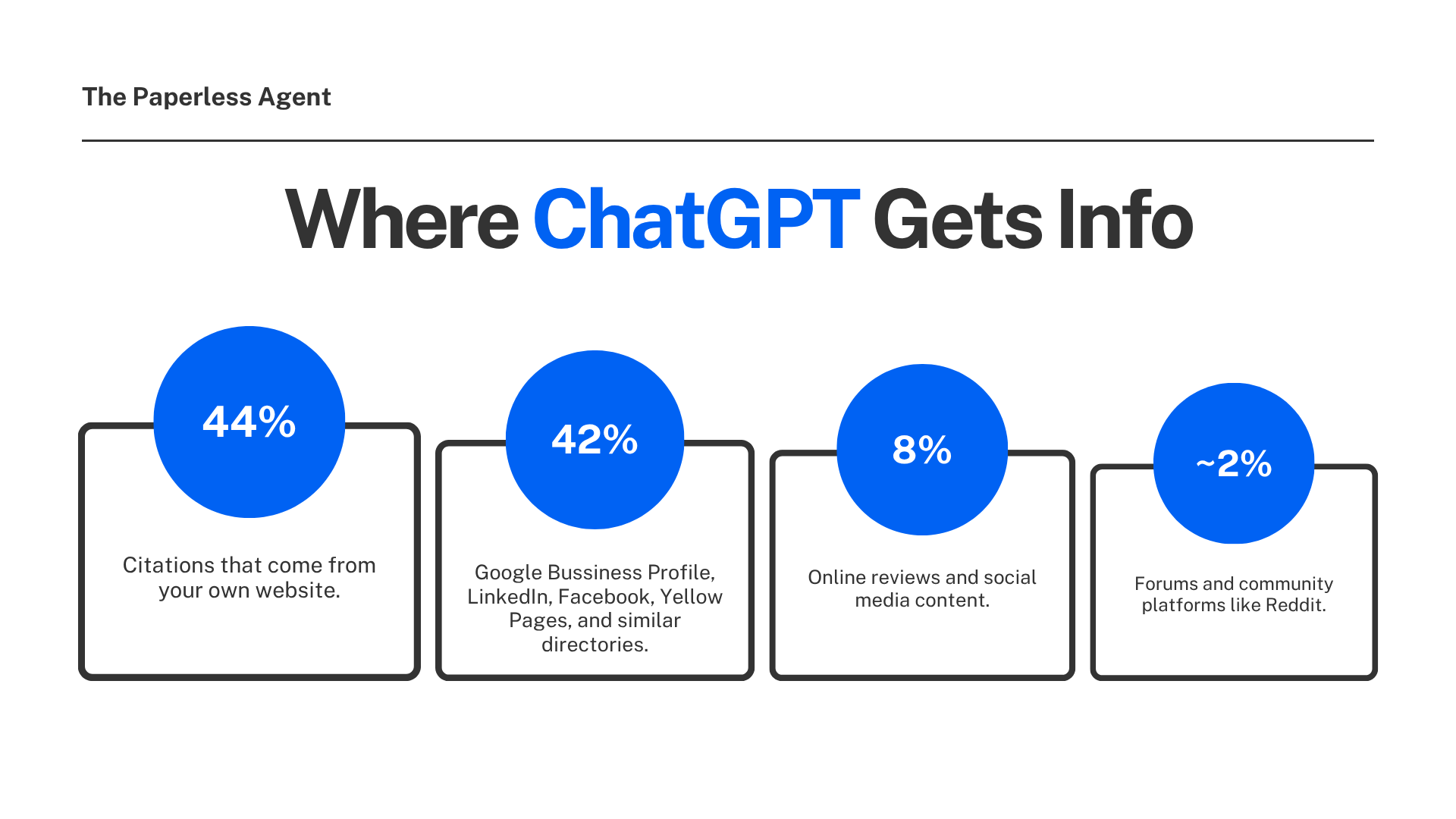
- 44% of citations come from your own website
- 42% come from business listing sites — Google Business Profile, LinkedIn, Facebook, Yellow Pages, and similar directories
- 8% come from reviews and social media
- ~2% come from forums and community platforms like Reddit
Add up that first and second number: 86% of what ChatGPT uses to form a recommendation about you is already in your direct control.
That’s the most important insight in this entire post. You don’t need a massive ad budget. You don’t need to be featured in a national publication. You need to make sure that the two categories of information you already control — your website and your business listings — are complete, accurate, and structured in a way AI can read and trust.
Part 1: Your Website — The Single Biggest Factor in AI Recommendations
Your website accounts for nearly half of everything ChatGPT uses to talk about you. Which means the quality, depth, and structure of what’s on your site is not a minor detail. It’s your most important AI asset.
Here’s what your website needs (at minimum) to give ChatGPT something useful to work with.
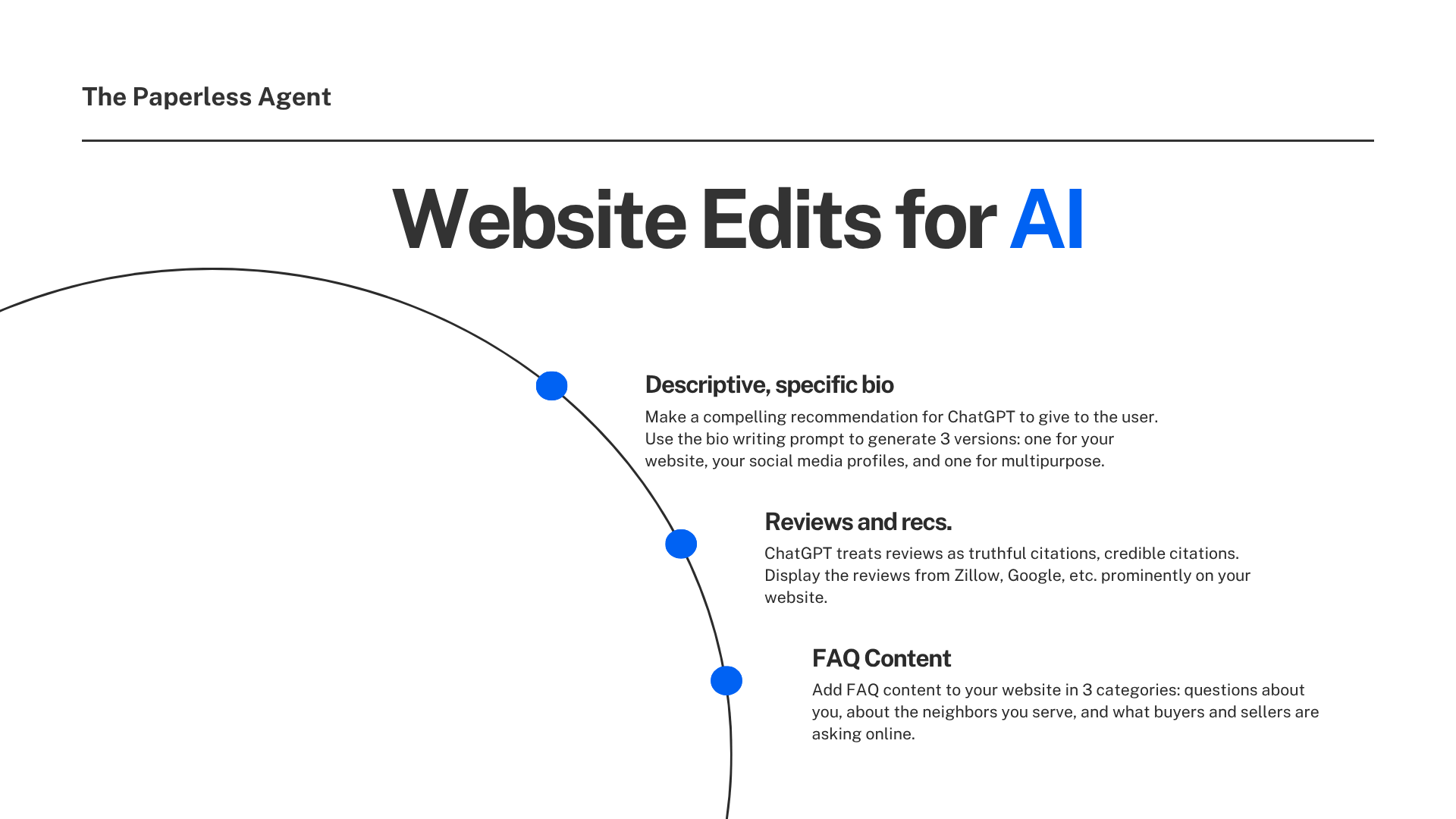
A Descriptive, Specific Bio
Not a generic summary. Not the paragraph that begins with “I’m passionate about helping families find their dream home.” A genuinely descriptive bio that differentiates you, tells the full story of your experience, and gives ChatGPT specific information it can’t find anywhere else.
Think about what makes your background unique: the markets you know deeply, the type of clients you specialize in, the transactions you’ve navigated, the neighborhoods you’ve lived in or sold in for years. That specificity is what ChatGPT can pull from, quote from, and use to make a compelling recommendation.
A strong bio should appear on your website, your brokerage profile page, your LinkedIn, and every major platform where you have a presence. Consistency across all of these is critical.
Practical tip: Use an AI bio writing prompt to generate three versions of your bio: one for your website (longer, more detailed), one for social media profiles (shorter, punchy), and one that’s multipurpose. A well-structured prompt will ask you a series of questions and then synthesize your answers into all three formats. Turn on voice dictation and just talk through your answers — the AI will do the writing. Use our bio writing prompt here →
Reviews and Recommendations on Your Own Site
Here’s something most agents don’t know: ChatGPT does not devalue reviews that appear on your own website. It treats them as valid, credible citations.
That means every review you’ve received on Zillow, Google, Realtor.com, or anywhere else should also be on your website. Pull them in. Display them prominently. Don’t make ChatGPT work to find social proof about you when you can put it right on your own site.
You should also have reviews on your brokerage profile if that’s an option. Brokerage websites often carry strong domain authority in local markets, especially if they’ve been around for years — which means AI tools give weight to what they say.
Companies with reviews on Google, Yelp, and Facebook are 2.8 times more likely to appear in AI search results than those with reviews on only one platform. Distribute your reviews. Don’t keep them all in one place.
FAQ Content: Questions and Answers
AI tools are specifically designed to find and surface answers to questions. One of the most consistent patterns in what gets cited by ChatGPT is content that’s structured as a question followed by a direct, clear answer.
Add FAQ content to your website — and be strategic about what questions you answer. Think in three categories:
Questions about you: How long have you been selling real estate? What areas do you specialize in? What are your average days on the market?
Questions about the neighborhoods you serve: What are home values like in [neighborhood]? Is [area] a good place to buy right now? What are the best neighborhoods for families in [city]?
Questions buyers and sellers are already asking online: Use Google to research this. Search a neighborhood or topic relevant to your market, then scroll down to the “People Also Ask” section. Every question listed there is something real people are actually searching for — and answering those questions on your site puts you directly in the path of AI tools that are looking for exactly that type of content.
Part 2: Business Listings — The Other 42%
Think of business listings as the Yellow Pages for the internet. They are directory-style profiles that establish your existence as a legitimate professional across multiple platforms — and AI tools use them heavily when deciding who to recommend.
Here are the six platforms every real estate agent should have a complete, claimed, and active listing on:
1. Google Business Profile: This is the most important one. It feeds Google Search, Google Maps, and is heavily weighted by AI tools. If you haven’t claimed and fully built out your Google Business Profile, this is your first priority.
2. Apple Business Connect: For everyone using Apple Maps — which includes every iPhone user who opens the Maps app. Often overlooked, which means claiming it now gives you an advantage over agents who haven’t.
3. Bing Places: For Business Microsoft’s search platform, and notably, ChatGPT draws heavily from Bing data when browsing the web in real time. If you haven’t claimed or optimized your Bing Places profile, now is the time to do it. It’s a direct pipeline into ChatGPT’s local data.
4. Facebook Business: Beyond social media, a well-maintained Facebook Business page carries visibility in both social search and AI tools. Posts from a business page also begin to surface in search results over time.
5. Yellow Pages: It may seem old-school, but Yellow Pages has high domain authority because it’s been online for decades. AI tools treat it as a trusted, established directory — and claiming your listing takes minutes.
6. LinkedIn: If you’ve searched your own name recently, you’ve probably noticed that your LinkedIn profile appears in the top five Google results. That’s not a coincidence — LinkedIn carries exceptional search authority for professional name searches, and AI tools treat it as a trusted directory of professionals. A complete, current LinkedIn profile is not optional.
The NAP Rule — The Most Important Detail Most Agents Get Wrong
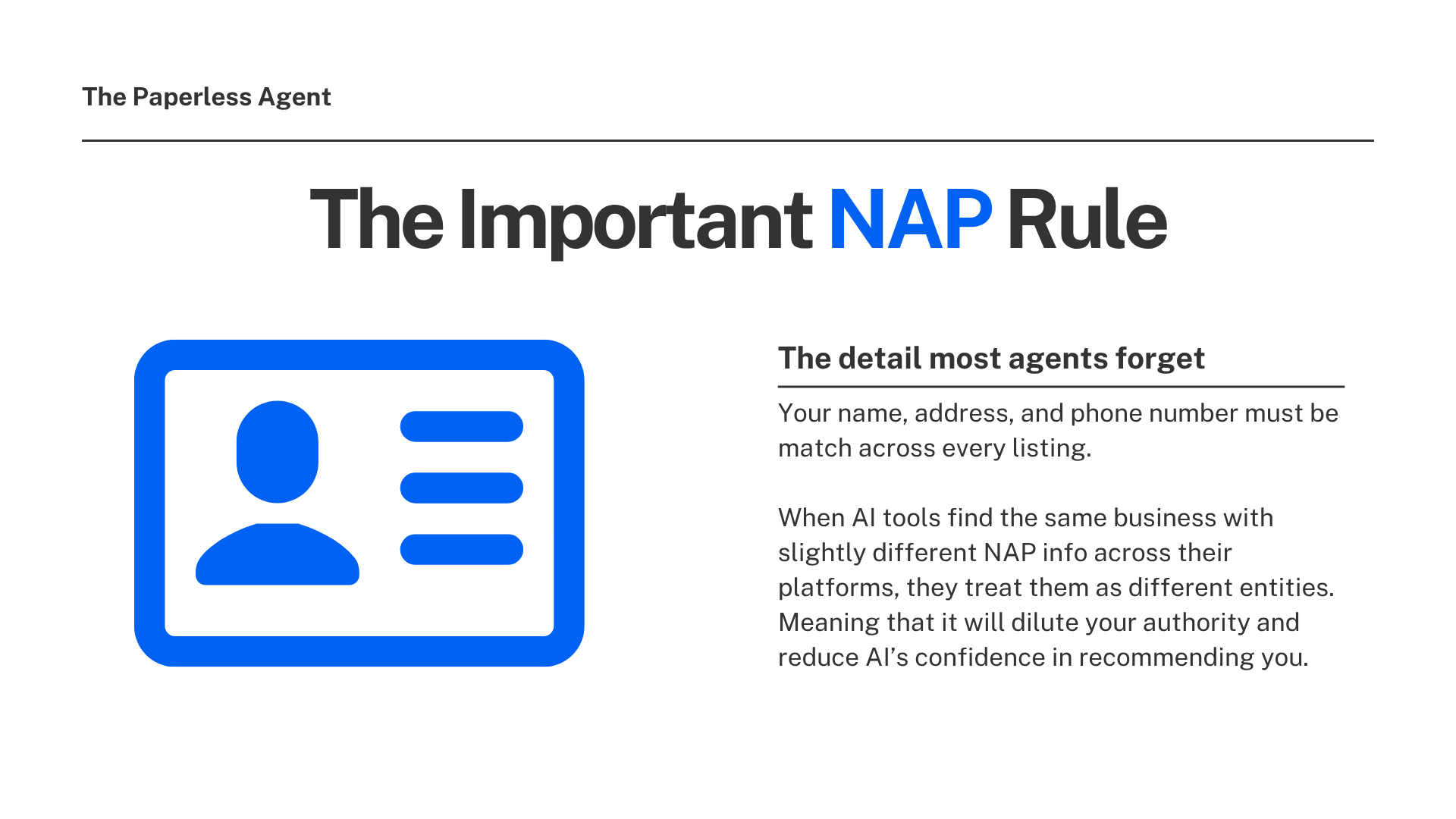
Here’s a critical point that determines whether your business listings actually work for you: your NAP — Name, Address, and Phone number — must be an exact match across every single listing.
Not similar. Not close. Exact.
The same spelling of your name. The same phone number. The same address format, including whether there’s a comma, whether “Suite” is spelled out or abbreviated, or whether your name includes a professional designation.
When AI tools find the same business with slightly different NAP information across multiple platforms, they treat them as potentially different entities. That dilutes your authority and reduces the confidence AI has in recommending you.
Check every listing you have and audit them for consistency. This is one of the simplest, highest-impact fixes you can make, and most agents have never done it.
The Bigger Picture: You’re Shaping What AI Says About You
Understanding the mechanics of AI recommendations changes how you think about your digital presence. It’s not just about showing up, it’s about shaping the interpretation.
When ChatGPT forms a recommendation, it’s not just answering the question “does this agent exist?” It’s answering “what should I say about this agent, and should I recommend them?” The difference between a weak recommendation and a strong one often comes down to the quality and specificity of the information it found.
A detailed bio gives it something to say. Strong reviews give it social proof to cite. FAQ content gives it specific answers to pass along. Consistent business listings give it confidence that the entity it found is legitimate and trustworthy.
Content freshness matters significantly — 71% of citations come from content dated 2023 to 2025. That means old, outdated information on your website or business listings actively works against you. Keeping your digital presence current is not just good practice — it directly impacts whether AI recommends you or passes you over.
Where to Start: Your Action Plan
If you’re not sure where you stand in AI search right now, the best place to start is a full AI search audit. This will tell you exactly what AI tools currently know about you, where the gaps are, and what to prioritize fixing.
To request a free AI Search Audit report: Email support@thepaperlessagent.com with the subject line: Free AI Search Audit
Once you have your audit results, here’s the priority order for taking action:
- Update and expand your bio: On your website first, then everywhere else. Use the bio writing prompt to generate all three versions.
- Audit your NAP consistency: Check every business listing and make sure your name, address, and phone number are an exact match across all platforms.
- Claim and complete all six business listings: Google Business Profile, Apple Business Connect, Bing Places, Facebook Business, Yellow Pages, and LinkedIn.
- Pull your reviews onto your website: Don’t let them live only on third-party platforms.
- Add FAQ content: Use Google’s “People Also Ask” to find questions your market is already searching for, then answer them on your site.
None of this is technically complicated. All of it is within your control. And the agents who take care of it now, while most of their competition hasn’t started, are building a recommendation advantage that will compound as AI search continues to grow.
Frequently Asked Questions
Q: Can I actually influence what ChatGPT says about me, or is it out of my control? More than most agents realize. Research shows that 86% of the information AI uses to form recommendations comes from sources you directly control — your own website and your business listings. The quality, accuracy, and completeness of those two things is the biggest lever you have.
Q: How long does it take to start showing up in AI recommendations? There’s no fixed timeline — AI tools update their information at different rates. That said, the foundational work (a strong bio, consistent business listings, reviews on your site, FAQ content) is what makes the difference over time. Think of it as building an asset, not flipping a switch.
Q: Does my Google Business Profile really matter for ChatGPT recommendations? Yes — significantly. ChatGPT draws heavily from Bing when browsing the web in real time, and Bing Places is directly connected to how Microsoft’s search ecosystem sees your business. But Google Business Profile also feeds into the broader citation network that all AI tools draw from. It’s foundational.
Q: What’s the NAP rule and why does it matter so much? NAP stands for Name, Address, and Phone number. For AI tools to confidently recognize your listings across multiple platforms as the same business, your NAP must be identical — same spelling, same format, same phone number — everywhere it appears. Inconsistencies signal to AI that these might be different entities, which dilutes your authority and reduces recommendation confidence.
Q: What if I don’t have many reviews yet? Start collecting them now. After every closing, ask your client directly and send them a single link to where you need the review most. Over time, a steady stream of recent, genuine reviews distributed across your website and the major platforms carries significant weight with AI tools. Quality and recency both matter — recent reviews outperform older ones.
Q: What types of FAQ questions should I put on my website? Focus on three categories: questions about you and your experience, questions about the specific neighborhoods you serve, and questions buyers and sellers in your market are already searching for. Use Google’s “People Also Ask” feature — search a neighborhood name or real estate topic relevant to your market and look at what questions appear. Those are the exact questions worth answering.
Q: Do I need to be on all six business listing platforms, or just some? All six are worth claiming and completing — they’re all free, they’re all used by AI tools, and together they build a comprehensive citation network that signals legitimacy and authority. LinkedIn and Google Business Profile carry the most weight, but omitting the others leaves gaps in your digital footprint that AI tools will notice.
Q: How do I know what ChatGPT currently says about me? The simplest way is to open ChatGPT and type: “Should I hire [Your Name] to sell my home?” Read what it produces. For a more comprehensive picture of your full AI search visibility, request a free AI Search Audit at support@thepaperlessagent.com — Subject: Free AI Search Audit.

Resources mentioned in this post:

Bio Writing Prompt — Generate three versions of your bio with AI: https://docs.google.com/document/d/1_jpndCVeykcGmKGtEs2SpQTXx2aEfk1C8vVolbIr5Xc/edit?tab=t.0

Free AI Search Audit — Find out exactly where you stand in AI search: Email support@thepaperlessagent.com — Subject: Free AI Search Audit