

Find the Local Market that Offers the Best Growth Opportunity
Selecting and working in the wrong local market is acostlymistake that many real estate professionals make but with some background knowledge it's an error that you can avoid.
If you selected your currentLocal Marketbased on the following factors, youmaywant to reconsider (and we will show the tools to do this, below):
- I live in this neighborhood;
- I like the area, the homes are nice;
- Other agents are marketing there so I should too;
- I've got a listing there
The reasons for choosing a local market area above aren'twrong, but they shouldn't be yoursole reasoning. In this article we'll look at how to select the bestLocal Marketarea; one that you canmaster (andbe profitable in). To achieve this, we'll need to do some calculations (which we will walk you through step by step).
Learn how to:
- Calculate the opportunity of a geographic area;
- Calculate the potentialfuture opportunitiesof a particular market area;
- Look at other variables that will affect the Local Market you choose.
To get started, grab a calculator, a pad of paper, and a pen. Let's get started!
Calculate turnover rate:
The turnover rate is thepercentage of homes that will sell in a given time periodcompared to thetotal number of homes in a specific area.
Example:
If there are500homes in a specific local market, and50of those homes sold in the last 12 months, the turnover rate of that particular area is 10% (50/500 = 10%).
In plain English, that indicates that10% of the homes in a particular areasold in the last 12 months.
How to calculate the turnover rate of a particular neighborhood:
Two pieces of info that you will need in order to calculate theturnover rate:
- How many homes are in your neighborhood?
- How many homes have sold in that neighborhood?
There are two ways to determine the number of homes in your neighborhood. Thefirst wayis through the local tax records. Thesecond wayis to call your title company's representative who will know how many homes are in that geographical area.
Here we will source that information using tax records onReal Listwhich ties into our public tax records (your screen and search will differ depending on the platform you are using).
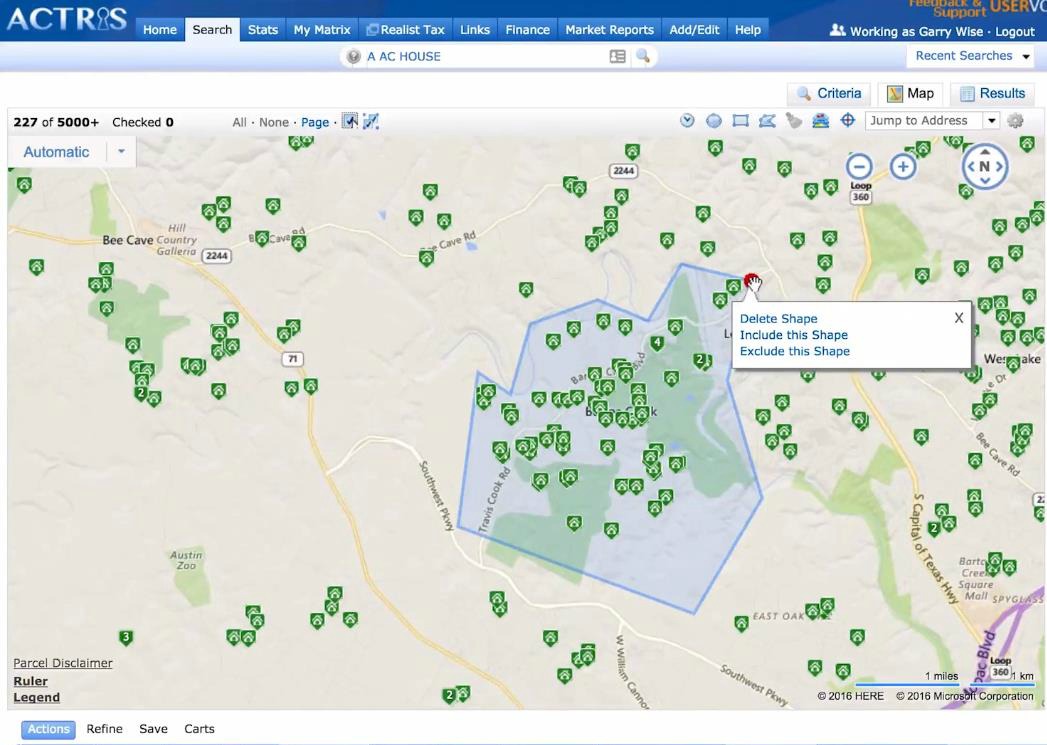
Garry Wise, luxury broker at Goodlife Luxury and The Paperless Agent co-founder, has a local market of Barton Creek in Austin, Texas, which we'll use as an example. First, we drew a polygon around the neighborhood to be assessed.
Garry's tip:look at neighborhoods that havemultiple streetsgoing in and out(we'll look at the profound effect this has on marketing your open houses in a future article).

Now hitsearch(for us this is at the bottom left of our screen) and a list of all the homes in the area will come up. In this example, a total of 890 properties were listed in this area (this number is important for our calculations so write it down).

If this is the first geographical area that you are trying to master, we recommend focusing on an neighborhood that has no more than500-1000 homes. Themorehomes in a given neighborhood, thehigherit costs to successfully execute the marketing strategy.
TIP:Don't exceed your limits! On average you are going to spend$1 per month for every home in that areato run a successful market campaign.
The next step is to go into the MLS and create that same search in theMap tab.
Then go back to theCriteria tabto see how many homes sold in the last 365 days.
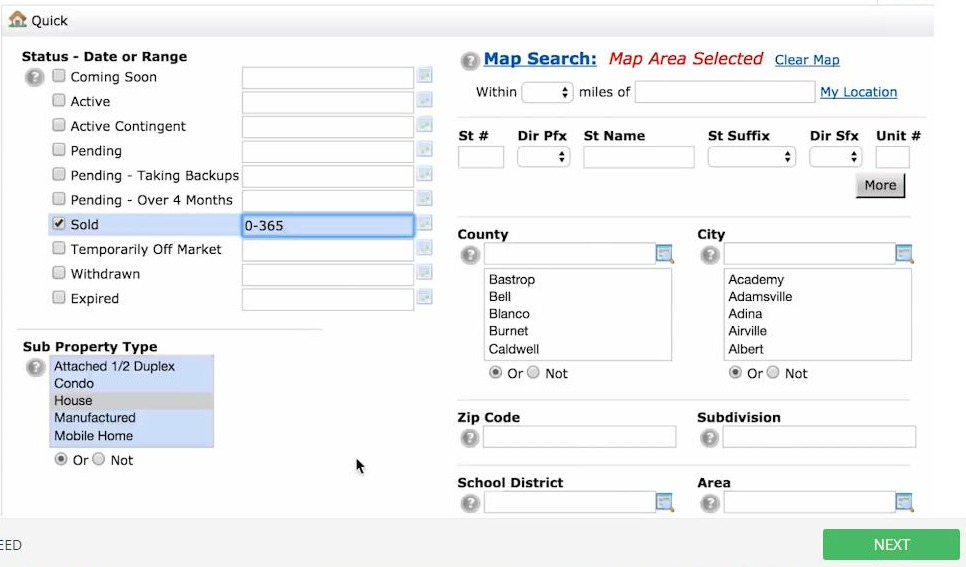
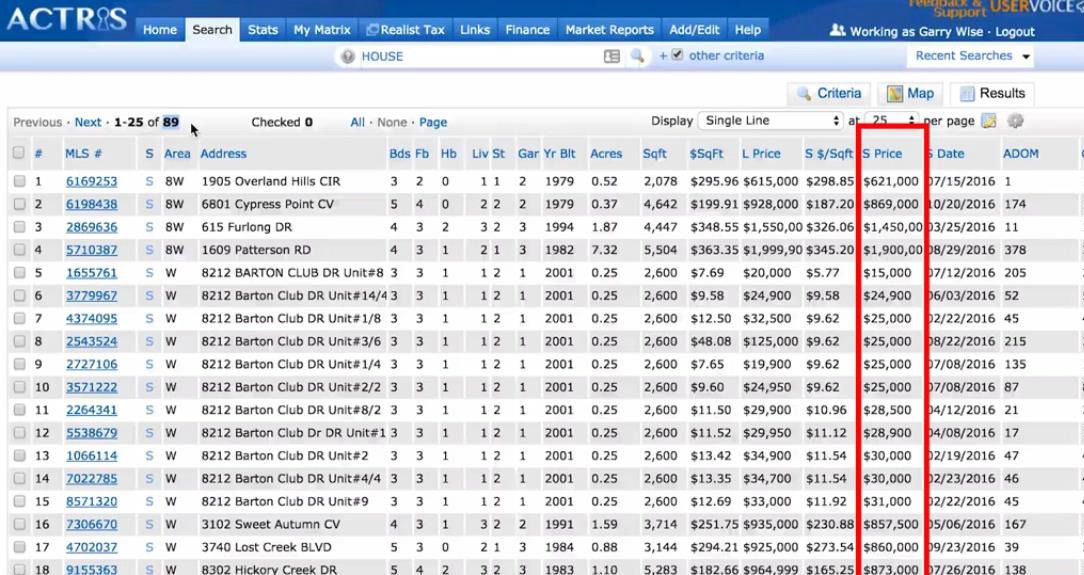
In our particular area, we see that 89 homes sold in the last 365 days.

Looking at the past 365 is fine for astable market, but to get a true sense of what is happening, look back over three yearsto see if any given year was one of unusual activity (an up or down swing) and then average out to an average of homes sold per year.
Tocalculate the turnover rate for this neighborhood:
Number of Homes Soldin the area÷Number of Homes in the Areax100(to find percentage)
=Turnover Rate
Now sub in the numbers from our example above:
89 homes÷890 homesx100=10%
In other words, 10% of the homes in that particular area were sold in the past year.
It's important to look at theaverage sales priceas well; a general (although not set in stone) guideline is thatas the sales price go uptheturnover goes down(this isn'talwaysthe case but it is something to keep in mind).
Calculate opportunity in a geographical area
TheHome Sales Potentialis thenumber of homes that will statistically sellin a particular neighborhood in a given year.
To calculate the opportunity in a given market you will need to look at theTurnover Rate, theNumber of Homes, theaverage sales price, andcompetitionin the market.
Number of Homes x Turnover Rate = Home Sales Potential
To calculate this you need theNumber of Homesin the geographical region and theTurnover Rate(that is the number that we already calculated above).
To illustrate the point, we are going toCalculate Opportunitybased on a geographical area of500homes and a turnover rate of7.5%.
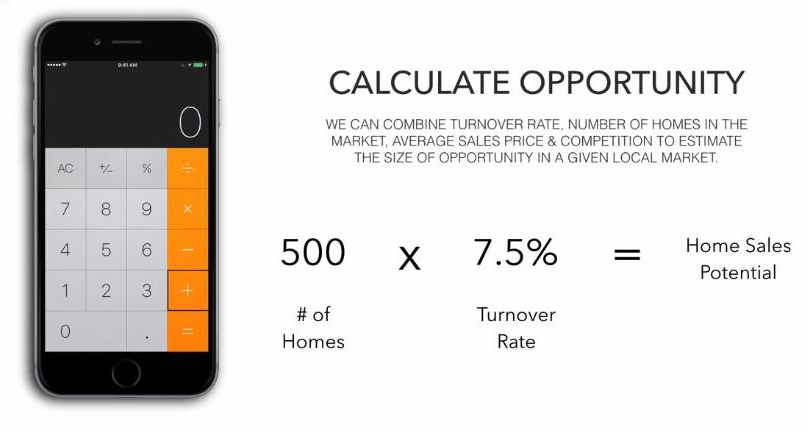
As in the graphic above:
500 x 7.5% = 37.5
In other words, in this particular neighborhood of 500 homes, 37 or 38 will sell each year.
Home Sales Target for the Geographical Area
The next step is to calculateHome Sales Targetfor this geographical area using thehome sales percentagethat you just figured out.
Homes Sales Potential x Market Share = Home Sales Target
We can't expect to jump into a new area and immediately have 40% market share so be conservative with this number (5-10% is a good place to start your calculations).
Continuing with the our sample scenario and estimating a 10% market share:
37.5 x 10% = 3.75 homes to sell over the next 12 months
Therefore, yourHomes Sales Targetin this particular example, what you could estimate to sell in that area with a 10% market share over the next year, would be 3 or 4 homes.
Calculate Home Sales Target as your Market Share Increases
Most of what you are calculating is out of your control except your Market Share (at least as you become more established in that market) so your goal should be togrow your market shareyear after year; it's how you gain ownership, increase your return on investment, and how you will ultimately sell more homes in that neighborhood.
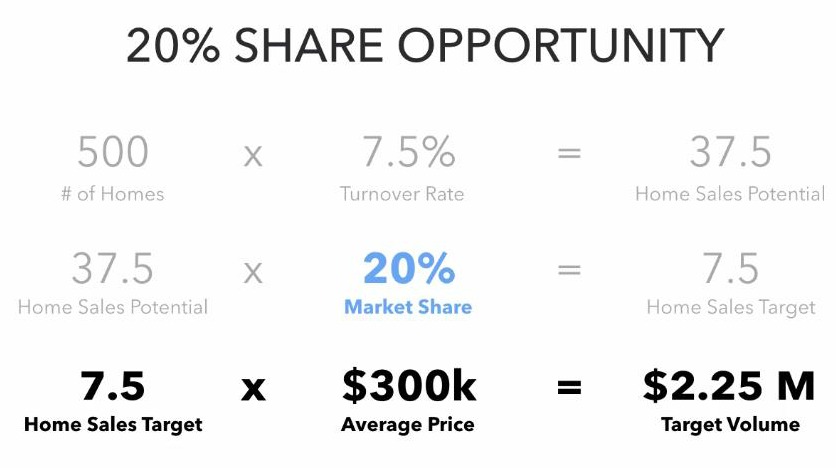
The only number you will change in this next calculation example is theMarket Sharepercentage Let's try with 20% (up from 10% in the previous example).
Home Sales PotentialxMarket Share=Home Sales Target
3.75 x20%= 7.5
In other words, if you have 20% of theMarket Sharein this particular geographical region, you would sell approximately 7 or 8 homes per year.
Now calculate and document what this would befor your specific neighborhood.
Calculating Target Volume and Market Opportunity
As mentioned above, the only variable within your control is yourMarket Shareso that is how you calculate your potentialMarket Opportunityfor the years ahead.
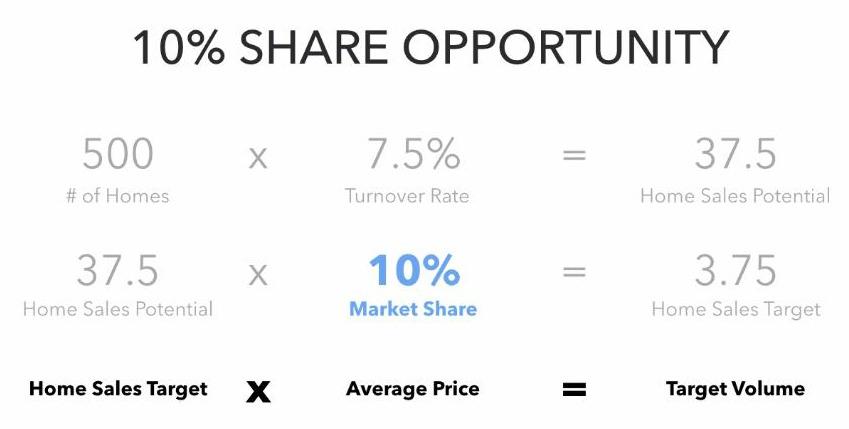
Take theHome Sales Target(based on your initial 10% market share) xAverage Price=Target Volume
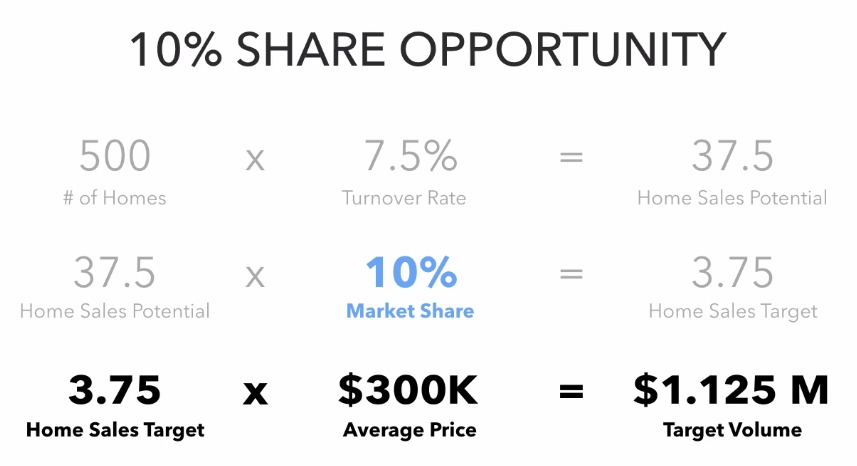
In that example, you are looking at aTarget Volumeof$1.125 million(annually).
What happens when you get to 20% market share? Let's see:
Consider whatMarket Ownershipwould look like at60% of the Market Shareof that neighborhood:
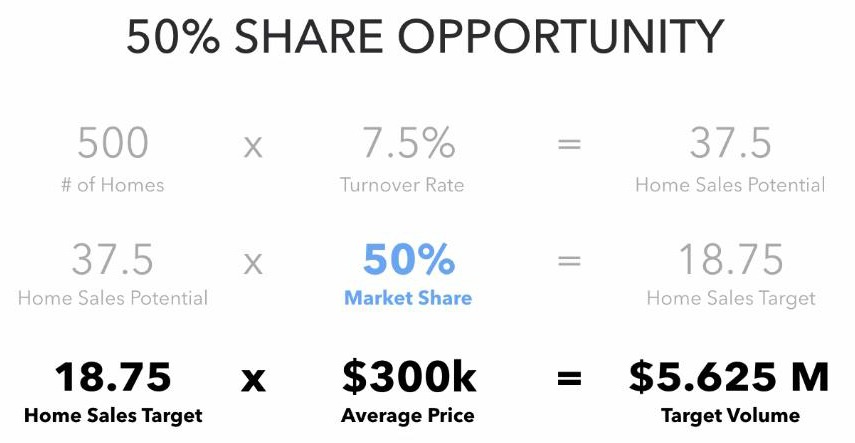
Of course,Market Ownership(40-60%) takes time to establish but calculating thepotentialallows you to see theopportunityavailableof a particular market and is a good way to determine whether the neighborhood will be a good fit for you inlong term.
Will it yield enough volume to be sustainable?
Does the neighborhood hold enough potential to be worthy of your investment in time, energy, and money?
This is powerful;and your answers may require you to look atmore than one market.
These numbers will also help you to set goals over the next year (and subsequent years) and should become a part of yourannual planning process. Markets do ebb and flow so recalculate each year and expect changes.
Other Variables that Affect your Local Market Selection
There are three additional points to consider when selecting your local market:
Existing Market Share
If you are already working in a geographical market, make an assessment of yourcurrent market sharein that area. Are you doing well? Play with the numbers and see what happens as your market share increases. Once you calculate that your areadoes have long term potential, set an intention to increase yourMarket Sharein that neighborhood, and utilize the tools offered in ourPaperless Agent Coaching Club, you are much more likely to reach your goals.
If youaren'tdoing so well in an existing market, by using the calculations above, you can now determine whether the situation is likely to improve or whether it's time to select a new market area.
Be honest.
Effects on Brand
Different price points, neighborhoods, and a variety of demographics (such as urban and suburban) will affect abrand. If you want toincrease sales priceyou will need to look at adifferentarea (this is something beyond your control).
Don't continually work the same area if it isn't right for thebrand that you buildingin your real estate business. Ask yourself:
- What is the average sale price?
- What is the lifestyle like in that area?
- Does my brand support the image reflected in that area?
Don't go backwards! If you are building a brand, and an area isn't in line with that brand you are building, even if itseemsprofitable, you may do your business a disservice in the long run.
Drive time
The time it takes to drive to your local market area really needs to be a factor that you consider for several reasons because it ultimately affects your sales cycle.
If it takes you an hour to drive to your market area, you will not get motivated to do all that is necessary to achieveMarket Ownershipof that area, including hosting an open house event on a Sunday or getting involved in the community. Thecloseryou are to that area, the morepresentyou will be in your market.
All of these factors need to be taken into consideration as you determine theMarket Areayou want to become known in.
This is the first step in becoming aLocal Market Master- selecting the right market! It will take time to go through the calculations, but it will save you from making a costly mistake!
Enjoy this activity of possibilities!