
Claude is Crushing ChatGPT in Real Estate
Let's be honest about something most agents won't say out loud.
You've used ChatGPT. You got something back that was technically correct, and then you spent ten minutes editing it because it sounded like a press release. Phrases like "I'm passionate about helping clients achieve their real estate dreams." Generic. Hollow. Nothing like how you actually talk.
Most agents do one of two things at that point: they go back and re-prompt repeatedly trying to fix it, or they accept the mediocre output because it's still faster than writing it themselves.
The result is content and communications that sound like a bot wrote them. And in a business built entirely on trust and relationships, that's a real problem.
Here's what most agents haven't discovered yet: there's a better tool. And after dozens of side-by-side comparisons across real estate-specific situations such as listing appointments, client emails, marketing copy, document review, one AI has consistently outperformed ChatGPT in almost every situation.
That tool is Claude AI, made by Anthropic. And in this post, I'm going to show you exactly why, including a live comparison using the same prompt in both tools.
What Is Claude AI?
Claude is Anthropic's answer to the same problem ChatGPT tries to solve: how do we make AI useful and practical in everyday work?
Like ChatGPT, Claude is an AI assistant you can have a conversation with, ask questions, write content, process documents, and work through complex tasks. The difference is in how well it does those things, especially the ones that matter most in real estate.
Getting started is simple. The free version is available at claude.ai and takes a couple of minutes to set up. No technical background required.
The ChatGPT Problem Real Estate Agents Already Know
Before getting into why Claude is better, it's worth naming the problem clearly.
ChatGPT has the largest market share of any AI tool, and for good reason. It was first to market, it's easy to use, and it handles a wide variety of tasks reasonably well. For brainstorming, quick research, or general questions, it's perfectly solid.
But when it comes to writing that needs to sound like a real professional, not a marketing robot, ChatGPT consistently falls short. ChatGPT's content can feel formulaic, particularly in introductions and conclusions. Writers often notice repetitive phrases like "in today's digital landscape" or excessive use of dashes that require editing.
In real estate specifically, that generic quality is more than an annoyance. When you're sending a price reduction email to a seller who's already frustrated, or writing a market update for clients who trust you, the words matter. A generic output doesn't just underperform, it can actively damage the impression you're trying to make.

3 Reasons Claude Outperforms ChatGPT for Real Estate
After extensive testing across real estate-specific situations, here are the three areas where Claude consistently wins.
1. Claude Is a Better Writer
This is the most important difference for most agents, and the most noticeable one.
If writing quality is your top priority, Claude is the clear winner. It's exceptional at understanding and replicating your unique voice, tone, and personality in written content. Unlike ChatGPT's tendency toward generic marketing phrases, Claude understands emotional hooks, tone, and writing techniques that make content feel like a real person wrote it.
In practice, this means client emails that sound like you wrote them. Market updates that don't feel templated. Social content that doesn't immediately signal "AI wrote this."
Claude's writing is more considered, more natural, and requires substantially less editing for client-facing use. It reads like a professional wrote it, not like an AI was told to sound like one.
For a business where your personal brand and voice are your primary competitive advantage, that distinction matters enormously.
2. Claude Handles Long Documents Better
Real estate involves a lot of dense, complex documents — CMAs, inspection reports, disclosure packages, contracts. And sometimes you need AI to help you pull out what matters without reading every word yourself.
Claude has a context window of up to 200,000 tokens — significantly larger than ChatGPT's — which means it can hold and process more information in a single session without losing the thread. Claude can hold an enormous amount of information in a single conversation. You can feed it an entire MLS database query, a tax record lookup, and a client's history, all in one session.
In practical terms: give Claude an inspection report and ask it to highlight the items most likely to affect the negotiation. Give it a CMA and ask it to summarize the pricing story in plain language for a seller conversation. It handles these tasks with more accuracy and less information loss than ChatGPT does.
3. Claude Follows Instructions More Reliably
This one is harder to explain until you've experienced the frustration of giving ChatGPT a multi-step prompt and having it decide to do its own thing by step three.
Claude follows detailed rule sets consistently across long sessions. It doesn't drift, it doesn't start improvising halfway through, it doesn't forget step 7 because it got excited about step 3.
For real estate agents, this means when you give Claude specific instructions, such as: write an email in this tone, include these three points, and end with this call to action. It actually does all of it. Every time. Consistently.
That consistency is what separates a tool you can build a workflow around from a tool you have to babysit.

The Side-by-Side Test: Price Reduction Email
The best way to see the difference isn't to talk about it, it's to show it. Here's a real comparison using the same prompt in both tools.
The prompt: "Write an email to a seller whose home has been on the market for 47 days with no offers. We need to discuss a price reduction. The original list price was $575,000 and I want to recommend reducing it to $549,000. Keep it professional, empathetic, and direct. No fluff."
Both tools were run in fresh, isolated sessions so neither was influenced by prior conversations.
What Claude Produced
Claude came back with two complete versions, one direct and data-driven, one empathetic and collaborative, and offered a Gmail integration to send directly from the draft.
The data-driven opening: "Hi [Seller Name] — I wanted to be straightforward with you. 47 days on the market with no offers is meaningful feedback from buyers, and I think it's time we respond."
The empathetic opening: "Hi [Seller Name] — I've been thinking carefully about where we are with your listing, and I want to have an honest conversation with you."
Both versions included structured bullet points explaining the reasoning behind the price reduction, specific justifications tied to the numbers, and a clear recommendation — all without a single phrase that sounds like it came from a template.
Every word has a purpose. Nothing is filler.
What ChatGPT Produced
ChatGPT produced one version with this opening:
The second paragraph included: "To better align with buyer expectations and increase traction, I recommend adjusting the price from $575,000 to $549,000. This positions the property more competitively, broadens the pool of potential buyers, and helps us avoid becoming stale in the market."
Technically correct. But phrases like "align with buyer expectations" and "I wanted to check in" are exactly the kind of language that makes an email feel like a template rather than a personal, direct communication from a trusted advisor.
The Verdict
Claude's outputs are sharper, more direct, and more human. It gave two options instead of one, integrated directly with Gmail for one-click sending, and didn't waste a single word.
For a conversation as important as a price reduction discussion with a seller, the quality difference is meaningful.
How to Get Started With Claude
Getting started couldn't be simpler:
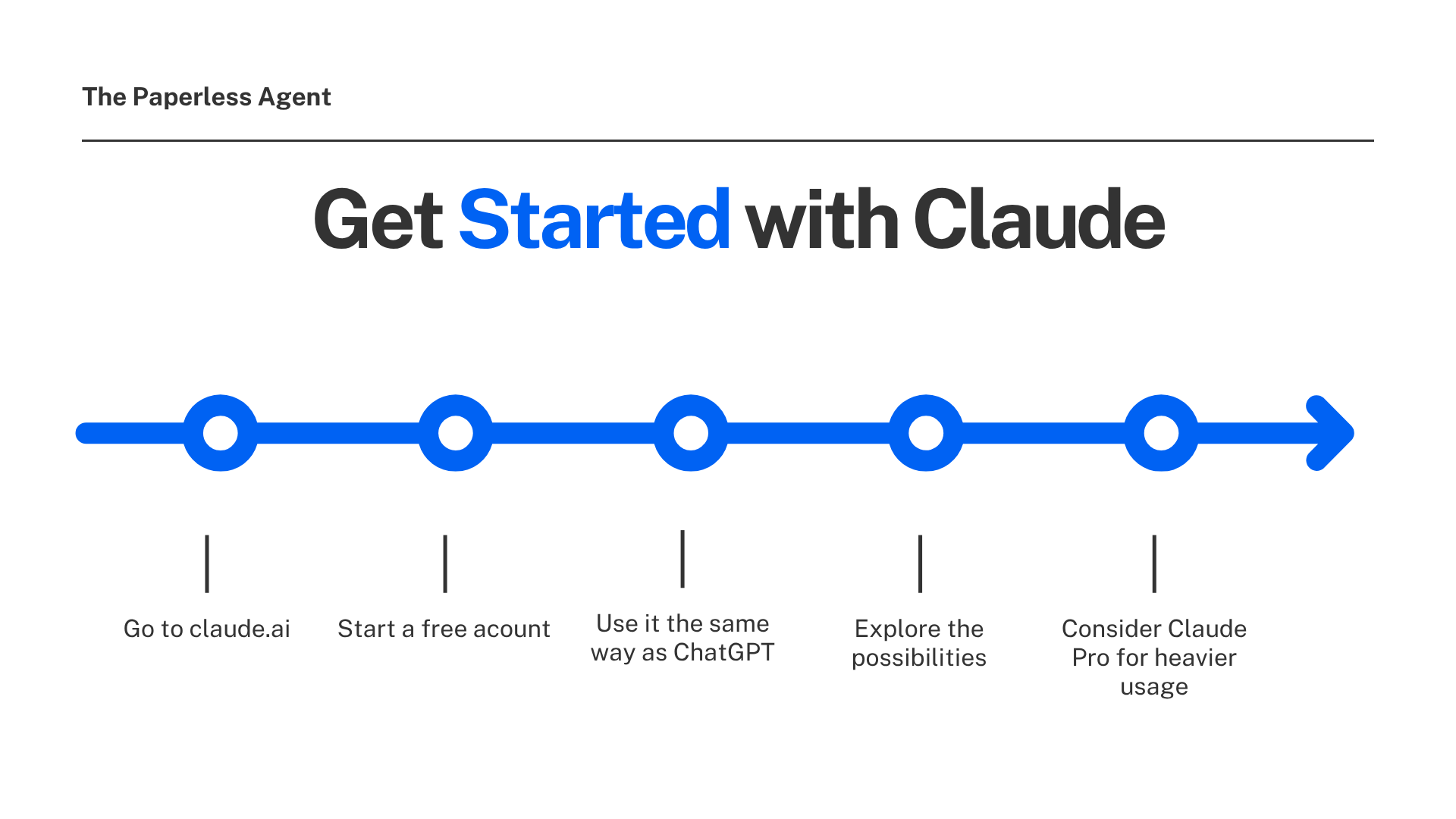
- Go to claude.ai
- Create a free account, takes about two minutes
- Start using it exactly the way you'd use ChatGPT
The free version gives you access to Claude's core capabilities. For heavier usage — more conversations, larger document uploads — Claude Pro is available for $20 per month, the same price as ChatGPT Plus.
The best way to see the difference for yourself is to take a prompt you've already used in ChatGPT and run it in Claude. Side by side. Same instructions. See which output you'd actually send to a client.
When to Still Use ChatGPT
To be clear: this isn't about abandoning ChatGPT entirely. There are things ChatGPT does well that Claude doesn't fully replicate.
ChatGPT has stronger image generation through DALL-E, a more robust plugin ecosystem, and better integration with tools like Microsoft Office. The best AI is the one you're actually using. Start with ChatGPT if you want one versatile tool that handles most tasks reasonably well. Add Claude when you need high-quality writing that sounds like you, especially for client-facing content, newsletters, and social media posts.
Think of it this way: ChatGPT for quick tasks, brainstorming, and image creation. Claude for anything client-facing that needs to sound like a real professional wrote it.
The Bottom Line
Claude won't replace your judgment. It won't replace your relationships. It won't replace the experience you bring to every transaction. Those things are yours, and they're what clients are actually hiring when they hire you.
What Claude can be is a better assistant. One that produces writing you'd actually put your name on the first time, processes the documents you don't have time to read word for word, and follows your instructions exactly the way you gave them.
That's what makes it a more useful, practical tool for real estate than ChatGPT — and why, after extensive testing, it's the tool that keeps winning.
Frequently Asked Questions
Q: Is Claude AI free to use? Yes. The free version of Claude is available at claude.ai and requires only a quick sign-up. Claude Pro, the paid version, is $20 per month — the same price as ChatGPT Plus — and includes higher usage limits and access to more powerful models.
Q: Is Claude actually better than ChatGPT, or is this just personal preference? For the specific things that matter most in real estate — writing quality, document processing, and following multi-step instructions — Claude consistently outperforms ChatGPT in side-by-side testing. That said, ChatGPT has advantages in areas like image generation and plugin integrations. The honest answer is that both tools have strengths, and many professionals use both. For client-facing writing specifically, Claude wins.
Q: What real estate tasks is Claude best suited for? Client emails and communications, listing descriptions, price reduction conversations, market update letters, social media content, document summarization (CMAs, inspection reports, contracts), and any writing where you need the output to sound like you — not like a bot.
Q: Can Claude read and process documents like CMAs and inspection reports? Yes. Claude has one of the largest context windows of any AI tool available — up to 200,000 tokens — which means it can process long, complex documents in a single session without losing information. You can upload a CMA or inspection report and ask Claude to pull out the highlights, flag concerns, or summarize the key points for a client conversation.
Q: Why does ChatGPT feel so generic sometimes? ChatGPT is trained to be broadly helpful across an enormous range of topics and users. That breadth comes at the cost of depth in any single area. It tends to default to safe, recognizable phrasing — which is why you end up with things like "I'm passionate about helping clients achieve their real estate goals." Claude's training produces more nuanced, specific, and human-sounding output, particularly for professional writing.
Q: Do I need to learn a new skill to use Claude? No. If you can use ChatGPT, you can use Claude. The interface is straightforward — a prompt box, an option to attach files, and responses that you can copy, edit, or send. The learning curve is minimal. The quality difference is immediate.
Q: What's the biggest practical advantage of Claude over ChatGPT for daily use? Two things: the writing sounds more human with less editing required, and it reliably follows multi-step instructions the first time. Both of those mean less back-and-forth re-prompting and more outputs you can actually use right away. That time savings compounds significantly over days and weeks of regular use.
Q: Should I switch from ChatGPT to Claude entirely? Not necessarily. A practical approach is to keep both. Use ChatGPT for tasks where its strengths are relevant — image generation, quick lookups, Microsoft Office integrations. Use Claude for client-facing writing, document processing, and any prompt that requires nuance and precision. The agents getting the most out of AI aren't loyal to one tool — they're strategic about which tool fits which job.