

5 Steps to Ace Your Next Listing Appointment
The truth is; the more knowledge you have the more you will differentiate your business, the better care you can give your clients, and the more successful (and respected) your agency will become.
The focus of this article is to help you stand out from the crowd at your next listing appointment with a step-by-step,5-Phase Listing Appointmentsystem that you can implement immediately, and that will sweep your potential clients off their feet (and get them signing on the dotted line before you leave the consultation).
Garry Wise, founder of The Paperless Agent and co-owner GoodLife Realty, and marketing guru Chris Scott sharewhat a listing appointment is(andisn't), the mindset that you need to impress a client, and the five (actually 6) steps you need to differentiate yourself from your competition.
This is part of a three-part series, read more about TheListing Appointment: Marketing Proposalhere,and the third installment,Tools and Resources for the Listing Appointmenthere.
What a Listing Appointment used to be:
A listing appointmentused to bethe opportunity for a real estate agent to beat their own drum, sound their own trumpet, and to tell the seller how great they are.
It was also when a CMA, acompetitive market analysis, was handed over to convince them to price their property atwhat the agent thought was best.
Approaching aListing Appointmentfrom that perspective means that it's all aboutyou, "What's in it for me (as the agent)?"
Everyone does the same thing, and it's tiresome for sellers. Guess what? It's NOT what they want or need to hear.
What's more, when all the agents offer the same presentation, a seller will view all agents the same, and then the biggest negotiating / deciding factorwill be how much you'll come down on your commission.
The seller will hire based on the lowest price.
What a Listing Appointmentisall about:
We've seen what a Listing Appointment isnot;now let's see what itis.
The cold hard truth is that the seller isn't thinking about the agent; they are only concerned about what is in the meeting for them.
"Can this real estate agent get the price I want AND in the timeline I want?"
Instead of thinking and presentingyourself, focus on theoutcomeand the needs of the seller.
How to approach a Listing Appointment
Manysellers are afraidof aListing Appointmentbecause they don't know what to expect from the meeting. Take away that fear by letting the sellerknow what to expectand what they need to do before your face-to-face consultation.
This starts with a phone callbeforeyou meet with the seller (Garry and Chris actually call thisPHASE 0of the5-PhaseListing Appointment Guide;it's the pre-work).
Set up a time with the seller to discuss their expectations; find out who they are, ask about their lifestyle, their expectations, and why are they selling.
In other words, get a clear idea ofwhat motivates that particular seller. Then let the potential client know what to expect form you during the listing appointment (walk them through an outline of the5-PhaseListing Appointmentsystem below).
This conversation is about transparency; let the seller know that if you both feel comfortable with each other, and are on the same page at the end of theListing Appointment, you will be signing a document that allows you to start marketing the property immediately.
You have now set an expectation that lets you address particular challenges (should they arise), before they become a real objection.
For example, if you sense that the seller is hesitating when you mention signing a document at the appointment, find out why. Perhaps there is an additional person (a spouse) that needs to be a part of the meeting. If that's the case, simply ask if there is a better time for the appointment and reschedule; it's important that all the decision makers are present.
By setting expectations and delivering on them, you set a level of trust with the client.
The 5-Phase System for Rocking your Next Listing Appointment
PHASE #1: Ask
PHASE #1starts at the face-to-face meeting with the seller, and it carries on wherePHASE 0left off. On the phone, you started to get to know the seller and understand their motivation. Now verify what you heard and what you believe that you understood.
The number one thing that people want is to be heard. By reviewing your notes from that initial telephone call, you are letting the seller know that theywere heard(and confirming that you heardcorrectly).
That has a powerful psychological effect. It shows that you paid attention to their details, and that you are looking out for their best interests.
Other agents don't do this. Most agents walk in, tour the home, and then sit down and tell the seller how great they are as agents and what the house is worth.
That's a one-way conversation about "I" (the real estate agent),not the seller.
Buyers and sellers are so used to agents not being transparent or taking care of their concerns; we need to put an end to that practice.
Chris is often asked this interesting question during our Paperless Club training:What if you take notes from your initial call and you've written something down that you don't want to the seller to see?
Garry's response?Don't take down that note! This is more than about your client simply seeing a disparaging remark; it's psychological for you too. If your initial phone call doesn't go as well as planned and your notes reflect that, you will not be able to go into that first face-to-face meeting and give 100% of yourself.
After you complete the review, let your seller know that it's time to move ontoPhase #2. And yes,do actually name your phases in front of the client! You already walked your client through the phases on the phone so this is a reaffirmation of the expectations that you have already set.
Let's move untoPHASE #2.
PHASE #2: Inspect the home
This isn't a "normal walk through" or tour. Set the stage and let the seller know that you are doing things differently.
Ask the seller to point outevery feature that they loveand usevoice-to-text to dictate notesontoEvernote(our preferred note taking and organizing app), in front of the seller, and take photos.

The seller will be blown away because you are taking so much time going around the house andaren't rushing through it. The seller sees the level of attention you give them and how you care for their needs.
This is a differentiating factor for you. When you take this level of care you are taking control of the entire appointment. You are becoming the authority in the situation.
Compliment the home and let the seller know you need an appropriate marketing strategy to create awareness of your property.
PHASE #3: The Marketing Proposal
For your actual listing presentation, Garry and Chris recommend using a mobile device, such as iPad, along withTouchCMA (an MLS-connected consulting tool) and Keynote or PowerPoint to display that slides of your presentation. Note: Refer to this presentation as theMarketing Strategyto the seller, which is a term they will recognize.
(For more information about the slides that you should have in you presentation, see this article.
Instead of telling the seller what makes you so great, show themhow you work differently.
For each slide,ask a question. Phrasing comments as questions, and not statements, invokes a different (and positive) response in the seller.
For example:
Garry may say, "Did you know that GoodLife Realty is the only estate agent in the world to be featured by Apple computers as a case study on real estate agents?"

That question will prompt a better reaction than simply singing your praises.
Here are some quick tips on yourMarketing Proposal:
- Usevery little text: use text topromptthe conversation, not toread
- Use beautifulimagesthat attract the attention of the seller.
- Don't give away too much info; it's a visual aid (and it reminds you to hit all the points).
The point is to engage in a marketing discussion and how that will impact the sellers (and most importantly, bring in a ton of qualified buyers). Start by telling the seller that according the National Association of Realtors, more than 95% of home buyers went online to find their new home. Therefore, theMarketing Strategyneeds to be online.
To close outPHASE #3, say "We covered a lot of information about all of the different very unique things we do to expose your home to the greatest number of buyers possible".
"Once we expose your home to all of these potential buyers, let's talk about when what those buyers might be willing to pay for this property".
This is not about whatyouthink the home is worth, it's all about thebuyers.
PHASE #4: Pricing conversation
Instead of talking about whatyouthink the home is worth, steer the conversation towhat a buyer would pay for the propertybased on the most recent statistical evidence out there(yes, you are shifting the responsibility for the housing price onto a third party and away from you).
This is important, because as you know, if you quote a price that is below what the seller had in mind; you become the bad guy.
The sellerthinksyou don't value the home.
The sellerbelievesyou don't see the home's potential.
And you lose the listing.
Don't ask what they think (it will always be too low).
Instead focus on what the market (thebuyers) will pay for the home based on what they are paying for similar homes in the neighborhood. Now you become partners with the seller (notthe bad guy), and that paves the way for a different type of conversation.
To prompt this discussion, lead in with, "I have done hours of preparation work, reviewing statistics reviewing what buyers have paid for similar homes in this area, and I've previewed listings in the area to see what buyers are willing to pay and have seen what our competition is going to be. I have this on spread sheets, including photos of the homes and the statistical data which I can show you; or I can simply tell you the buyers are willing to pay."
"What a buyer is willing to pay and the market will accept is (insert the amount here)."
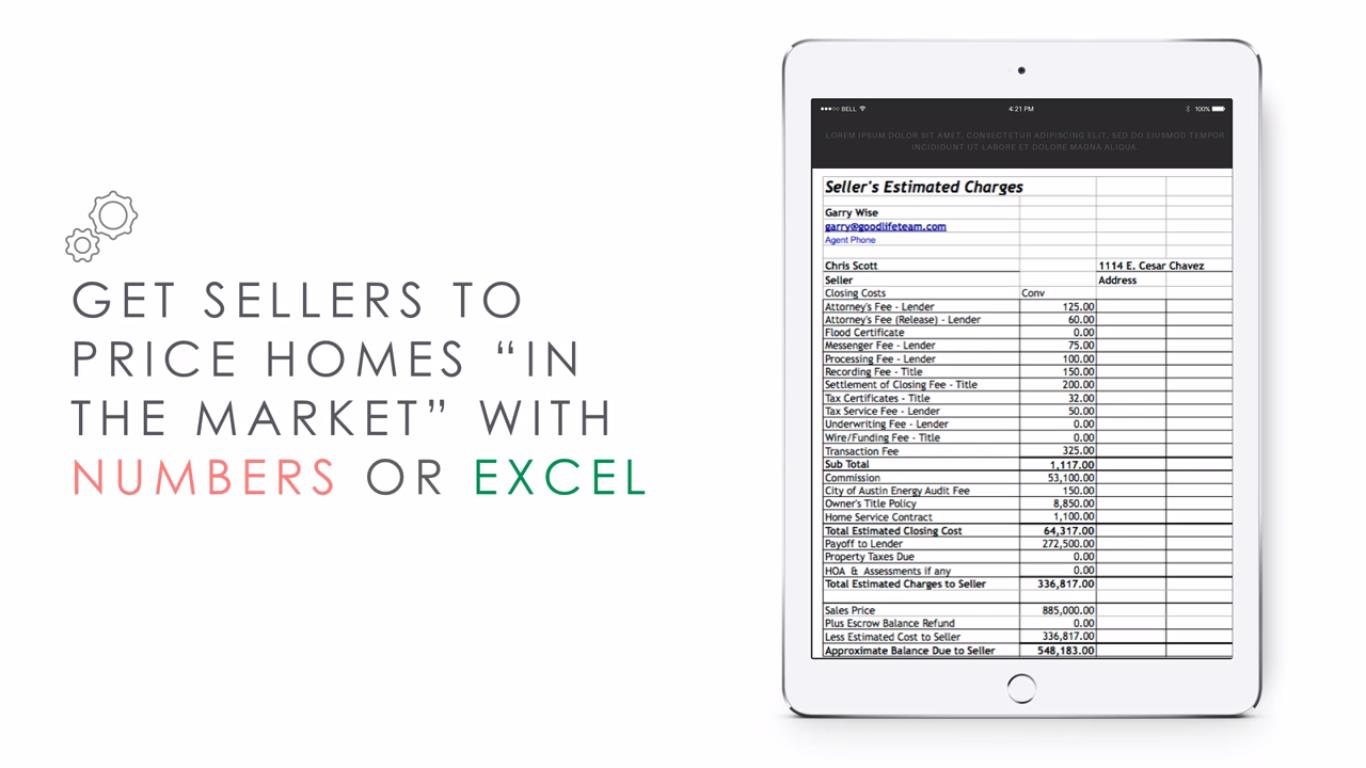
Butthe amount isn't actually what is most important to the seller; what they really need to know is theamount they will be putting in their pocketat the end of the day.
Garry provides aNet Sheet(useNumbersorExcel) that breaks down fees and shows what the seller will receive at the end of the transaction.
Ask if there are any questions but, again,notwhat they think!
If there are objections,empathizewith the seller (weallwant more money for our homes, so no judgement here); this is the time to go back into the statistical data you collated and show why the market will bear a particular amount and what is happening with the competition (other homes on the market in the area).
PHASE #5: Agree & Sign
This is where we review the conversation that has taken place during the meeting, and you go ahead and say, you think you are a great fit, don't you agree? Once the seller agrees, sign the listing agreement document which will legally allow you to start marketing their property.
This simple5-Phase Listing Appointmentsystem will help you to rock your next Listing Appointment and wow your clients and differentiate you from the competition.