

Last month, Jodi, a real estate agent in our network, reached out with something that surprised me.
"I had 4 listing leads in the past month and every one of them said they found me on ChatGPT… but I am not sure how that happened… hoping you can shed some light on it."
Four leads. One month. All from ChatGPT. And she had no idea why.
That's the opportunity hiding inside one of the biggest shifts happening in marketing right now — and most business owners are completely unaware it exists.
The Way People Find Businesses Has Changed
Not long ago, someone looking for a real estate agent, a contractor, or a financial advisor would type a query into Google, scan ten blue links, and click through to a few websites.
Google itself is changing that model. AI Overviews, the AI-generated summaries that now appear at the top of Google search results, show up in roughly 50% of all searches and are used by more than 2 billion people monthly. A year ago that number was closer to 13%. The shift is happening fast.
The consequence: 58% of Google searches now end without a click. People read the AI summary, get their answer, and move on without ever visiting a website. For local searches the rate is lower for now, but the trajectory is clear.
And Google isn't the only platform driving this. A growing number of buyers and sellers open ChatGPT, Perplexity, or Google's AI Overview and simply ask: "Who is the best real estate agent in Austin?" or "Can you recommend a listing agent in Circle C Ranch?"
The AI answers directly. It names names, describes credentials, and makes recommendations all before the person ever visits a website.
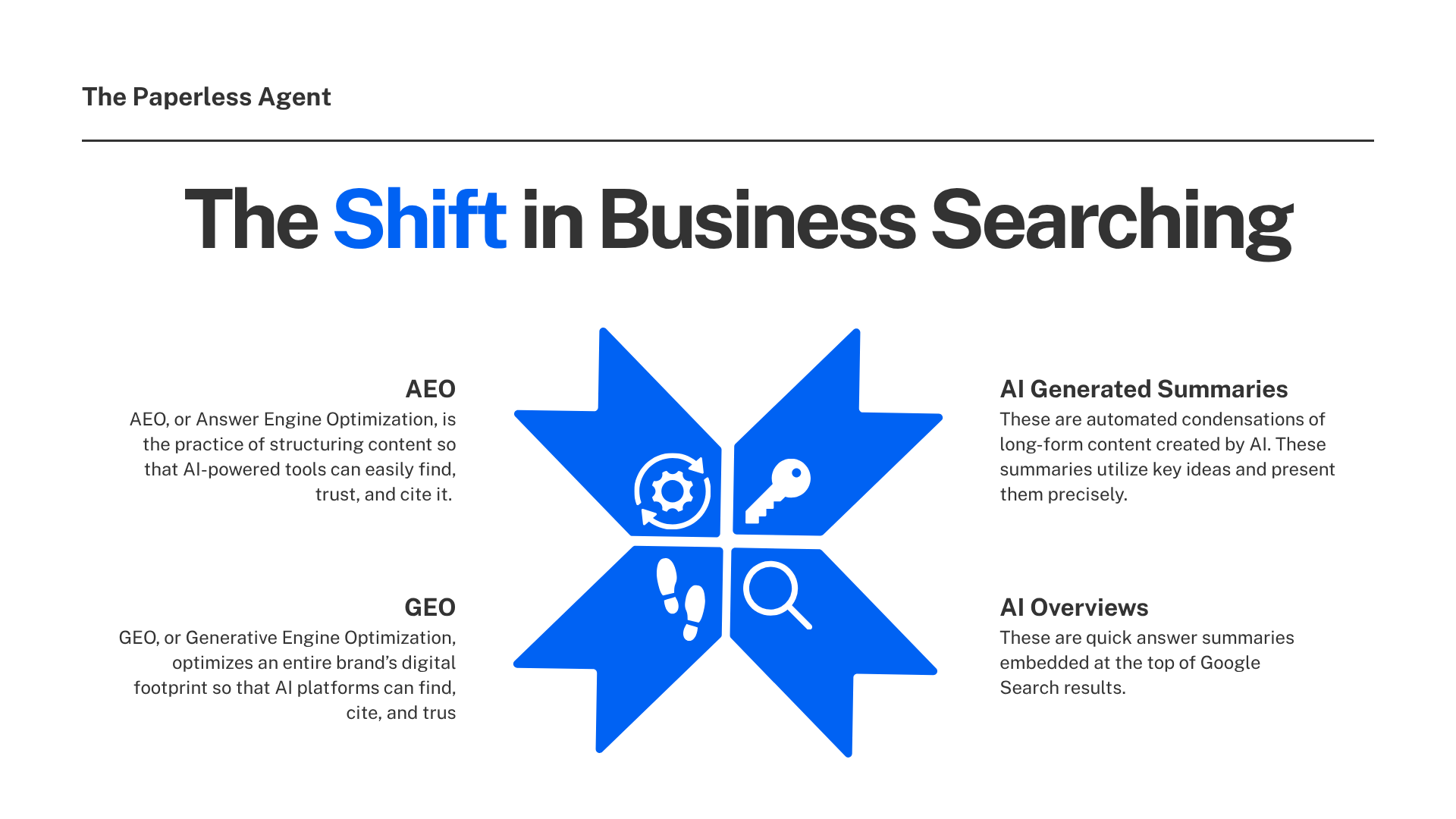
This shift has a name. Marketers call it AEO (Answer Engine Optimization) or GEO (Generative Engine Optimization). The core idea: AI systems are now answer engines, not just search engines. They don't show you a list of options. They give you a recommendation.
For businesses that show up well, it's a pipeline of high-intent leads who arrive already educated, already trusting, and ready to act, which is exactly what Jodi experienced.
For businesses that don't show up (or worse, show up with wrong information), it's a problem most of them don't even know they have.
What Happens When You Run the Audit
I've been running AI visibility audits on real estate agents using SEMrush's AI visibility tool. The findings are consistent enough that a pattern has emerged.
Almost everyone starts with a low score. That's expected, considering this is a new discipline and the playing field is still wide open. The agents who pay attention now will build an advantage that compounds over the next 12 to 24 months.
But the score isn't always the most important finding.
"ChatGPT Says I Haven't Sold Anything Recently"
Jena is a real estate sales associate working in the Austin market. Her AI visibility score came back at 23 out of 100.
She was showing up in some searches — her name, her firm, and hyper-local questions like "is Circle C Ranch a good place to live?" — the kinds of queries where someone already knows who she is.
Where it got interesting was what ChatGPT was really saying about her when she did show up.
When I showed her the results, she responded with this:
"ChatGPT says I haven't sold anything recently. It was so wrong and I don't know how to correct that info. I actually sold 10 homes in the past 8 months."
— Jena, Real Estate Sales Associate, Austin TX
Ten homes in eight months. ChatGPT called her inactive.
A potential seller researching agents in her market would walk away with that impression before visiting her website, reading a single review, or picking up the phone.
This is the part that catches most business owners off guard. AI is already talking about them, and sometimes getting it badly wrong.
The Technical Side: Small Errors With Big Consequences
Not every AI visibility problem involves inaccurate data. Some of the most common issues come down to basic setup.
Joseph L. is another agent I audited. His numbers looked reasonable, but he was largely invisible to AI systems for searches in his market. The reason turned out to be something simple.
His Google Business Profile listed his brokerage name inside his business name field. This is a common setup that creates a Name, Address, and Phone (NAP) inconsistency across the web.
Everywhere else online, it was just his name. AI systems interpreted these as two different businesses and stopped surfacing his profile even though it was there and fully filled out.
One field. Significant impact.
NAP consistency matters for all search — Google, Bing, and AI alike. It's been a foundational principle of local SEO for years. For AI visibility specifically, business listings account for 42% of AI citations.
If your listing information doesn't match exactly across every directory, profile, and platform, AI systems discount it entirely. A dash in your phone number on one platform and not another is enough to cause a mismatch.
This is the kind of issue that takes less than ten minutes to fix once you know it's there.
What AI Looks For When It Makes Recommendations
Understanding why Jodi showed up for ChatGPT while Jena's data was wrong and Jean-Luc was invisible comes down to how AI systems decide who to trust.
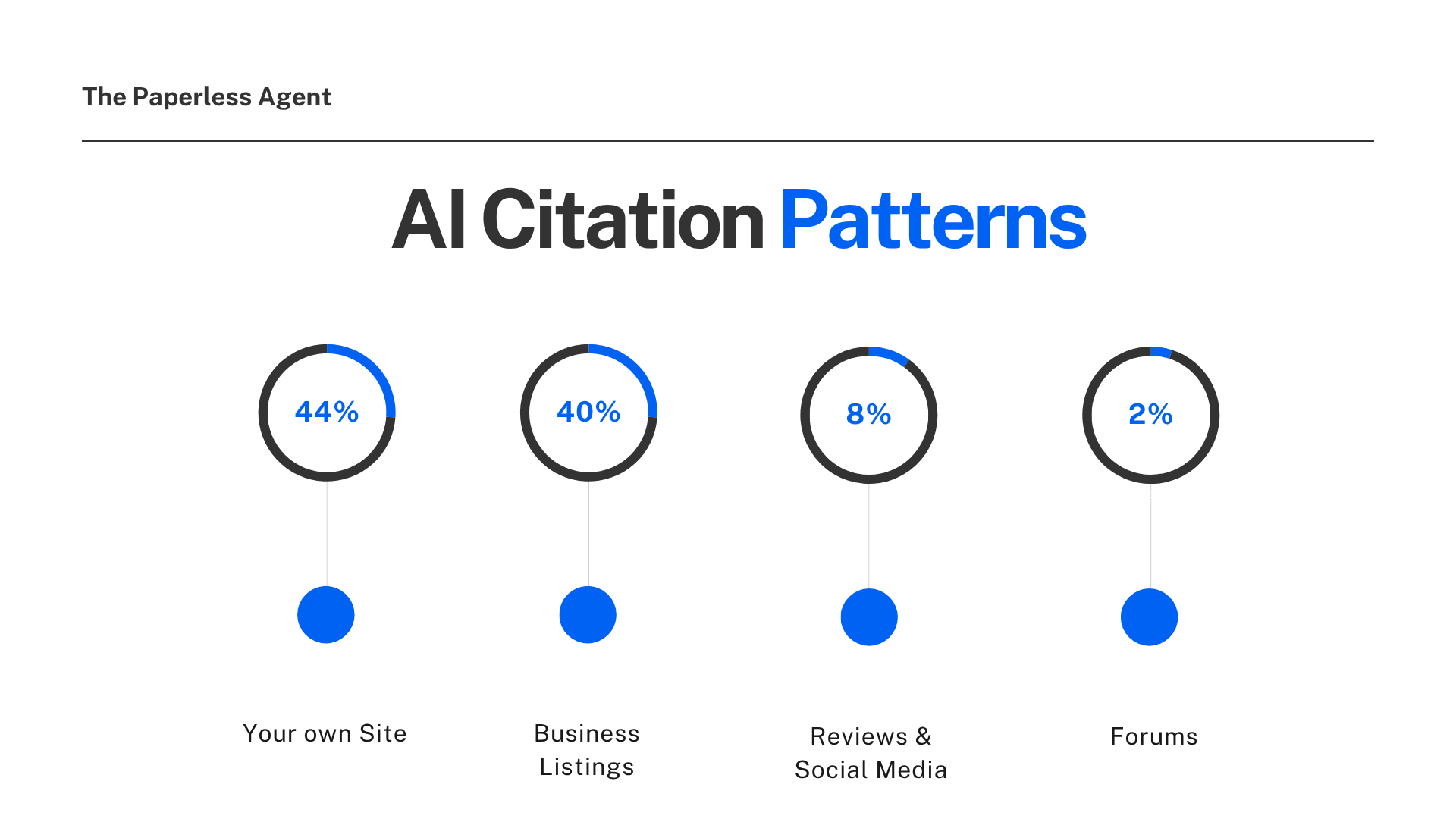
Research into AI citation patterns shows where recommendations come from:
- 44% come from your own website
- 42% come from business listings such as Google Business Profile, Facebook Business Page, LinkedIn, and similar platforms
- 8% come from reviews and social media
- 2% come from forums and community groups
That means 86% of AI citations trace back to just two things: your website and your business listings. You have meaningful control over both.
The catch is that AI doesn't take your word for it. It cross-references your information across all of these sources simultaneously. Consistency is what builds confidence. When multiple independent sources agree on who you are, what you do, and where you operate, AI systems start recommending you. When they conflict, AI pulls back.
A few specific factors that move the needle:
NAP consistency. Your name, address, and phone number need to be identical across every directory, profile, and listing online.
Content that answers real questions. AI systems are trained to answer questions. Content structured around the specific questions buyers, sellers, and clients ask signals expertise and earns citations.
Reviews aggregated on your website. Most agents think of reviews as something that lives on Google or Zillow. For AI visibility, reviews on your own website matter just as much, because AI reads your site directly and 44% of its citations come from there. Aggregate all your reviews in one place on your site. AI tends to cite the source that has the most complete information, and your website can be that source.
Schema markup (JSON-LD). This one I'll be straight about. It's technical enough that I have our engineering team handle it for our own website. But it matters. Schema markup is essentially a hidden label on every page of your site that tells AI systems exactly what the content is: who you are, what you do, your service area, your credentials. Without it, AI has to guess. With it, there's no ambiguity.
An llms.txt file and sitemap. Two more technical items worth asking your website provider about. The llms.txt file tells AI systems how to read your site. The sitemap tells them what's on it and when it was last updated. AI favors fresh content, and the sitemap is how it knows what's current.
How Long Does It Take?
Changes to your website and business listings don't show up in AI results immediately. Based on what I've observed, and what others studying this space have found, meaningful changes take roughly three to four weeks to be reflected in AI search results.
That timeline matters for two reasons. First, set realistic expectations. Second, start now. The agents making changes today are the ones who will see results next month while their competitors are still wondering whether any of this is real.
The Window That's Open Right Now
Jodi's four ChatGPT leads aren't an accident. Something in her digital footprint, such as her content, her consistency across platforms, or her reviews, gave AI systems enough confidence to recommend her. She didn't set out to optimize for AI search. She just happened to be doing the right things.
Most of her competitors haven't looked at this yet.
That's the window. The agents and business owners who audit their AI presence, fix what's wrong, and build the right signals now will own this channel before their competition realizes it exists.
.png)
What You Can Do Right Now
Start by finding out where you stand.
Open ChatGPT or Perplexity and search for your name. Then search for your business category in your market — "best real estate agent in [your city]" or "who should I use to sell my home in [your neighborhood]." See what comes up, what it says, and whether the information about you is accurate.
What you find might surprise you.
If you want a full picture with your AI visibility score, what AI systems are saying about you, and the specific issues holding you back, I run audits and can walk you through exactly what I find.
Drop a comment, send a DM, or visit thepaperlessagent.com to subscribe to Agent Machine — our newsletter covering AI strategies that are working right now for real estate agents and small business owners.
Chris Scott is Co-Founder of The Paperless Agent, a platform helping real estate professionals and small business owners navigate AI tools, marketing systems, and the changing landscape of digital visibility.