

Here is a number that should stop every real estate agent in their tracks:
ChatGPT currently recommends just 1.2% of all local business locations, according to research from SOCi's 2026 Local Visibility Index, which analyzed over 350,000 business locations across 2,751 brands.
That means 98.8% of local businesses, including the vast majority of real estate agents, are completely invisible when a potential client asks ChatGPT who they should hire.
And here is what makes that number even more significant: 45% of consumers now use AI tools to find local services, up from just 6% one year ago. The audience using AI to find real estate agents is not coming in the future. It is here right now and growing fast.
The difference between agents who show up in those recommendations and agents who do not often comes down to one thing: business listings. Which ones you have, how complete they are, and whether the information in them is consistent across the board.
This post covers the five business listings that matter most for ChatGPT visibility, why each one carries the weight it does, and the one mistake that quietly cancels out all of your work.
Why Business Listings Are the Foundation of AI Search Visibility
Before getting into the specific platforms, it is worth understanding why business listings matter so much for AI recommendations in the first place.
When someone asks ChatGPT who they should hire to sell their home in your market, ChatGPT does not pull from a single database. It pulls from multiple sources simultaneously: your website, business listing platforms, social media, reviews, and directories. Each of these sources contributes to the picture the AI assembles about who you are and whether you should be recommended.
A recent study on AI citation behavior found that business listings are one of the four primary sources AI tools use when forming local recommendations. Local citations are important information sources for large language models, and if your business does not refresh and rebuild its listings for this new AI-driven world, it is definitely going to miss out.
The good news for real estate agents is that business listings also do double duty. Optimizing your website, directories, and local citations benefits both Google rankings and ChatGPT recommendations. Local search is evolving quickly, but the fundamentals of local SEO still apply. Having accurate listings, building citations, earning media mentions, and maintaining an updated website all feed into ChatGPT's local knowledge base.
One investment. Two search channels. That is the case for making business listings a priority.
Listing 1: Google Business Profile — The Non-Negotiable Starting Point
If you only claim and optimize one business listing, it needs to be your Google Business Profile. There is no close second.
Your Google Business Profile controls how you show up in Google Search, Google Maps, and Google's AI Overviews that appear at the top of search results. For real estate agents, local search visibility is everything. When a potential seller in your market searches for a real estate agent, your Google Business Profile is one of the primary signals Google uses to decide whether your name appears.
AI tools like ChatGPT will usually crawl relevant reviews on Google Business Profile, Yelp, and industry-specific review platforms. If multiple reviews say "great real estate agent in [city]", AI starts associating a business with those services and locations.
That means your Google Business Profile is not just helping you show up in Google. It is actively feeding the information that ChatGPT and Gemini use when forming recommendations about real estate agents in your area.
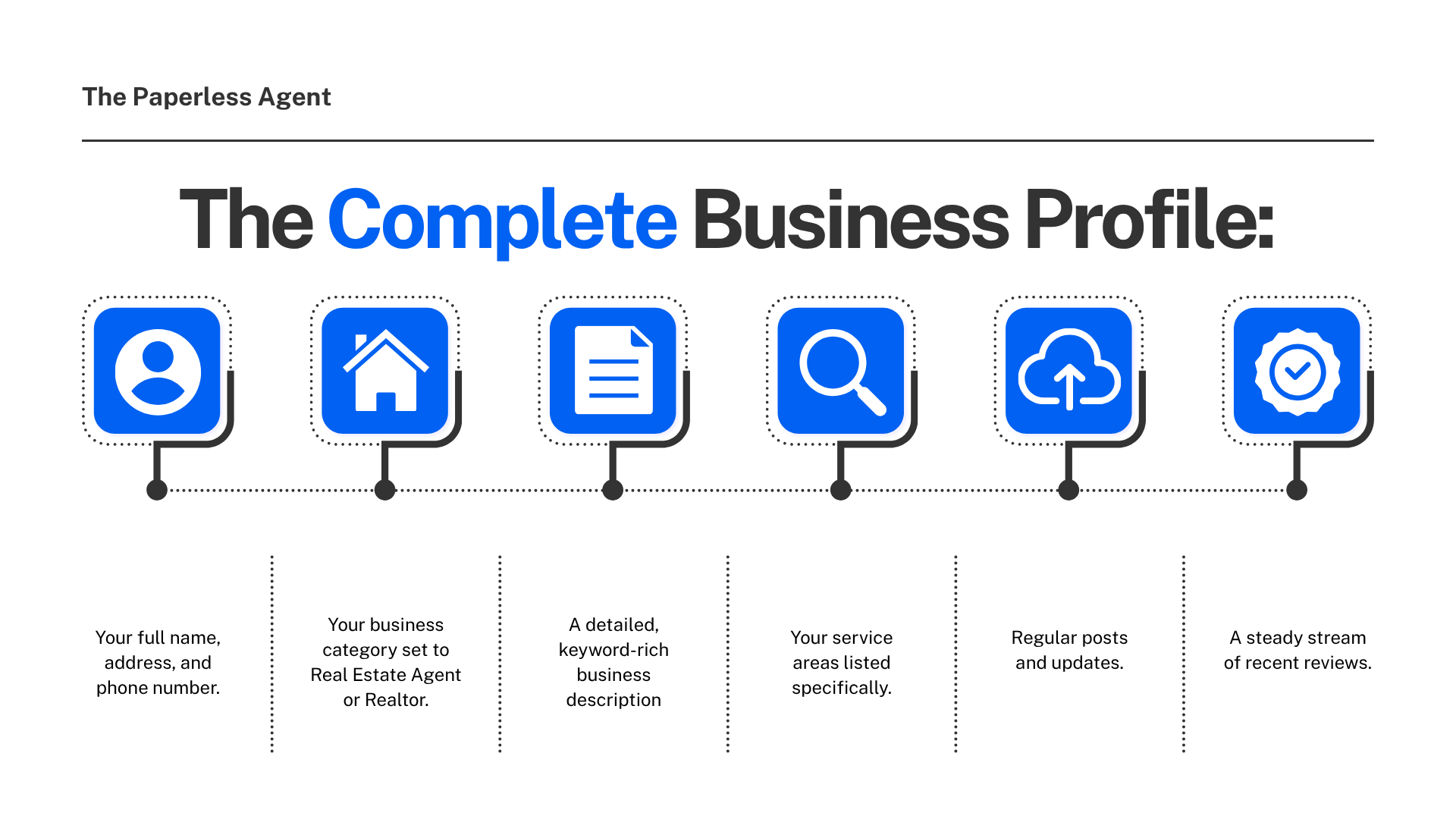
What a complete Google Business Profile includes:
- Your full name, address, and phone number
- Your business category set to Real Estate Agent or Realtor
- A detailed, keyword-rich business description
- Your service areas listed specifically
- Regular posts and updates
- A steady stream of recent reviews
A local business is more likely to show up as recommended by AI if it has a high rating with consistent positive reviews. That means collecting reviews on your Google Business Profile is not just good for social proof. It is directly feeding your AI recommendation potential.
Listing 2: Apple Business Connect — The 1.6 Billion User Opportunity Most Agents Miss
Apple Business Connect controls how your business appears to every iPhone and iPad user using Apple Maps, Siri, and Apple's growing ecosystem of location-based services.
With 1.5 to 1.6 billion active iPhone users worldwide, this is not a niche platform. It is a massive, largely untapped opportunity for real estate agents because most simply have not claimed it.
The agents in your market who have claimed and optimized their Apple Business Connect listing are showing up in a channel their competition has ignored. The ones who have not claimed it are invisible to every Apple Maps search that happens in their market.
Apple Business Connect is free to claim and set up. The profile includes your business name, address, phone number, website, hours, and photos. Getting it set up correctly takes about 20 minutes and the payoff compounds every time an iPhone user asks Siri or Apple Maps for a real estate agent in your area.
Listing 3: Bing Places for Business — The Direct Pipeline Into ChatGPT
This one surprises most agents. Bing? Really?
Yes. And here is exactly why it matters more for ChatGPT visibility than almost anything else on this list.
Bing Places doesn't dictate ranking order in ChatGPT answers, but it is a direct pipeline into ChatGPT's local data. If you haven't claimed or optimized your Bing Places profile, now is the time to do it.
Microsoft made a significant investment in OpenAI, and Bing is baked into how ChatGPT searches for and surfaces local business information. When someone asks ChatGPT who the best real estate agents are in your city, ChatGPT is using Bing's local data infrastructure to find and evaluate local businesses.
That makes your Bing Places listing a direct line into ChatGPT recommendations, it’s more direct than almost any other single action you can take.
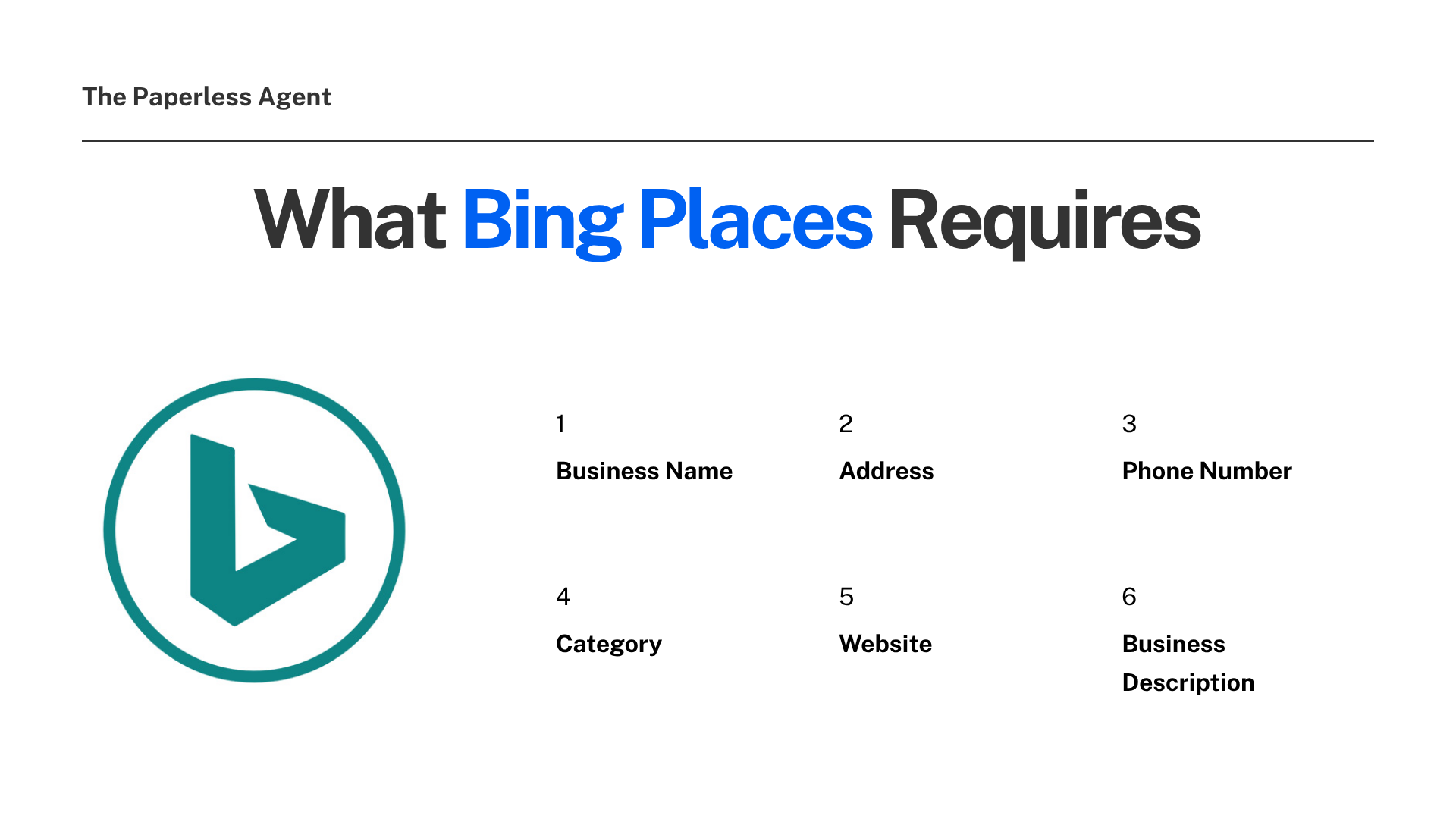
Like Google Business Profile, Bing Places is free to claim. It requires your business name, address, phone number, category, website, and a business description. Setting it up correctly takes about 15 minutes and represents one of the highest-return visibility investments available to real estate agents right now.
Listing 4: Facebook Business Page — More Than Social Media
Most real estate agents think of Facebook as a social media platform, not a business directory. That distinction matters less and less as AI tools increasingly index social platforms as business data sources.
Facebook business pages have really high visibility, not just to all Facebook users, but also when doing search. Facebook business pages and Instagram accounts now increasingly show up in search results and are also being referenced and indexed by AI chatbots and crawlers.
A complete, active Facebook Business Page does three things simultaneously: it gives your social media presence a professional foundation, it appears in Google search results for your name, and it feeds AI tools that are crawling social platforms for local business data.
The key is that your Facebook Business Page needs to function as a business listing, not just a social account. That means your business name, address, phone number, website, and category all need to be filled out completely and accurately. The content you post from your business page also contributes to your overall visibility footprint in ways that go beyond reach and engagement.
Listing 5: LinkedIn — The Professional Directory AI Trusts Most
LinkedIn may be the most underestimated business listing in real estate. If you have not updated your LinkedIn profile in a year or more, you are not alone. Most real estate professionals treat LinkedIn as a secondary platform at best.
Here is why that is worth reconsidering.
Search your own name right now. Your LinkedIn profile will almost certainly appear in the top five Google results. That is not a coincidence. LinkedIn carries exceptional domain authority for professional name searches, and that authority directly influences both Google's impression of you and AI tools' confidence in recommending you.
LinkedIn is being used as a business listing or professional directory by both Google and AI. Updating that LinkedIn profile and making it available online for ChatGPT and Google to find is important for visibility.
Think about LinkedIn the way a seller thinks about hiring you. When they look you up (and they will) LinkedIn is often one of the first things they see. A complete, current, professional LinkedIn profile signals credibility before the conversation even begins.
For AI visibility specifically, LinkedIn provides structured professional data: your name, your title, your location, your experience, your specializations, and your endorsements. All of it is indexed by AI tools and contributes to how confidently they recommend you.
.png)
Bonus: YouTube — The Rising Citation Source
YouTube is not technically a business listing or professional directory. But it belongs in this conversation because it is increasingly being used by both Google and AI tools as a cited source of information.
YouTube mentions and branded web mentions are among the top factors that correlate with AI brand visibility in ChatGPT, AI Mode, and Google AI Overviews.
For real estate agents, this means creating even occasional video content such as market updates, neighborhood tours, buyer and seller tips builds a citation footprint that AI tools reference when forming recommendations. A YouTube channel with consistent, local, informative content positions you as an authoritative voice in your market in a way that feeds both traditional search and AI search simultaneously.
If you are not creating video content yet, YouTube is worth adding to your strategy. Even a handful of well-titled, locally-focused videos can meaningfully expand your AI citation footprint.
The NAP Rule: The One Mistake That Cancels All of This Out
You can claim every listing on this list and still be invisible in AI search if you make this one mistake.
NAP stands for Name, Address, and Phone number. And the rule is simple: your NAP must be an exact match across every single business listing you have.
Not similar. Not close. Exact.
Here is what exact means in practice:
Name: If your name is Chris Scott on some listings and Christopher Scott on others, those are two different entities to AI. If you have a professional designation on some profiles and not others, that is an inconsistency. Pick one version and use it everywhere.
Address: If your suite number appears as "Suite 200" on some listings and "#200" on others, that is not a match. If there is a comma after the street address on some listings and not others, that is not a match. The format must be identical down to punctuation.
Phone number: If you use dashes in some listings and not others, that is not a match. If you include the area code in parentheses in some listings and without them in others, that is not a match.
Local search is about being selected by AI as the primary provider for local services. As users turn more toward AI to make decisions, being visible in AI tools is essential. NAP inconsistency is the single most common reason agents with otherwise strong digital presences still do not show up in AI recommendations.
Before claiming new listings, audit the ones you already have. Open each platform and check that your name, address, and phone number are formatted exactly the same. Fix any inconsistencies before adding new listings.

Your Action Plan: Where to Start
Here is a practical sequence for getting your business listings in order without feeling overwhelmed:
Week 1: Claim and complete your Google Business Profile and Bing Places for Business. These two have the most direct impact on AI visibility and local search simultaneously.
Week 2: Set up or update your Apple Business Connect listing and audit your Facebook Business Page for completeness.
Week 3: Update your LinkedIn profile with your current markets, specializations, and experience. Make sure it reads like a professional profile, not an afterthought.
Ongoing: Collect reviews consistently after every transaction and distribute them across Google, Zillow, and Realtor.com. Review volume and recency are factors that AI tools weigh when assessing recommendation confidence.
GEO emphasizes citation diversity and source credibility. Most real estate operators need all three approaches: traditional SEO, AEO, and GEO working together. Getting your five core business listings right is the foundation all three are built on.
Frequently Asked Questions
Q: Why do business listings matter for ChatGPT recommendations specifically? ChatGPT draws from multiple sources when forming local recommendations, and business listings are one of the primary citation sources. Research shows that business listing data contributes significantly to AI recommendations. Each listing you claim and optimize becomes a data point that AI tools use to verify your existence, your location, and your professional legitimacy.
Q: Does Bing really matter for ChatGPT visibility? Yes — more than most agents realize. Microsoft made a significant investment in OpenAI and Bing is the primary search engine ChatGPT uses to find local business information. Claiming and optimizing your Bing Places for Business listing is one of the most direct actions you can take to improve your ChatGPT recommendation visibility.
Q: What is NAP consistency and why is it so important? NAP stands for Name, Address, and Phone number. When your NAP is inconsistent across business listings — different name formats, different address punctuation, different phone number formatting — AI tools and Google cannot confirm that all of those listings represent the same business entity. Inconsistent NAP fragments your authority and reduces AI recommendation confidence. The fix is simple: audit every listing you have and make your NAP an exact match across all of them.
Q: How many reviews do I need before AI tools start recommending me? There is no fixed threshold, but research consistently shows that review volume and recency both matter. More recent reviews carry more weight than older ones. A practical approach is to ask every satisfied client to leave a review immediately after closing, send them a direct link to the platform where you need reviews most, and distribute reviews across your website, Google, and the major home search platforms rather than concentrating them in one place.
Q: Does LinkedIn really help with AI search visibility for real estate agents? Yes. LinkedIn carries exceptional domain authority for professional name searches and consistently appears in the top five Google results for most name queries. AI tools treat LinkedIn as a trusted professional directory and use it as a source when forming recommendations. A complete, current LinkedIn profile contributes meaningfully to both your Google visibility and your AI recommendation potential.
Q: Are these listings free to claim? Yes. Google Business Profile, Apple Business Connect, Bing Places for Business, Facebook Business Pages, and LinkedIn profiles are all free to claim and maintain. The investment is time, not money.