

Google just published its official guidance on AI search and AI visibility. Not a rumor. Not a speculation piece from an SEO blog. Official documentation from Google Search Central, laying out exactly what they recommend for showing up in AI Overviews, Gemini, and AI-powered search results.
The good news: the guidance is practical, it applies across all AI tools (not just Google's) and one of the three keys is something real estate professionals have that the major portals and national brands simply cannot replicate.
Here is what it says and what it means for your business.
Why Google AI Overviews Matter More Than Most Agents Realize
Before getting into the three keys, it is worth understanding the scale of what has changed.
AI Overviews and Featured Snippets together now take up 75.7% of screen space on mobile and 67.1% on desktops. This means even top-ranking pages can be pushed below the fold, dramatically reducing their visibility.
Based on over eight billion impressions across key industries, 2025 data shows that AI Overviews reduce click-through rates on both organic and paid listings while reshaping user intent entirely.
What this means practically: when a buyer or seller searches Google right now, they are likely seeing an AI-generated summary before they ever see a list of websites to click on. The AI answers their question directly. Some searches never result in a click at all.
For real estate agents, this creates an urgent question: when someone in your market asks Google "who should I hire to sell my home?", does your name show up in that AI summary, or does someone else's?
Google's new guidance gives a clear answer to how you get there. It has three parts.
Key 1: Create Content Only You Could Create
Google calls this non-commodity content, and they were explicit about what it means. They even used a real estate example in the guidance itself.
Generic content includes things like "seven tips for first-time home buyers." That content already exists on the internet tens of thousands of times. AI does not need you for that. It can pull that answer from anywhere.
Google's example of great content was: "Why we waived the inspection and saved money."
That is a real experience. AI cannot invent it. A real estate portal cannot produce it. Nobody else can write that story except the agent who lived it.
Google confirms that content must be original, useful, and written for people, not just algorithms. The SEO world is moving away from keyword obsession and toward real-world context and experience.
This is your unfair advantage as a local real estate professional. You know these neighborhoods. You walk these streets. You know why one home sells in three days and why another sits for three months. You have been in rooms where deals almost fell apart. You have navigated inspections, appraisals, competing offers, difficult sellers, and nervous buyers. None of that exists in any database. None of it can be generated by AI.
What this looks like in practice:
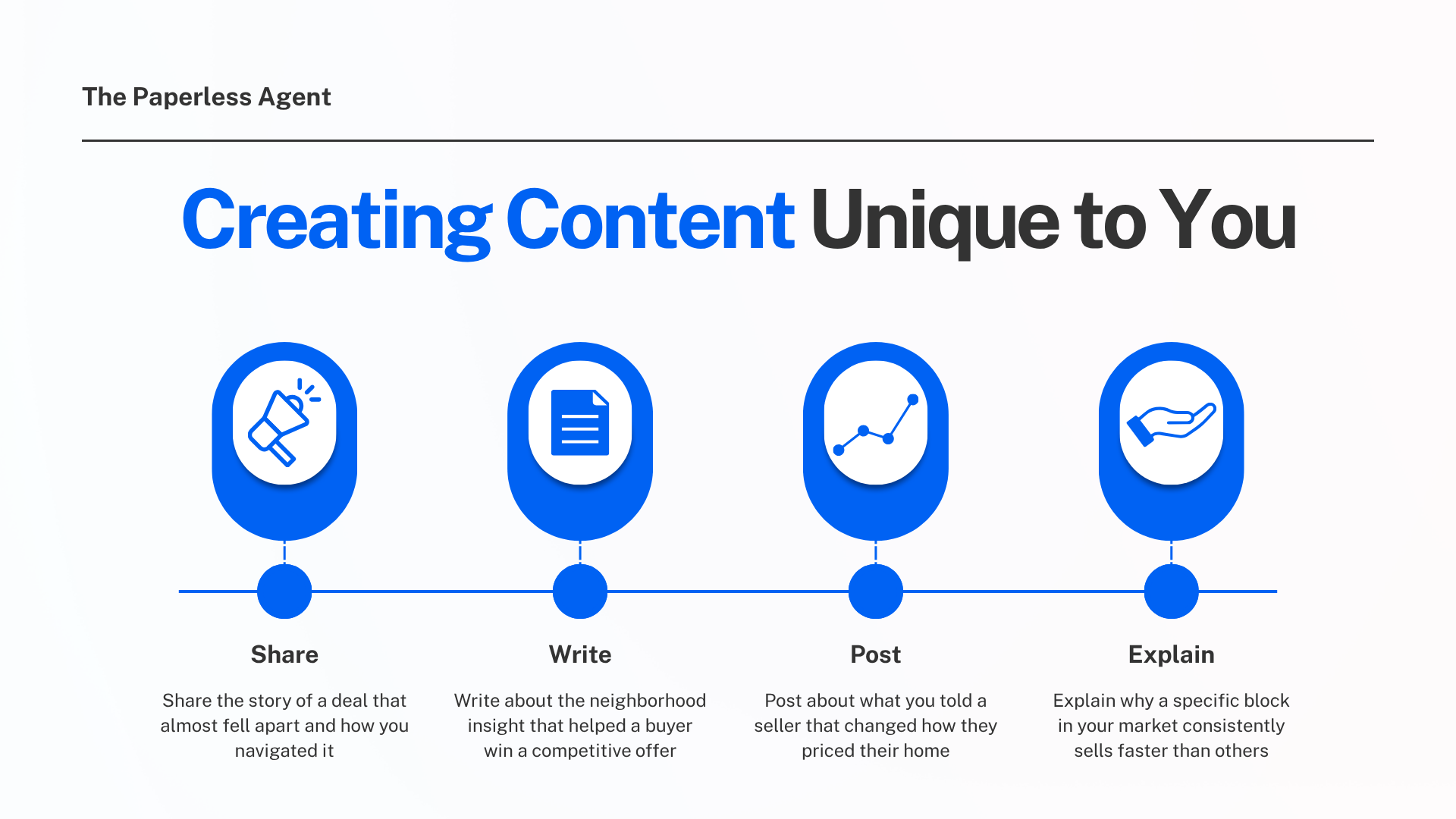
Share the story of a deal that almost fell apart and how you navigated it. Write about the neighborhood insight that helped a buyer win a competitive offer. Post about what you told a seller that changed how they priced their home. Explain why a specific block in your market consistently sells faster than others.
These are not marketing pieces. They are expertise documented in a format AI can find, cite, and recommend.
Specific content beats generic content every time because it is genuinely more useful to the person asking the question.
Using AI to Create This Content
You can absolutely use AI tools to help write and organize your content. Google confirms that AI-generated content is allowed, but human oversight and authenticity are required.
The rule of thumb from the video is worth repeating: AI can assist your expertise, but it cannot replace it.
Use AI to brainstorm topics, organize your thoughts, tighten a rough draft, or fix your grammar. One particularly effective technique: use the voice dictation feature in an AI tool and have it ask you questions about a specific topic. Answer out loud, stream-of-consciousness. The AI extracts your expertise, your opinions, and your real-world experience, and then turns that into finished content. Your knowledge goes in. Polished content comes out.
The filter to run every piece of content through: Did my expertise go into this? Did I review it? Can I put my name on it?
If the answer to all three is yes, the content qualifies.
Key 2: Make It Obvious a Real Trusted Person Created the Content
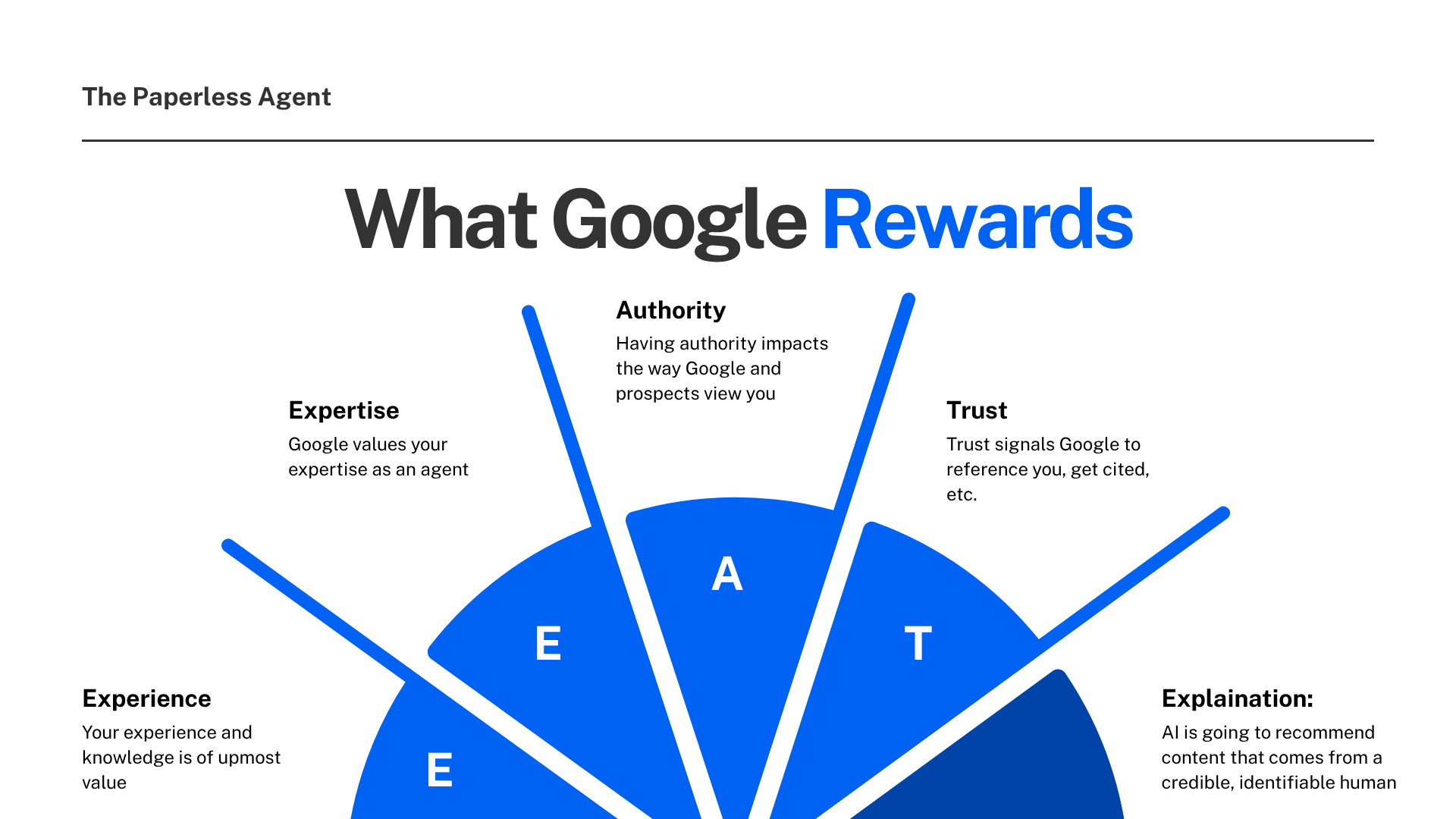
Google rewards what it calls EEAT — Experience, Expertise, Authority, and Trust. Trust signals like author bios, citations, and structured data help content get cited in AI Overviews. Schema markup for authors, organizations, and FAQs improves visibility in AI results.
In plain terms: AI is going to recommend content that comes from a credible, identifiable human, not anonymous filler.
This plays directly into how real estate works. Buyers and sellers want to know and trust an agent before they hire one. The content on your website is often the first place that trust gets built or lost.
What to put on your content:
Every blog post, every neighborhood guide, every market update should have your name on it. Your photo. A bio that includes how long you have been selling in the area, your credentials, your track record, and your specializations. Google says to add author information any time a reader might ask themselves "who wrote this?". And in real estate, that is essentially every time.
Sites that serve as trusted sources in AI Overviews can capture attention even if their pages are not at the very top of classic search results. Being cited in AI-generated summaries is now a visibility pathway independent of traditional ranking positions.
The EEAT framework gives real estate professionals a structural advantage. When a national portal publishes a market update, it comes from an editorial team no one knows. When you publish a market update, it comes from a named professional with a photo, a bio, a track record, and a specific geographic expertise. That is exactly what Google is looking for.
Google also offers a simple gut check for any piece of content: Who made this? How was it made? Why does it exist?
If the answer is that a real local professional made it to genuinely help people in their market, that is where you want to be.
Key 3: Be Findable
The third key is less glamorous than the first two, but it is essential for showing up in local AI answers specifically.
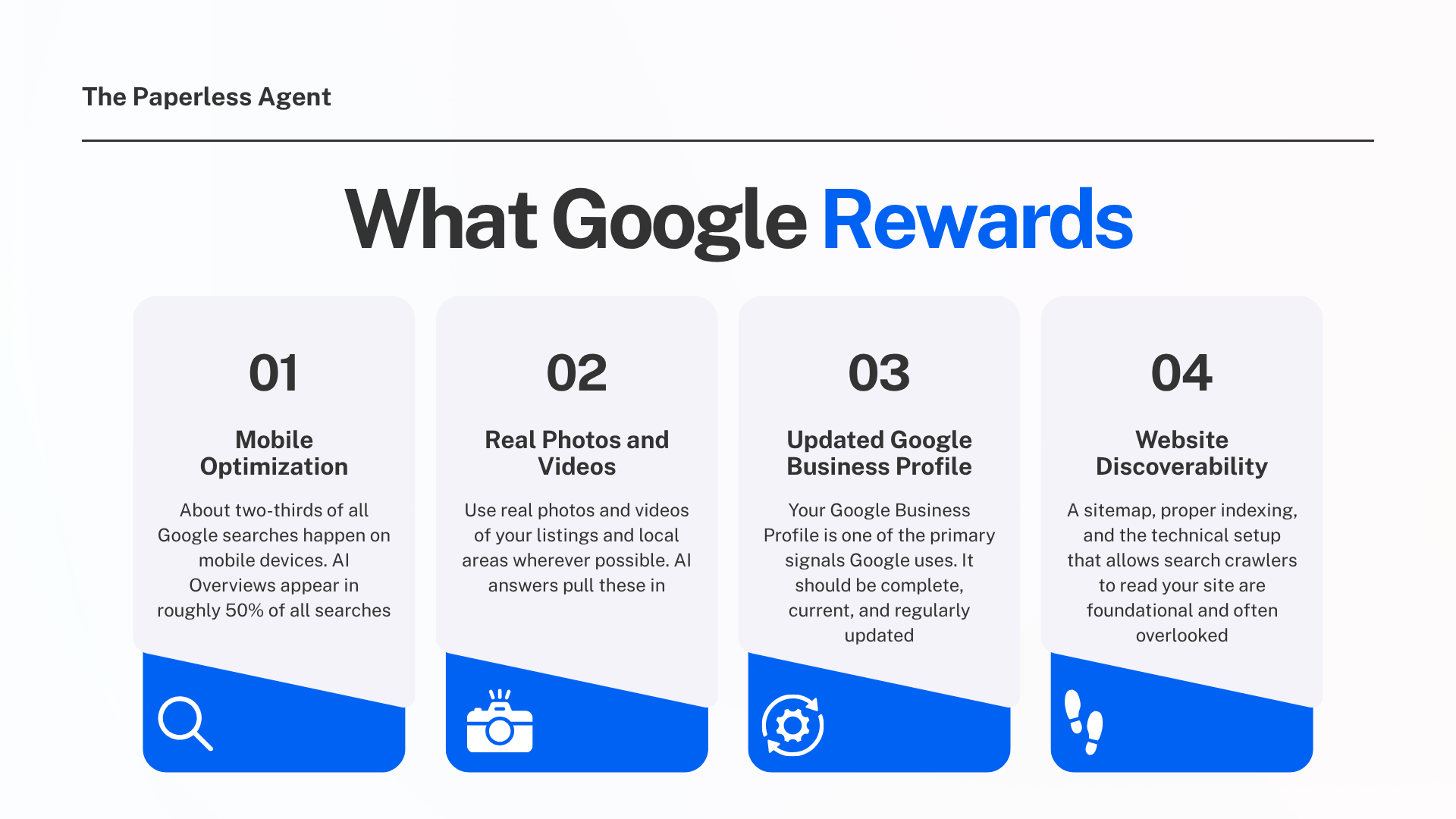
Mobile optimization. About two-thirds of all Google searches happen on mobile devices. AI Overviews appear in roughly 50% of all searches and are used by more than 2 billion people monthly, and the majority of mobile searches are now getting an AI Overview. If your website does not work well on a phone, AI will have difficulty surfacing your content to the people most likely to be searching for you.
Real photos and videos. Use real photos and videos of your listings and local areas wherever possible. AI answers pull these in. A market update post with a real photo of the neighborhood it covers performs differently than one without.
An updated Google Business Profile. For local AI recommendations specifically, your Google Business Profile is one of the primary signals Google uses. It should be complete, current, and regularly updated with posts and new reviews.
Website discoverability. If you are not sure whether Google can even find your website, that is a quick conversation to have with your website provider. A sitemap, proper indexing, and the technical setup that allows search crawlers to read your site are foundational and often overlooked.
From Google Search's perspective, optimizing for generative AI search is optimizing for the search experience and thus still SEO. Creating content that people find unique, compelling, and useful will likely influence your website's presence in generative AI search in the long run more than any other specific tactic.
The Broader Takeaway
Google's guidance essentially tells real estate agents something worth holding onto:
Your local expertise is the strategy.
Not your ad budget. Not your brokerage affiliation. Not the number of times you can get a keyword to appear on a page. Your firsthand knowledge of your market, your neighborhoods, your clients, and your transactions is what AI is specifically designed to find, cite, and recommend.
SEO is shifting from keywords to real-world relevance and intent-based answers. AI-powered search is built to synthesize answers, not just match terms.
That shift favors agents with deep local expertise who document and share it consistently. No portal or national brand can replicate that. No AI can generate it from nothing.
The three keys: content only you could create, a real expert clearly behind it, and a website that is easy to find. These are the frameworks any agent can execute. They do not require a marketing team or a technical background. They require the willingness to share what you know in a format AI can read.
Frequently Asked Questions
Q: What are Google AI Overviews and why do they matter for real estate agents? Google AI Overviews are AI-generated summaries that appear at the top of Google search results, synthesizing information from multiple sources to directly answer a user's query. They appear in roughly 50% of all searches and can push traditional website links below the fold. For real estate agents, showing up in these summaries when buyers and sellers search for agents in your market is increasingly more valuable than a high traditional search ranking.
Q: Does Google allow AI-generated content for real estate websites? Yes. Google's official guidance confirms that AI-generated content is acceptable as long as there is genuine human expertise, oversight, and authenticity behind it. The key distinction is whether your knowledge went into the content — not whether AI helped write it. Using AI to organize your thoughts, tighten your writing, or turn a voice memo into a finished post is fully consistent with Google's guidance.
Q: What does EEAT mean and how does it apply to real estate content? EEAT stands for Experience, Expertise, Authority, and Trust, the four signals Google uses to evaluate whether content comes from a credible human source. For real estate agents, this means putting your name, photo, bio, credentials, and track record on every piece of content you publish. The more clearly a real, qualified professional is behind your content, the more confidence Google's AI has in citing it.
Q: What is non-commodity content and how do I create it? Non-commodity content is content that could only be created by someone with specific firsthand experience, not content that already exists thousands of times online. For real estate agents, this means writing about real situations from your practice: a deal that almost fell apart, a pricing decision that made all the difference, a neighborhood insight only a local agent would know. These are the stories and observations AI is specifically designed to surface, because no one else can produce them.
Q: Do these three keys apply to ChatGPT and Perplexity, or only to Google? Google's guidance is written for their own products: Google Search, AI Overviews, and Gemini. But the three keys apply broadly across all AI tools because they reflect how AI systems evaluate content in general: original content from a credible source that is technically accessible. An agent who follows these three keys will improve their visibility across Google, ChatGPT, Perplexity, and Claude simultaneously.
Q: How important is the Google Business Profile for AI visibility? Very important, particularly for local AI recommendations. Google Business Profile is one of the primary signals Google uses to surface local professionals in AI answers. It should be complete, current, regularly updated with posts, and consistent with how your name, address, and phone number appear across every other online platform.
Q: How long does it take for content changes to show up in AI Overviews? There is no fixed timeline, but meaningful changes generally take several weeks to appear in AI search results. Consistent publishing over time produces the most durable results. The agents who start now are building an advantage that compounds, because AI systems learn to trust sources that maintain a consistent, high-quality body of work over time.
Q: Is it enough to just have a good website, or do I need to be active on social media too? A strong website is the foundation and accounts for the largest share of AI citations. Social media contributes a smaller but real portion of AI visibility signals, particularly platforms like LinkedIn and Facebook Business Pages that are actively indexed by AI tools. The highest-leverage starting point is your website and your Google Business Profile. Adding consistent content and reviews over time builds the broader footprint that AI rewards.
Chris A. Scott is a Real Estate Digital Marketer & AI Strategist at The Paperless Agent where we make AI and real estate technology useful, practical, and profitable.