

Does ChatGPT Know Who You Are? A Real Estate Agent's Guide to AI Search Visibility
Here's a question worth sitting with for a moment: if a potential home seller opened ChatGPT right now and typed "Should I hire [your name] to sell my home?", what would it say?
For most agents, the honest answer is: I have no idea.
That's a problem. Because buyers and sellers are increasingly skipping Google entirely and going straight to AI tools like ChatGPT, Gemini, and Perplexity to research, compare, and make decisions, including decisions about which real estate agent to hire.
The agents who understand this shift and take action now are building a real competitive advantage. The ones who don't won't even know what they're missing.
This post is a practical guide to AI search visibility for real estate agents — what it is, why it matters, how to find out where you currently stand, and exactly what to do to improve it. No technical background required.
What Is AI Search and How Is It Different From Google?
To understand why this matters, it helps to understand what's actually different about how AI tools handle search compared to Google.
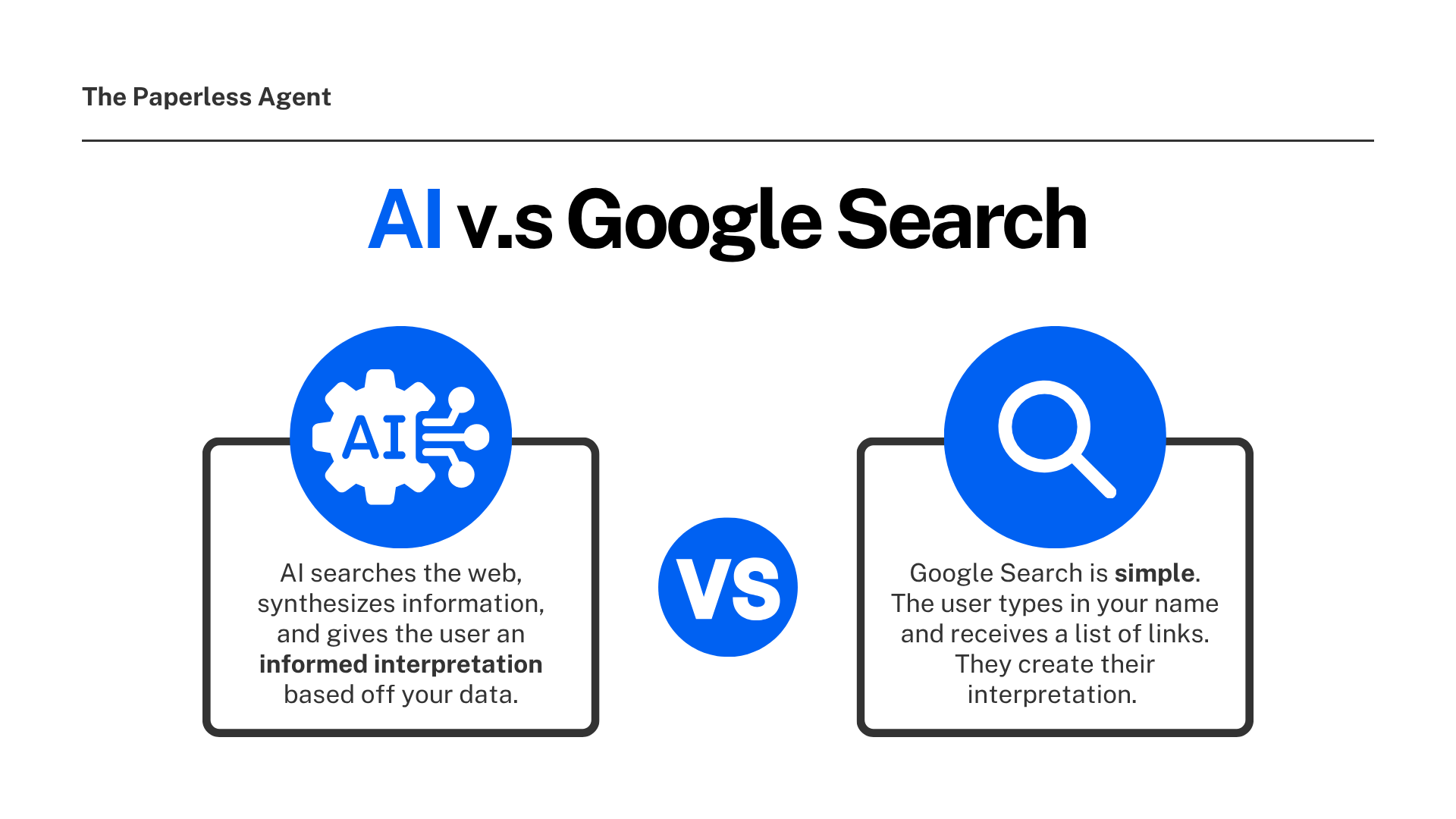
When someone searches your name on Google, they get a list of links. The user clicks through, reads your website, checks your Zillow profile, maybe visits your LinkedIn — and then forms their own opinion about whether to hire you. Google delivers the raw material. The human does the interpreting.
When someone prompts ChatGPT with your name, something fundamentally different happens. ChatGPT goes out, finds many of those same sources, reads through them, synthesizes the information, and then hands the user a fully formed interpretation. ChatGPT doesn't just pass along links, it tells the person what to think.
That's a significant shift. In the Google model, you have a chance to win someone over when they land on your website. In the AI model, the AI has already formed an opinion before the person ever reaches you. If that opinion is weak, vague, or missing entirely — the conversation may be over before it starts.
Why This Is Happening Now
This isn't a trend on the horizon. It's already underway, and the numbers are striking.
ChatGPT now has hundreds of millions of weekly users. AI-driven search referrals to websites surged dramatically year-over-year between 2024 and 2025. At the same time, traditional Google click-through rates have dropped as AI-generated summaries answer questions directly — without requiring users to visit a website at all.
The field emerging around how to show up in these AI-generated answers has two names that are used interchangeably: AEO (Answer Engine Optimization) and GEO (Generative Engine Optimization). Both terms describe the same goal: getting AI tools to recommend, reference, and cite you when someone asks a relevant question.
This is a brand new field. It's evolving fast. But the foundational strategies are clear, and most real estate agents haven't started yet. That's actually good news for the ones reading this.
Step 1: Run the Quick Test — Does AI Even Know You Exist?
Before you do anything else, you need to know where you currently stand. Here's the fastest way to find out.
Open ChatGPT at chat.openai.com and type this prompt:
Put on the hat of a prospective home seller who is researching whether to hire you. Read what ChatGPT produces. Is it confident? Does it pull accurate information about your experience, your market, your specialties? Or does it produce something vague, incomplete, or — in some cases — nothing at all?
Also try this in Google at the same time. Search your name alongside "realtor" or your city. Compare the two results side by side. You'll quickly see what information is out there, how it reads, and whether it adds up to a compelling case for hiring you.
This quick test gives you a baseline. Most agents are surprised by how thin their AI presence is or by how outdated the information being pulled is.
Step 2: Run a Full AI Search Audit
The quick test tells you what AI says about you. The full audit tells you why — and what to do about it.
For this step, you'll want to use a more powerful tool than standard ChatGPT. Two free options that work well:
- Manus.im — An agentic AI tool that breaks complex tasks into sub-tasks, researches each one individually, and assembles a comprehensive report
- Genspark.ai — Another strong option that pulls your full digital footprint and generates actionable recommendations
Manus.im Manus.im Genspark.ai Genspark.ai
Here's the prompt to use in either tool:
What makes these tools different from standard ChatGPT is that they don't just process the prompt, they break it into a series of sub-tasks, research each one, and bring it all together into a higher-quality result. The reports they produce typically include your current digital footprint across platforms, what information AI can and can't find about you, and specific, prioritized recommendations for improvement.
Both tools have free versions. Run both if you have time — they often surface different findings.
What AI Actually Uses to Decide Who to Recommend
Here's something worth understanding before you start taking action: AI tools are not random in how they decide who to recommend. Research analyzing thousands of AI prompts and responses has revealed a clear picture of where the information comes from.
Based on that research, here's what AI is looking at when forming an opinion about a real estate agent:
- 44% from your own website — This is the single largest factor. What your website says about you, how it's structured, and what information it contains carries enormous weight.
- 42% from business listings you control — Google Business Profile, LinkedIn, Facebook Business Page, Zillow profile, Realtor.com profile. These platforms are heavily weighted.
- 8% from reviews and social media content — The volume and quality of your reviews across platforms matters.
- 2% from forums and third-party sources — Reddit, community sites, and similar platforms round out the picture.
The encouraging takeaway here is that 86% of what AI uses to form a recommendation is something you directly control. You don't need a massive marketing budget or a team of SEO specialists. You need a clean, consistent, information-rich digital presence — and most of the platforms are free.
Step 3: Take Action — What to Fix and Where to Start
Once you've run your audit, you'll have a list of specific recommendations. But across dozens of audits, the same priorities tend to come up again and again. Here's where to focus your energy.
Update Your Bio — Everywhere
AI tools heavily weigh the biographical information they find about you online. A weak or outdated bio produces weak AI results.
Your bio should appear consistently across your own website, your brokerage profile, Google Business Profile, LinkedIn, Facebook, Zillow, Realtor.com, and any other platform where you have a presence. It should include your name, your market areas, your specializations, your years of experience, and any credentials or designations.
LinkedIn deserves special attention here. Many real estate professionals have let their LinkedIn profiles go stale, but research consistently shows that LinkedIn tends to appear in the top five Google results for any name search — and AI tools treat it as a trusted directory of professionals. A strong LinkedIn profile is not optional.
Build Your Review Presence
Reviews signal credibility to both Google and AI tools. The goal is to have reviews on your own website and distributed across the major home search platforms — Zillow, Realtor.com, Google, and others.
If you've done the work but haven't collected the reviews, fix that now. Reach out to past clients and ask directly. Send them a single link to the platform where you most need the review. Make it easy for them. A steady stream of recent, genuine reviews is one of the highest-leverage things you can do for your AI visibility.
Add Transaction History to Your Website
AI treats structured data with high value — and a table of your transaction history is exactly that. List your past transactions with as much detail as you're permitted to share: city, neighborhood, price range, property type, date. Place it in a clean table format on your website.
This serves two purposes: it gives AI a clear, data-rich record of your experience, and it answers the implicit question every prospective client has — has this agent actually done this before?
Add FAQ Content to Your Website
AI tools are specifically designed to find and surface answers to questions. If your website is structured as a series of statements about how great you are rather than as a resource that answers real questions, it's not optimized for how AI reads content.
Add a section to your website with genuine FAQ-style content. What should I know about selling a home in [your market]? What's the difference between list price and sale price? How long does it take to sell a home right now? Questions and answers are one of the content formats AI searches for most directly.
The Bigger Picture: What This Shift Means for Your Business
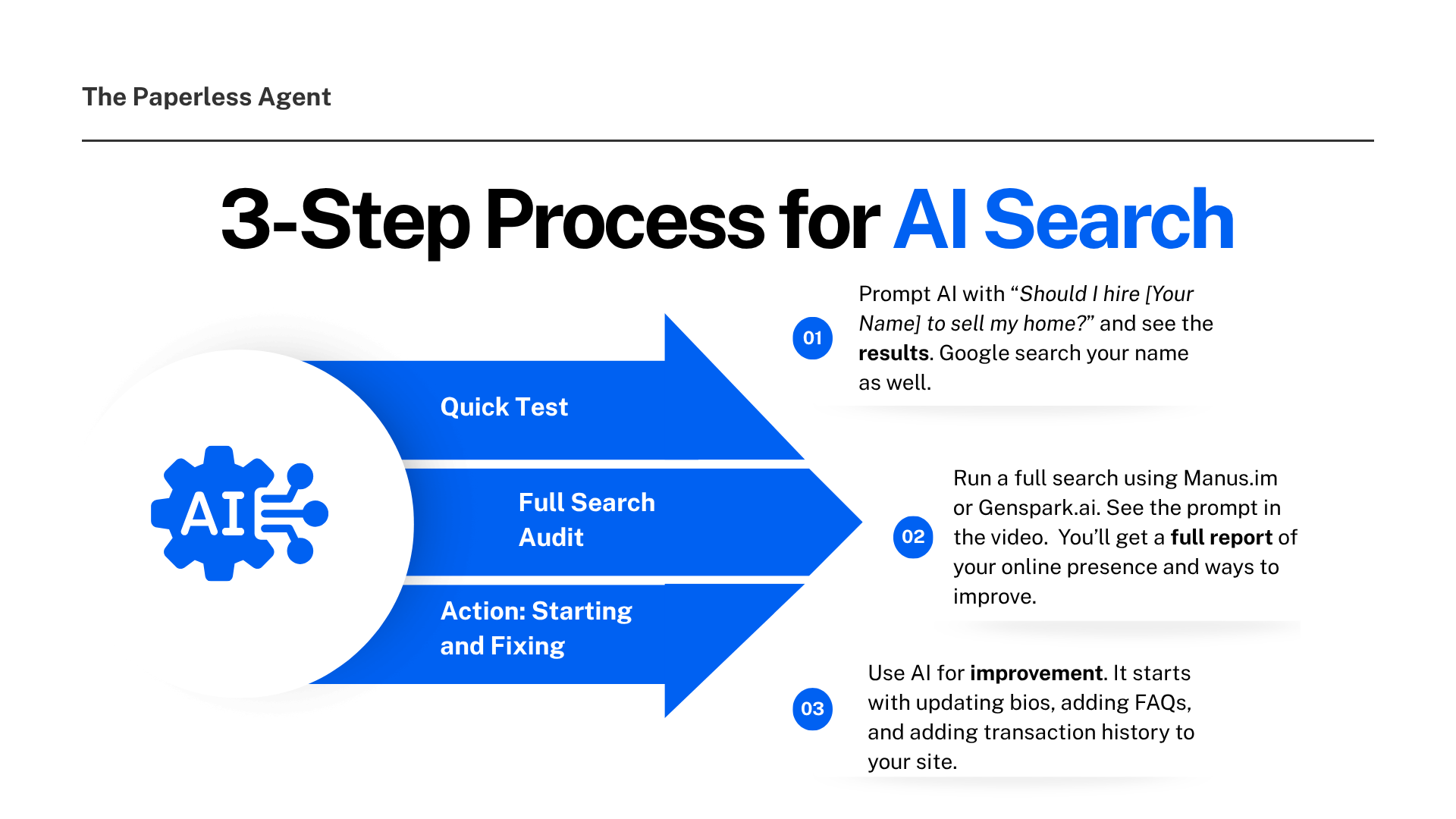
Think about the shift that happened when Zillow launched. Agents who understood it early — who built strong profiles, collected reviews, and stayed active on the platform — got a head start that compounded over years. Agents who ignored it eventually had to play catch-up.
AI search is a similar inflection point, except the audience is broader and the adoption curve is faster. Gartner has projected a significant drop in traditional search volume as more users shift to AI-powered answer engines. The buyers and sellers who are already using ChatGPT to research agents are early adopters — but that group is growing quickly.
Gartner has projected a significant drop Gartner has projected a significant drop
The difference between showing up powerfully in an AI recommendation and not showing up at all could eventually be the difference between getting the call and never knowing it was placed.
Your Action Plan: Three Steps to Get Started Today
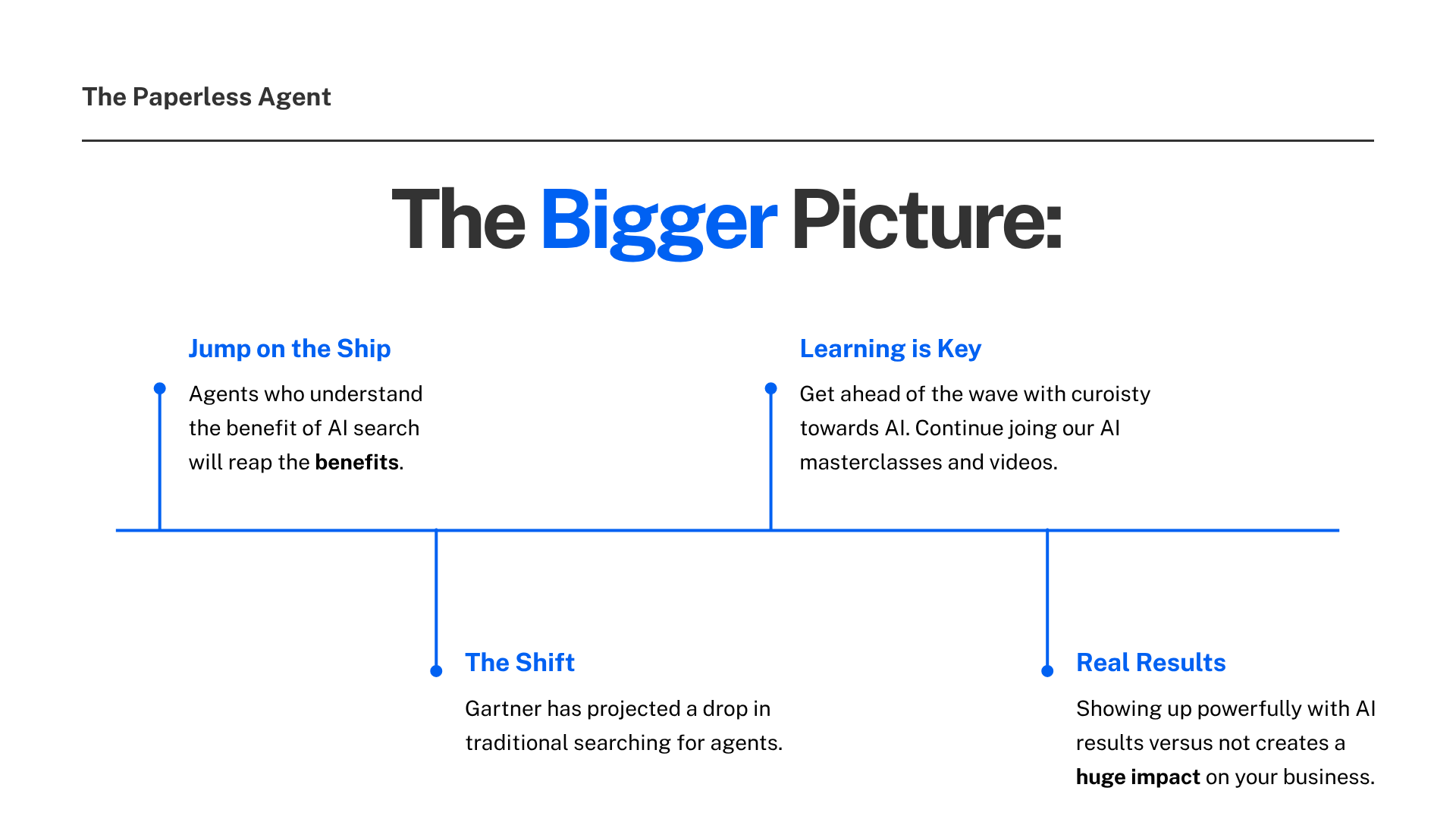
Step 1: Run the quick test. Go to ChatGPT and search: "Should I hire [Your Name] to sell my home?" See what it produces. That's your starting point.
Step 1: Run the quick test "Should I hire [Your Name] to sell my home?"
Step 2: Run the full audit. Use Manus.im or Genspark.ai with the prompt above. Let the tool do the research. Read the report and note the top three to five recommendations.
Step 3: Start with your bio. Before anything else, make sure your bio is complete, current, and consistent across your website, your brokerage profile, LinkedIn, and your Google Business Profile. This single fix touches the largest share of what AI uses to form an opinion about you.
The field is called AEO and GEO. It's new. It's evolving. But the foundational work — a solid digital presence, strong reviews, structured content — is the same good practice that's always mattered. The difference now is that AI is reading it for your clients before they ever pick up the phone.
Frequently Asked Questions
Q: What is AI search, and how is it different from Google? Traditional Google search returns a list of links and lets the user form their own opinion. AI search tools like ChatGPT, Gemini, and Perplexity read through those same sources, synthesize the information, and hand the user a pre-formed interpretation. The AI creates the impression — not the user browsing through websites.
Q: What does AEO or GEO stand for, and do I need to know the difference? AEO stands for Answer Engine Optimization. GEO stands for Generative Engine Optimization. In practice, the terms are used interchangeably and describe the same goal: getting AI tools to recommend and cite you when someone asks a relevant question. You don't need to worry much about which term is correct — just focus on the strategies.
Q: How much does it cost to improve my AI search visibility? Most of the high-impact actions are free. Updating your bio, completing your Google Business Profile, building your LinkedIn, collecting reviews, and adding FAQ content to your website all cost time but not money. The tools recommended for the audit — Manus.im and Genspark.ai — both have free versions.
Q: Is it hard to show up for searches like "real estate agents in Austin"? Yes — broad, competitive search terms are extremely difficult and expensive to rank for because you're competing against large firms with significant marketing budgets. The better strategy is to focus on name-based searches and specific, long-tail prompts, like searches that include your neighborhood, your specialization, or your specific market. Those are searches where you can have real influence without a large investment.
Q: Why does LinkedIn matter so much for AI search? LinkedIn consistently appears in the top five Google results for name-based searches, and AI tools treat it as a trusted professional directory. A strong, complete LinkedIn profile contributes to both your traditional search visibility and your AI visibility — and it signals credibility to prospective clients in the same way a job applicant's profile would to an employer.
Q: How often should I update my digital presence to stay visible in AI search? Research on AEO best practices suggests that the brands leading in AI search visibility update their content regularly — quarterly at minimum. For real estate agents, a practical rhythm is to review your bio and business profiles twice a year, collect reviews consistently after every transaction, and add new FAQ content or market updates to your website a few times per year.
Q: What if my audit comes back with low scores across the board? That's completely normal — and it's actually an opportunity. AEO and GEO are new fields. Most agents haven't touched this yet. Low audit scores right now just mean there's a lot of room to improve, and the agents who start early are building an advantage that will compound over time. Start with the highest-impact items: your bio, your Google Business Profile, and your reviews.
Q: Does this replace traditional SEO? No. AI search and traditional SEO work together. Many of the same signals that help you rank in Google — a well-structured website, authoritative content, consistent business listings — also help you show up in AI recommendations. Think of AEO and GEO as an extension of good digital practice, not a replacement for it.