

AI agents have entered the real estate industry. It is official.
They are not just writing listing descriptions. They are qualifying leads, managing follow-up, running entire workflows, and doing it all while you sleep.
If that sounds like something that is coming in a few years, it is not. The tools are available today. Some of the most productive agents, teams, and brokerages in the country are already running them. And the gap between agents who understand this and agents who do not is widening faster than most people in the industry realize.
This post breaks down the three levels of AI maturity in real estate: where most agents are right now, what is actually possible today, and where this is all headed. By the end, you will know exactly where you stand and what your next move should be.
Why This Is Different From What You Have Been Doing With AI
Before getting into the levels, it is worth understanding the distinction between using AI and having an AI agent working for you. Most agents have experienced both without knowing there is a name for the difference.
When you open ChatGPT, type a prompt, read the response, and manually copy it somewhere, that is using AI as a tool. You are the engine. The AI works with you.
When an AI takes a trigger, executes a sequence of actions, makes decisions along the way, and delivers a finished outcome without you in the middle, that is an AI agent. The AI works for you.
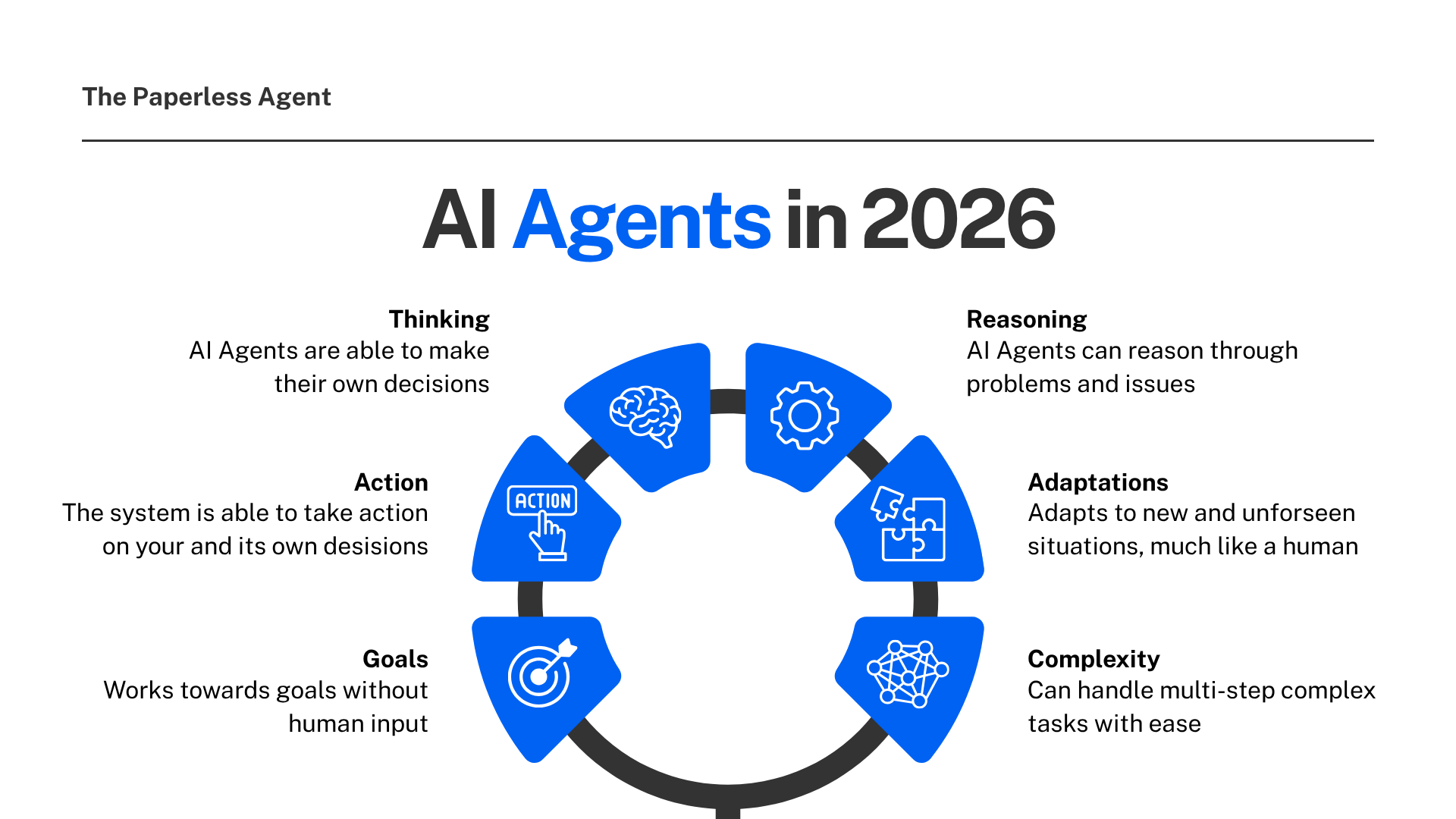
An AI agent is software that makes decisions, takes actions, and works toward goals with minimal human input. Unlike basic automation that follows if-this-then-that rules, AI agents can reason through problems, adapt to new situations, and handle complex multi-step tasks.
That distinction, from tool to agent, is the shift happening in real estate right now. Understanding it is the first step to taking advantage of it.
Level 1: Simple Tasks (The ChatGPT Phase)
Level one is where most agents are today, and there is nothing wrong with that. It is the foundation everything else is built on.
Level one looks like this: you open ChatGPT or Claude, type a prompt, and get a response. You read it, maybe edit it, and manually do something with it. The typical use cases at this level include writing social media posts, drafting listing descriptions, generating scripts for listing appointments, creating marketing copy, and producing images for marketing materials.
Here is the honest description of level one: you are still the engine. You have to open the app. You have to type the prompt. You read the response and copy it manually to wherever it needs to go. The AI is not really working for you, it is working with you.
That is still valuable. A well-crafted prompt at level one can save an agent hours every week. But it is not autonomous. It is not sequential. And it is not what we mean when we talk about AI agents.
Level 2: AI Agent Applications
Level two is where AI starts doing the thinking, not just the typing.
The difference between level one and level two is one word: sequence.
A level two AI agent does not just answer one question. It knows that step two depends on step one. It holds context across multiple actions. It does not need you in the middle to move from one step to the next. It completes a workflow, not just a task.
Think of it this way. ChatGPT is like a vending machine. You put something in and you get something out. A level two AI agent is a trained assistant who knows your business, understands your process, and can execute a multi-step workflow without asking for direction at every turn.
What Level 2 Looks Like in Real Estate
Lead qualification while you sleep.
AI agents can interact with website visitors, capture lead information, respond to inquiries immediately, and evaluate buyer intent using conversational follow-up questions. They qualify leads by updating CRM tags and prioritizing those most likely to convert, ensuring every promising client receives attention while automating the nurturing of long-term prospects.
Picture this: a lead comes in at 11:00 PM on a Sunday. Your AI agent asks about their timeline, their preferred neighborhoods, their budget range. It qualifies them, scores them, and routes the hot opportunities straight into your CRM for your immediate follow-up in the morning. All of that happens while you sleep. That is a level two AI agent doing real customer service and support.
The urgency behind this workflow is significant. Leads contacted within five minutes are 21 times more likely to convert than those contacted after 30 minutes. And 78% of homebuyers ultimately work with the first agent who responds to their inquiry. An AI agent that qualifies and responds to leads at 11:00 PM on a Sunday is not just a convenience. It is a competitive advantage.
Listing workflow automation.
Think about what happens right now when a listing goes live. How long does it take you to write the description, generate social media posts, draft an email to your database? Even using level one AI to help with each of those tasks individually takes meaningful time.
A level two AI agent changes that entirely. It takes the listing address, pulls the property details, writes the MLS description, generates captions for Instagram, Facebook, and LinkedIn, and drafts an email to your sphere. All triggered by a single click. All done in sequence without you managing each step.
AI is not a future consideration for real estate agents. It is the operating system behind the most productive marketing workflows in 2026. AI-assisted social content, chatbot lead qualification, predictive analytics, behavioral email campaigns, and AI-driven paid ads are not theoretical, they are what agents using level two tools are running right now.
Level 3: Multi-Agent Workflows — The AI-Powered Business
Level three is where it gets genuinely exciting. And for many agents reading this, it may also be where it starts to feel like science fiction. It is not.
At level two, you have one agent doing one job. At level three, you have multiple AI agents coordinating with each other. Each one handles their specialty. They pass information between each other automatically. They work as a team that never sleeps, never forgets a follow-up, and never has a bad day.
A Real-World Level 3 Scenario
Here is what a multi-agent workflow looks like in practice when a new lead fills out a form on your website:
Agent 1 scores and qualifies the opportunity based on their answers: timeline, motivation, price range, neighborhood preferences.
Agent 2 pulls matching listings from the MLS based on the criteria they shared.
Agent 3 drafts a personalized email with those listings included and sends it to the lead. The CRM is updated automatically with every interaction logged.
You wake up the next morning. The lead is sitting in your inbox. They have been prepped. They are ready to act. You did not do anything. Your AI team did it all.
During testing with multi-agent systems, leads flowed in, conversations stayed organized, and CRM updates happened automatically in the background. That autonomy is what makes it effective and lets you do more than just generate leads without increasing headcount.
At level three, you are no longer doing the tasks. You are setting the rules. The AI team executes.
Who Is Doing This Right Now?
Level three is not theoretical. It is being implemented at forward-looking brokerages and teams today. reAlpha Tech Corp. has already launched an internal AI-powered Engagement Assistant. It’s a multi-agent system designed to handle top-of-the-funnel lead qualification, appointment booking, and other pre-application workflows, showing clear improvements across key front-end workflows.
The AI real estate market is growing at an extraordinary pace. The AI real estate market is expected to grow from $222.65 billion in 2024 to over $303 billion in 2025, with projections approaching $990 billion by 2029. The agents who understand this framework now are positioning themselves to lead, not catch up.
Where Do You Stand Right Now?
Here is a quick self-assessment based on the three levels:
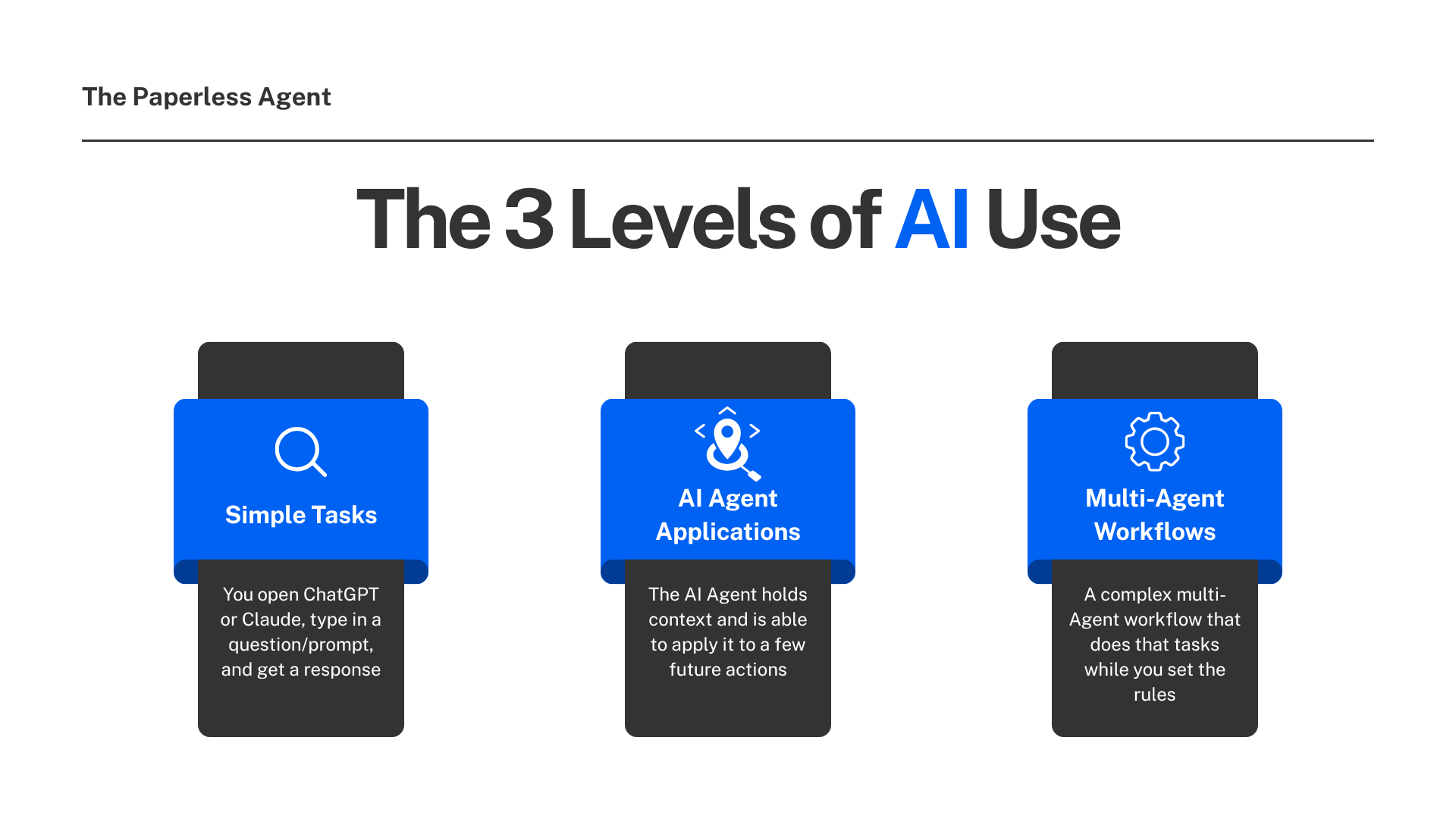
You are at Level 1 if: You use ChatGPT or Claude regularly for writing tasks, but you are manually involved in every step of the process. You open the app, type the prompt, read the response, and copy it somewhere. The AI responds to you, it does not act on your behalf.
You are at Level 2 if: You have set up at least one workflow where AI takes a trigger and executes a sequence of steps without you in the middle. This might be a chatbot on your website that qualifies leads, a listing workflow that auto-generates content from a property address, or an automated follow-up sequence that responds to leads based on their behavior.
You are at Level 3 if: You have multiple AI agents working together on coordinated workflows — lead qualification feeding into listing matching feeding into personalized outreach, with CRM updates happening automatically throughout.
Most agents reading this are at level one. That is the right place to start. Level two is achievable today with tools and training that exist right now. Level three is where the industry is heading, and it is arriving faster than most people expect.
How to Move From Level 1 to Level 2
The most practical starting point is identifying one workflow in your business where the same sequence of steps happens repeatedly, and asking whether AI could handle that sequence without you in the middle.
The most common starting points for real estate agents moving to level two:
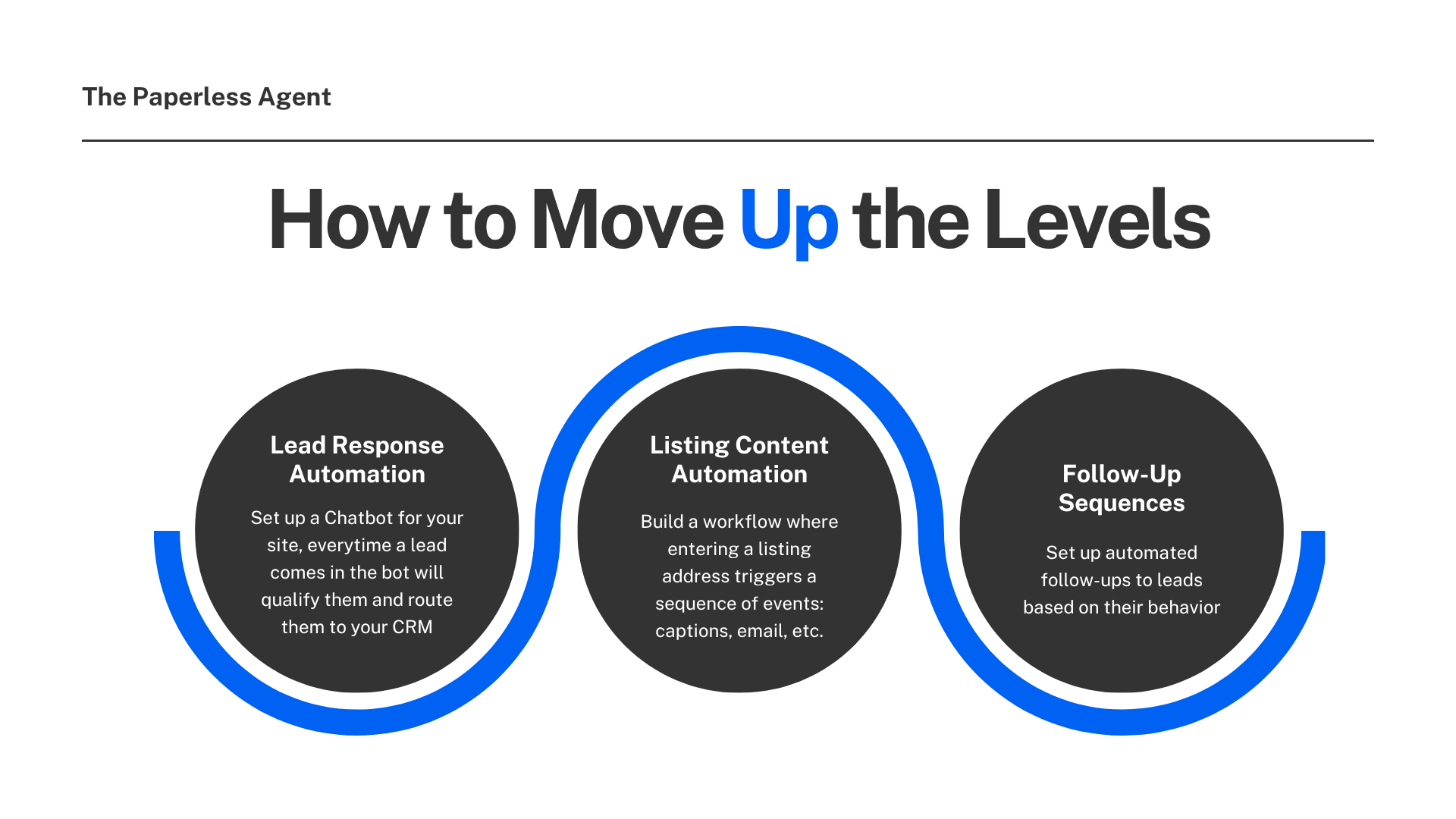
Lead response automation. Set up a chatbot on your website trained on your business and your client experience standards. When a lead comes in, the chatbot qualifies them, asks the right questions, scores their intent, and routes them to your CRM. AI automation software can process inquiries in seconds, ask qualifying questions, score leads based on behavior, and route hot prospects to your team while you are sleeping or showing properties.
Listing content automation. Build a workflow where entering a listing address triggers the creation of an MLS description, social media captions, and a sphere email all in sequence, all without manual steps between them.
Follow-up sequences. Set up automated follow-up that responds to leads based on their behavior, not just a timer. A lead who views three listings in one evening gets a different follow-up than one who has been dormant for two weeks. AI can manage that distinction automatically.
Consider deploying agentic AI-powered chatbots to handle inquiries and keep leads engaged. Maintain a human touch by setting the AI assistant to forward complex questions or reach-outs from top clients to yourself, ensuring your expertise always adds value to the transaction. Always remember that the client hired and trusted you, not an AI model.
That last point is worth holding onto as you build toward level two and three. AI agents handle the volume. You handle the relationship. The combination is what produces results neither could achieve alone.
The Question Worth Sitting With
Here is the question to carry with you after reading this:
What level are you operating at and what is your next move?
Level one is a solid foundation. Nothing wrong with it. But the agents who are building toward level two and three right now are not waiting for the industry to force their hand. They are building a capability advantage that will be very difficult to close once it compounds.
The tools for level two are available today. The training and strategies for building these workflows are available right now through The Paperless Agent's YouTube channel and programs. Level three is coming faster than most people in this industry realize.
If you understand this framework, you are ready. If you do not take action on it, you will get left behind. That is not a prediction. It is already happening.
Frequently Asked Questions
Q: What is the difference between using AI and having an AI agent? Using AI means you interact with a tool — you open it, type a prompt, and manually do something with the response. An AI agent is software that takes a trigger, executes a sequence of actions, makes decisions along the way, and delivers an outcome without requiring you in the middle of each step. The difference is sequence and autonomy.
Q: What is a realistic first step toward Level 2 for a solo agent? The most practical starting point is a lead qualification chatbot on your website. When a new lead fills out a form, the chatbot asks qualifying questions, scores the lead, and routes qualified prospects to your CRM automatically. This removes the need for you to be available 24/7 while ensuring every new lead gets an immediate, professional response regardless of when they reach out.
Q: Do I need technical skills to implement AI agents? Not at the level most agents need to start. Many of the tools available for real estate AI automation use no-code or low-code builders that allow you to set up workflows without writing a single line of code. The more complex level three multi-agent systems may require technical support, but level two is accessible to agents who are willing to learn the tools.
Q: Why does lead response speed matter so much for AI agents? Research shows that leads contacted within five minutes are 21 times more likely to convert than those reached after 30 minutes. And 78% of homebuyers ultimately work with the first agent who responds to their inquiry. An AI agent that responds to leads at 11 PM on a Sunday is not just a convenience — it is a conversion tool that operates in the moments when most agents are unavailable.
Q: What is a multi-agent workflow and how is it different from a single agent? A single AI agent handles one job. A multi-agent workflow has multiple AI agents coordinating with each other — each one handling a specific specialty and passing information to the next automatically. In real estate, this looks like one agent qualifying a lead, a second pulling matching listings, and a third drafting and sending a personalized email — all without human involvement between steps.
Q: Will AI agents replace real estate agents? No. AI agents handle volume, repetition, and sequence. They qualify leads, manage follow-up, generate content, and coordinate workflows. But the relationship, judgment, negotiation, and trust at the center of every real estate transaction belong to the human agent. The most effective combination is AI handling the work that does not require human expertise, so the human agent can focus entirely on the work that does.
Q: What tools are available for real estate agents looking to build Level 2 workflows? Several platforms serve this use case well in 2026, including MindStudio for custom no-code AI agent workflows, Lindy for end-to-end lead qualification and CRM automation, and various CRM-integrated chatbot tools built specifically for real estate. The Paperless Agent's YouTube channel and programs cover specific tools and implementation strategies for agents at every level.
Q: How fast is AI adoption actually happening in real estate? Faster than most agents realize. The AI real estate market is projected to grow from $222.65 billion in 2024 toward $990 billion by 2029. Major brokerages and technology companies are already deploying multi-agent systems for lead qualification and workflow automation. The agents who build these capabilities now are not early adopters — they are on-time adopters. The late majority will have a much harder time catching up.